My husband took me to The Alzheimer’s Association support group yesterday. Bless him! My legs felt wobbly walking to the bus but I plowed on. Heaviness and the feeling of a lack of an axis to balance me, is how I can describe it. He steadies me now when we walk together. His arm holding mine, his quick hand pulling me back as I lean into the street to cross. He is becoming more protective. A comfort to me, though the thing he cannot save me from is happening between my ears. Missing my independence and accepting his support, which he gives more freely now.
This was the third time I met with the group. We are each as different as snowflakes, as all people are. Everyone is different from each other whether they have dementia or are “normal”. Who are these people that are suddenly in my life? How did they get here? How do we support each other? Like spectators of each others oddities, we shared and went around in a circle talking about what we still can do. Most are in their 80’s or late 70’s. Only one is close to my age, and practices acceptance with the tenets of the 12 step step program he learned as a former member of Alcoholics Anonymous, and still retains. I look to him with admiration for offering that. The Serenity Prayer (Reinhold Niebuhr)
God, grant me the serenity to accept the things I cannot change,
Courage to change the things I can,
And wisdom to know the difference.
I am the youngest in the group. I know in younger folks the disease moves faster. None of them is experiencing the changes I have been. They each have their own “peckle” (package). I share my stories about what I’m experiencing, careful not to dominate, eliciting the stories of the others.
Political correctness in the world of Alzheimer’s and dementia is that acceptance of having and living with this is what’s most important. What’s the point of complaining? But I see the other person’s snapshot perception of me is not the movie I’m living. For me there is physical decline as well as cognitive decline and it’s not been the slow decline of aging. I fell off of a proverbial cliff. Accept this? Relax into it? Ha! Yet it’s mandated in life that to carry on is what we must do. No matter what, as long as we can.
*****
After last week’s Alzheimer’s Association support meeting – I felt like I nailed it, and felt optimistic. A good meeting. A good feeling. I gave myself a pat on the back. Not too much anxiety traveling there, complete orientation to time and place. Able to walk 3 miles. Then wham! My husband and I had walked across town to the Port Authority. We went up the escalator to the second floor where the gate for our bus is located. I reached into my purse to take out the tickets from my wallet. I was holding the tickets in my right hand, and the wallet in my left. Suddenly there was what looked like a blue string or blue line connecting my wallet and the tickets. Then it disappeared. I looked down at the tiles on the ground, and saw there were lines between tiles. Apparently a line from the tiles had jumped up and become a virtualblue string that appeared and then disappeared. The only other time something like this happened was over a year ago. I was laying in bed, and looked to my left, and there was a sheath of pinkred light, a ceiling to floor curtain of colored light. I reached out to touch it and it disappeared. I’ve been told that people with neurodegenerative diseases hallucinate, and sometimes see people and animals, creatures that aren’t really there. Would I prefer that to sudden visuospatial depth of field distortions? Dancing bunnies in the middle of my living room. Talking zebras? A singing pink elephant on my ceiling perhaps? I had better watch out what I wish for (no snakes please).
*****
My friend Dallas is a devout Christian who is really funny. He talks to G-d (don’t we all ?) and in his last blog post, a letter to G-d, he says he thinks death is underrated. I think that’s a funny thing to say. He’s joyful, prayerful, thankful, no matter what, and waiting on G-d. Not the least bit antagonized by it. I love that about this man. Wish he were a rabbi!
Speaking of rabbis. I had a visitor who is transitioning from her role as a chaplain to becoming the rabbi of a congregation in the neighboring city next to mine. She visited me twice before over the past year. I hadn’t heard from her and accepted that she was gone from my life. Then she called me out of the blue to make an appointment with me. The reason for her visit? I found out it was to tell me that she would never visit me again. Why? Because she was transitioning from the role of chaplain to being a rabbi. At the time I was really hurt. Why make an appointment with me to tell me that she would never visit me again? Couldn’t she have broken up with me over the phone? (Obviously I am not dying fast enough and this woman is busy).
When I first met her, I asked her to read my blog. She gave me her email address and I sent it to her. The next time I saw her, I asked her if she had read it. She said she receives so many emails, she could not possibly open mine and read my blog. I guess people with who have Alzheimer’s are not supposed to ask for a rabbi/chaplain who visits them to read their blog. But my dear friend who is the chief rabbi to Poland reads my blog, so I figured she would too. Then she told me that she would never see me again. I thought of my friend Lon, who told me some people are acting out the role of their job – rabbi, priest, chaplain, and a rare few do it because it is their calling. My friend in Poland, the rabbi, tells me he learns from me. This woman, a rabbi and a chaplain is too busy to learn from me. Not too busy to visit and hurt my feelings though. Odd how people’s roles and jobs do not fit who they really are. I am learning.
What’s important now? My daughter looked at me crazily when I snapped the photo. Her eyes were as wide as marbles. My daughter was 23 when this began. She had just begun to launch herself. She started a career. Moved in with her boyfriend. Spread her wings. She does not want to be a caregiver for her mama who has Alzheimer’s. I see-sawed between being needy and being overly concerned about her and how she could weather the loss of me as I change. She is going to be okay.
I hope. I worry about her, as a mother does. Is she taking care of herself, now that I can’t be the mom who takes care of her? This disease is a curse that has robbed our happiness as a mom and daughter. When she is with me now, our roles are reversed, and she acts like the mom. She prepares the food, calms me down, does the research, brings CBD oil. I love her and hate this disease.
My son is now 36 years old. A lawyer married to a lawyer, and father of a toddler, owner of a house, that is a castle. Member of a family that has extended family that helps them raise their daughter. He is fully launched, unlike my daughter who was far too young to have this happen to her mom and her family. I see his sadness, and the loss and dismay he has experienced in seeing symptoms of this illness in me, and what it’s done to our family. My granddaughter. The next generation. The Alzheimer’s began when she was in her mother’s womb. Now she is two and half, a bubbly effervescent bundle who is smart and strong. Blessed with a family that dotes on her, she beams with confidence. I used to envision myself introducing her to art museums, and fashion and culture. I so wanted to be that grandma. She will be untouched by this. My husband, my soul mate, my caregiver. My back up brain. Weary. Lonely, very sad and tired. Me, his wife of forty one years, and mother of his children, a woman that was his equal partner. Now I am in need of his help and support for the simplest things. He works full time and is far too young to have this happen to him and to us. It has been robbing him too of all the dreams we had for a happy future, a time that we were going to continue to enjoy together. Our partnership. A normal life. Who are those people looking at my family that are depicted in my drawing? They’re in shadow witnessing the story unfold. Souls, I think. The watchers, spirit guides perhaps. Witnesses. I am fading from view. Eclipsed. My family members are drawn as large heads aggregated into a kind of land form, a kind of mountain. The figures watch. There are the watchers and the experiencers. I think we do this in our lives and it is our journey that we watch. There is a part of us that does not feel the pain. A part that is more evolved than the drama. An inner being that transcends. Witnesses.
*****
To maintain a positive attitude is hard for me, but I try. How? I try every day to maintain some kid of a routine. Get up, get dressed, play cognitive games, watch how the scores have declined and then brain train until they improve. Force my brain and body to work. Look for the ways to find peace in myself. Humor, friendship and connection. Appreciating the love that is still there. Giving myself the liberty to use this forum to express myself. Telling people I love, that I love them. Today a call from an old friend. He indulged me with listening to my story, going on about the changes and challenges. He’s been going through his own illness, but listened. I am grateful for his call.
There are things I notice now that I never saw before. Noticing things that I didn’t take the time to notice before. My husband and I walked east on 41st Street and then sat for a moment on chairs in the park, and looked around. I asked him about a building with an indented triangle in it’s corner. He always looked around and has noted the things he saw, that I now see, but I didn’t notice before. He thinks the building’s architect is a Japanese designer. We stopped to look at the daffodils blooming in Bryant park and proceeded up 42nd Street in the direction of the Chrysler building.
The days roll by. I had a birthday on March 28 and turned 64. Passover and Easter arrived and I marked this period with reflections of what this means to me. I’ve been writing but was unable to complete this post, though I started a week ago. I am back again, in a repetitious cycle that is part and parcel of what it has been like for me to have Alzheimer’s.
*****
Albert Einstein is broadly credited with exclaiming “The definition of insanity is doing the same thing over and over again, but expecting different results”.
*****
Passover marks the commemoration of the emancipation of the Israelites from slavery in ancient Egypt. This held a lot of meaning for me, as the matriarch in my own family with my kids and my husband, and earlier as a child of Jewish Holocaust survivors, my parents who marked this holiday with rigorous celebration.
As an adult, I would clean my home of “chametz”, (any food product made from wheat, barley, rye, oats or spelt that has come into contact with water and been allowed to ferment and rise), spend days shopping, and nights preparing a feast, and each year we would take out our Haggadahs (Haggadah means “telling,” as its primary purpose is to facilitate the retelling the story of the Exodus from Egypt).
I’ve experienced a life abundantly rich with family coming together for this holiday.
The memories of sharing many years of seders with my parents, my husbands uncles and aunts and cousins, and his late parents are in my head like virtual snapshots. My husband’s aunt Harriet and uncle Jerome in their home in Englewood, New Jersey, welcoming us into their kitchen where they had both prepared a feast. Their warmth, the hugs, the colonial dining room, the feeling of love accompanied by great food. Then there were elegant seders at my husband’s wealthy uncle Marty and aunt Marsha’s home in the ritziest part of Long Island, where I never felt I quite fit in. I remember the many trips to my sister’s home where our kids came together and we all got along. Over the years, I witnessed her change from a sophisticated New York actress to a sheitl wearing Orthodox Jew (sheitl is a wig worn by some Orthodox Jewish married women in order to conform with the requirement of Jewish law to cover their hair, and a part of modesty-related dress and signifying humility), and our relationship changed. She implored me to wear long sleeves and a long dress, and be like her, which I was not. Things went terribly wrong along the way. My parents and my husband’s parents got sick and died, Harriet died, and then Jerome, and the cousins splintered, and relationships suffered. My sister and I fought miserably over my late father’s will. I see now that all of it was so damaging.
I want to make peace with it all now. No more suffering the slings of the past. I want to go in love now. Forgive myself for hurting others, and forgive others for hurting me. Let us forgive each other and forgive ourselves.
For this Passover, my daughter went to her boyfriend’s uncle’s seder in Long Island, as she has done since I became ill. My son invited us at my urging to see him and his family, in their suburban home in New Jersey. My daughter in law ordered sushi, and there was no Seder. We brought matzo and my adorable granddaughter, who is two and half, played with us, and demonstrated her ability to play with puzzles, speak in Russian and English and name everything she was doing. She is a joyful bundle.
The rituals are gone for now. I am no longer the matriarch who can bring the family together, and orchestrate the Seder. I am sad about this, but thankful to simply have had the opportunity to see my son, his wife and my granddaughter. Just to be together is enough now.
The last seder I held in my home was in 2014. That was four years ago. I remember knocking myself out preparing a feast, and my beautiful daughter preparing some delicious dishes too. It was a joyous event and friends and family gathered around. I was strong and resilient then. This was the year before my mind started to spiral. The year before Alzheimer’s came for me.
*****
Last year I went to a Passover seder at the Chabbad, the center run by the Lubavitcher Jewish rabbi and his family in my city. I had already been diagnosed. This year I was not able to go. I could not comfortably sit with strangers and speak with them. I no longer know how to dress up for an occasion like this. Taking a shower and staying clean and simply getting dressed is a more critical concern now, and my wardrobe has been reduced to what can be managed from the hanger I set up before getting to bed for the next day.
*****
Dementia will cause personality changes to individuals, and can affect their moods as well. Those with dementia are often fearful or depressed and experience severe mood swings.
*****
My aide, Keith, wrote me about how my writing about people in my past reminded him of Bob Dylan’s song, Tangled Up In Blue. I made the drawing of Dylan’s profile, inspired by the designer, Milton Glazer’s famous image of Dylan, and intersected it with a drawing of a profile of myself made from a photograph of me when I was sixteen.
All the people we used to know They’re an illusion to me now Some are mathematicians Some are carpenter’s wives Don’t know how it all got started I don’t know what they do with their lives
I see in these photographs from age fourteen and age sixteen, that I started to turn inward at sixteen. By then my sister was married and my parents had given up on me, although my mother would appear at my high school to complain about me to the principal, and I would be aghast to see her there. In the black and white photograph with my waist length brown “hippie” hair, I see that I am already wandering out to that place that ultimately brought me here.
Fate and Acceptance
The other night I watched The Theory of Everything, on TV – the film about the life of the late scientist Stephen Hawking, the world famous English theoretical physicist. His scientific works on gravitational singularity theorems in the framework of general relativity, and the theoretical prediction that black holes emit radiation, are beyond my comprehension. What did I ever know about physics? He died on March 14, at the age of 76, and left a legacy that would have been startling for a normal bodied genius. He had ALS (Amyotrophic Lateral Sclerosis) for 53 years and lost all ability to move, speak and take care of himself. How did he do it? Hawking was a determined and stubborn person. On many occasions he got through serious medical issues with sheer determination. This same determination could make him very difficult to work with. But it could also push research projects forward. He would refuse to give up on seemingly unsolvable problems.
ALS obviously did not rob Hawking of his cognitive ability (one fifth of people who have ALS do develop FTD and dementia). In fact, he was one of the very lucky ones with ALS. His mental processes were not altered. While ALS is a neurodegenerative disease and some who get it do develop dementia, he did not. This allowed him to be self determined and direct his care and communication until the end. It enabled him to be a genius even though he could not feed himself, clothe himself, walk, or go to the bathroom by himself. He was able to find the engineering support needed to create a voice assisted program so that he could talk through ‘the computer’, using a speech-generating device or a voice output communication aid. Without finding a way to communicate, he would not have been able to bring forth his ideas.
*****
Once again I think about Michael, the man with Alzheimer’s I met at The Rubin Museum, who is a quadriplegic, incontinent and mute, who I feel great compassion for in his stark progression and survival. The last time I saw him, he tried to say something to me when I greeted him, although it was completely unintelligible. I said to him, “Michael, I know you are trying to say something, and I would like to understand what it is”. I wonder if a voice activated device could somehow decipher what Michael was trying to say. He was trying to say something! His aide told me that he had been able to learn and say her name! Michael had been a very well off attorney, a partner in his firm, and has private home care in his apartment in New York. That he has an aide who takes care of him 24/7, feeds, bathes and dresses him, teaches him to say her name, and other words, and stimulates him by bringing him to The Rubin, is as good as it gets for a person at his stage of Alzheimer’s. This is the reality of economics and the progression of this disease.
*****
Alzheimer’s affects each person who has it differently in that rates of progression vary wildly. Some get it early, unfortunately like I did, and not all, but some progress very very early and rapidly, as Amy Norton did.
Amy Norton was a beautiful woman diagnosed at age 43. She died of Alzheimer’s on March 22, the first day of spring, at age 48, having lived with the disease for five years. I followed her story, aware that she never really had much awareness from the time she got diagnosed until she started to lose memory and cognition. She and her husband had two young children, a daughter who was thirteen and a son who was eight, at the time of her diagnosis. https://www.democratandchronicle.com/story/news/2018/03/22/early-onset-alzheimers-dementia-amy-norton-pittsford/450041002/
*****
Lessons
On The Waterfront, is an Academy award winning movie from 1954, the year I was born, that was made in the city where I have lived for forty years. It featured stars Marlon Brando, Eva Marie Saint, Rod Steiger, Karl Malden, and Lee J. Cobb. Directed by Elia Kazan, one of the most honored Broadway and Hollywood directors, the script was written by the legendary screenwriter, producer and novelist, Bud Schulberg. He was the late uncle of a woman I knew when I was trying to get my Lilliput movie produced. At the time, I thought that finally I would get a chance to make the film. She introduced me to a young woman, a producer who was interested in my script and the project, but whose newborn baby was struggling to thrive. After a few months of back and forth, she stopped being in contact. The baby’s name was the same as mine- Minna.
Today, On The Waterfront is considered one of the best movies ever made. In it, Marlon Brando plays the washed-up boxer turned longshoreman, Terry Malloy. While I take the line out of the context, Brando playing Terry confronts his brother Charley (played by Steiger) an ethically-challenged lawyer who works for the brutal mobster who runs the local longshoreman’s union, after he witnesses a fellow longshoreman murdered by the brutal mobster’s thugs. “You was my brother, Charley,” he says.“You shoulda looked out for me a little bit. You shoulda taken care of me, just a little bit, so I wouldn’t have to take them dives for the short-end money…I coulda had class. I coulda been a contender. I coulda been somebody, instead of a bum, which is what I am.”
I coulda been a contender.
I had dreams and hopes, to be somebody. I thought I was very talented and hard working, and I had achieved a lot, but never got that big break. No matter what I did or how close I came to the elusive dream of breaking through, real success eluded me.
Now I am changing in ways so extreme that I do not recognize myself. Where I was strong, I am now weak. Where I was brave, I am now afraid. The simple act of going somewhere outside of my home and comfort zone, is daunting. I get lost, anxious, disoriented. I had been a New York art dealer, owned a gallery, was a world traveler, an American Fulbright, a professor, a woman who enjoyed meeting people, spoke to large audiences of people about my film work, enjoyed expounding on art history, film, Jewish history, I enjoyed teaching – now I get disoriented walking on the street alone, concerned that the confusion and brain numbing may create lapses and I will not know where I am. I see my body and brain changing every day. There are new concerns that my immune system is failing and I may have cancer. My immune system is breaking down. There are distinct physical signs and an appointment has been made with a specialist. This has all happened so quickly.
Four years ago I was thriving or so I thought, and having fun looking forward to achieving my dreams, and watching my adult children blossom and thrive. Enjoying each new challenge, and embracing each day. Now I struggle to get through the day and take care of my own needs as best as I can. It’s a challenge now remembering how to eat, dress, and walk. The most basic things that make a person function. But I remember that I wanted to be somebody and felt before this happened that I still had a chance.
Do I still have a chance? I have a chance to accept this and ask for prayers to help me accept this part of the journey.
Acceptance rather than regret is vital now. I see it is the time to listen to others who have lived with neurodegenerative disease, to find my way to deal with the grief – finally. It is essential that I do this now because left to my own devices, I keep failing to find the courage. Listening to others who have forged the way. Some are no longer here, But we have their recordings and writing to reflect on, and it’s in their example, that I find the strength, the fortitude, to accept what is happening.
Brian LeBlanc who has been diagnosed with Alzheimer’s, and is in the early stages, hosts an online video show called This Dementia Life https://www.youtube.com/watch?v=kV3e9Atn18M produced by Mike Bellville. I’ve had the pleasure of meeting these two men in Zoom chats, and love that they put this out there. The interviews have given me a reality check when I drift too far into my own head.
In Brian’s interview with Greg O’Brien, the author and journalist who has Alzheimer’s and prostate cancer, and wrote, Living On Pluto: Inside The Mind of Alzheimer’s, Greg says “Grief is important whether it’s cancer, or Alzheimer’s, or trauma in the family. Go through the grief, but don’t lie down”. He likes to quote the great Bugs Bunny, who once said, “don’t take life too seriously, because no one get’s out of it alive”. Brian counsels, “when you have a pity party, there’s only one person at that party, and that’s you. Nobody else wants to come to that party. It becomes very boring, and most of the time you pull yourself up”. Greg says, “no one wants to talk about Alzheimer’s, it freaks people out, but we need to get comfortable and talk about this disease, and push the damn stereotypes aside”.
Greg’s book inspired me to come out and write about my experience with having this disease. Living On Pluto: Inside The Mind of Alzheimer’s is a book written by one of the most eloquent writers I have ever read https://onpluto.org/the-book
To my mind Greg is a slow progresser, who fights the disease. He has retained his sense of humor which I believe is a hallmark of his high intelligence. He has written “my mind used to be my best friend, but now I see no chance for reconciliation”. His exit strategy is prostate cancer that he is not treating, because he and his family have seen the end place of Alzheimer’s. He says this is because he’s not going to a nursing home.
*****
*****
My GLORIOUS trip to The Alzheimer’s Association Support Group in Manhattan
This was the second trip there. The first was the prescreening. This was the first support group meeting. Admittedly, the photos do not look glorious. It’s the feeling I had inside of being able to attend. The crazy sense of victory of accomplishing a journey that I didn’t think I’d be able to make. I didn’t think I would be able to get up at 7am last Thursday, and be dressed and ready to go with my wonderful daughter, who had arrived the night before to take me, but I did it! We got to the bus stop by 9:30am and waited with the with others. It was raining. I’ve been so weird about rain and getting wet, another crazy symptom of this disease, and how it’s affected me, but I had my umbrella open over my head, and my daughter had hers, and it was okay. We boarded the bus together, a large coach with padded seats, and we sat together, she texting on her iPhone, and me playing games on mine to help distract me from what I perceived to be too much stimulation. When we got to the Port Authority, I knew what to do – go out the 8th Avenue exit and get a taxi. This time the cab driver had to take 44th Street, rather than 42nd Street, and I was calm about it, with lots of time to get there, there was no rush. Then the procedure of getting through the sign in process where we had to show identification to gain access to the elevator to the 22nd floor. That was easy. Once inside the Alzheimer’s Association offices, we were greeted by the group leader who led us to a large room with chairs set up for us. For the purposes of respect for anonymity, I have included only photos of the back of people’s heads. Accompanying the people who have Alzheimer’s, were their care-partner’s, mainly spouses.
The presentation commenced in which the group leader talked about her goals, which included photography classes and learning to use a camera, a future exhibition of the group’s photographs, a music class, dancing and tai chi. I have no idea if I’ll be able to learn how to use a different camera, since I only know the process of using my iPhone camera. I know that learning and retaining new information is very hard for me. I had started to learn some tai chi from a private instructor last summer, and I wondered if I could retain the knowledge of the postures. No matter. I figure as long as I can show up, I can try to learn.
Then the group went into another area for refreshments, cut fruits and bagels, generously provided, and the caregivers met separately. We, the actual people who had been diagnosed with Alzheimer’s, were left to meet each other. Two were in their late sixties, but most were in their seventies, some late seventies. Everyone was quite amiable and chatty. There was Ed, Liz, Robert, Fred, Suzanne and two grey haired men men named Bob, one obviously older, likely the oldest among us, but who knows – looks are deceiving. Liz, who is her late sixties, has an aide, a Columbian woman who takes care of her. She was a well dressed European woman, who one would never know from speaking with her, has AD. Robert, a large man possibly around seventy with dark hair, was quite talkative and seemed comfortable with himself. He struck me as a little odd in a good way. He wore a suit jacket and was reasonably well dressed. Suzanne has a lovely open face, blue eyes, and a red streak on her left eyelid. She lives on the upper West side, attends movement and yoga classes, cooks and shops. It was hard to get a read on the two Bob’s. They were fully able to converse, and both appeared to be quite oriented. I gravitated to Ed, a slim casually dressed African American man, who had come there by himself. He told me his mother had had Alzheimer’s in her seventies, and that he took care of her until she died. He said she had it for five years after her diagnosis. He is single, lives alone and takes care of all of his own needs – food shopping, cooking, finances, everything a normal adult person does. He was obviously in the very very early stages.
Aware that I am younger onset, and my disease has progressed rapidly, I see that I am different from these people who all seemed relaxed and accepting of their lives and diagnosis. I’ve read so much about younger onset, and know that it is often experienced much more rapidly than late onset. In fact, my neurologist has called it a variant that is like a different disease. With me there has been so much anxiety and agitation, along with loss of abilities and motivation. These folks in the group appear more accepting of what this disease is and how it’s affected them. It looked to me like theirs was a graceful acceptance of aging.
The group of us with Alzheimer’s were asked to meet in the other room, where the chairs had been reassembled in a circle. Robert talked about how having been in AA was his source of support, and how he was able to practice acceptance of his diagnosis because of what he’s learned in AA and his sobriety. I recited the Serenity Prayer, and he and others chimed in. The older Bob voiced his calm acceptance, with a little smile on his face. The younger Bob asked questions and looked a little tense. Suzanne was relaxed and liked to talk about all the things she still does.
As a woman who has lost so many of my instrumental activities of daily living, I was reluctant to share about the particulars of my own experience. I know I have AD and have experienced progression. When it was my turn to speak about acceptance, I spoke about the wonderful online dementia communities I have become a part of. No one in the group had any idea about Zoom chats and online dementia support group communities. I talked about how making art and writing my blog is my mainstay and helps me to practice acceptance. That’s not far from the truth.
After the meeting, when my daughter and I got onto the street, I opted to walk to the Port Authority rather than hailing a cab. I’m so glad we did. I got to see and photograph things that were a part of my life before – the glorious New York Public Library, a walk through Bryant Park. I saw a graffitied train car displayed in a huge windowed store front- a relic of the past. Graffiti on NYC train cars was outlawed in 1989, but persisted for a while. Now artists who try to spray paint on train cars are fined tens of thousands of dollars, so it’s not likely to happen. We continued our walk towards 8th Avenue on 42nd Street, passing the MacDonald’s with an overhang which is a spectacle of Capitalism and light emitted from hundreds, maybe thousands of light bulbs. We passed Madame Tussaud’s Wax Museum, where a life size wax sculpture of Pharrel Williams greets visitors, and his rap song, Happy, blasts cheerily onto the street.
I thought of how this rap song has signaled change in my life. I listened to the twenty four hour version, the upbeat four song minute song played on a loop, with each cycle introducing a new dancer (or dancers) at a different location, in 2013, as I worked to mat dozens of student artworks for an exhibition of historical figures. The song and images of dancers played on an overhead monitor all night long as I worked. I was alone in the art studio and took breaks and would dance in the middle of the room, cheered on by this song. Now when I visit the memorial page for Susan Suchan, a woman I met through Dementia Mentors, who was a huge positive force in advocacy for people with dementia through Dementia Action Alliance and Dementia Alliance International, Pharrel’s song Happy plays continuously. Susan had Primary Progressive Aphasia and died in January after advanced cancer accelerated her journey. She left this world acknowledging how blessed she had been, and how kindness and love were her redeeming factor. She taught me that between diagnosis and death there is LIFE. I came into the dementia world extremely depressed, and Susan told me depression is a cloak she would remove. At that time I did not believe that this was possible. I am sad and I am tired, but I am filling up with love in this part of my journey, and it is because my spirit has been buoyed by those who have held hands with me. Many others have showed me the way, and I want to thank them.
I walked to The Port Authority, losing my way briefly because I did not orient myself well. We came in from another entrance and rather then turning left to go to the bus platform, I turned right. I caught myself, alarmed momentarily. Then we proceeded to the platform. I was happy to have been able to take the journey, and waited patiently for the bus. Even this moment of waiting for the bus is cherished. Everyone in the next photo appears to be looking at their phones, save for the man standing by the door, and the man at the left, who is cut by the left edge. To me, he looks like he is smiling.
I was 14 years old and ironed my hair at the kitchen table. My idols were Cher, the American singer and actress who is now sometimes called the Goddess of Pop and Twiggy, the British cultural icon who was a prominent teenage model in swinging sixties London. Twiggy painted on little black lines on her lower eyelids to mimic eyelashes. I copied that, and painted black eyeliner on my upper eyelids and inside the crease above my eyes. I applied lipstick and powder to my lips to whiten them. I remember the outfit, a matching set with a jumper that was miniskirt length and grazed the middle of my thighs. It was polyester and the backing inside the jumper was a shiny blue plastic. My mother bought this at Alexanders department store on Fordham Road at my urging. My parents never objected to the makeup. In their world, girls who were pretty had a better chance. They didn’t discourage all the primping, though they probably should have focused more on what was inside my head. Save for a set of an Encyclopedia Britannica, and piano lessons in which my mom insisted I learn to play tunes from Fiddler of the Roof, they were not terribly concerned with my intellectual development. That was what school was intended to do for me, and I was pretty smart. I had skipped 8th grade at Elizabeth Barrett Junior High School, an all girls school. I had been in the SP program, an accelerated program for those who excelled at taking the standardized tests validating their advanced academic ability. To me the other girls in the class as nerds, I did not connect with them. I had one close friend in that class, Helen, also a child of Jewish Holocaust survivors, who was a ballet dancer with long wavy golden hair. Her parents owned a candy store near Yankee Stadium, about a mile from our home. The art teacher at EBB took her out on dates and fondle and kiss her, she told me. Of course, today that would be considered illegal. She and I applied and were both accepted to The High School of the Performing Arts, where I attended 10th – 12th grades. I caught the eye of Claude, whose parents were French Jews, and whose father was a theater producer. He was my first real boyfriend. My parents adored him. Little did they know what we would do when we went to his parents apartment in Manhattan on our “dates”. I stopped looking like this photo after Claude and I broke up. I let my hair wave and curl naturally and stopped wearing makeup, and wore jeans with colorful patches I sewed on. I started to hang out with the “cool” kids at PA, the “freaks”, who smoked pot and experimented with LSD.
Many of the kids at Performing Arts had wealthy famous parents who were actors, actresses, producers, directors. Their families lived on the Upper East Side of Manhattan. One girlfriend ended up marrying the director who won an Oscar for Rocky, and directed The Karate Kid. She became a minor Hollywood movie star. Another girlfriend who came from a more modest Jewish background, and was a Queens girl who grew up in the Bronx, was highly self disciplined and would never have been the kind of teenager caught smoking in the school bathroom (as I did). She became an ultra famous actress, and has starred in many major films and is today a huge Hollywood star. She ended up marrying a billionaire, followed by an acrimonious divorce. He reportedly paid her 60 million in the settlement.
Maxine was my best friend before Performing Arts high school. Once again she is my dear friend who knows about my diagnosis, and emailed me a scan of this 40 year old photo yesterday. We attended the same public elementary school and when she skipped 3rd grade, we ended up together in Mrs. Friedman’s class. She was a maverick, a very smart kid, a whiz at math and science, who was not a nerd. I picture her now in her black fishnet stockings and white go-go boots. A neo-punk genius! She lived upstairs in our pre WWII, six story elevator building on Morris Avenue in the Bronx, in apartment 5E, directly above mine.
Her mother had white blond hair, which she wore in a French twist. Her beautiful broad face beamed with joy and kindness. She possessed a zest for life. Her dad had lustrous dark hair and reminded me of Desi Arnez, who played the character of Ricky Ricardo on the I Love Lucy tv show. He had escaped and avoided the Nazis occupation in Belgium. Her dad repaired TV’s and her mom sold insurance from a spacious store where she worked with her parents, the grandparents.
Maxine’s parents were crazy about each other. There was a palpable feeling of love between them. I sensed this and felt the implicit emotional difference between their and my own parents relationship. My perception was that theirs was an easy going home with a balance of power between the husband and wife. My home life felt constricted by patriarchal rules. My father felt powerful to me and could be loving and scary within the same day. I never knew when he was going to be gentle or rough. I loved him when he walked in the door in the winter, took off his herringbone coat and I would fling my arms around him and feel his cold skin on my face. My Daddy. But then he would sit down to dinner, served by my mother, and if I started chattering about heaven knows what, he would say, “when I eat everything is dead”. I knew what that meant. He wanted dead silence.
To me Maxine’s was what an American family should act like. Parents who adored each other, and kids who were encouraged and given every opportunity to develop themselves. Maxine was a girl scout and took ballet classes, which I would often accompany her to, and watch her as she danced. Her older sister dyed her hair platinum blond and played the electric guitar. She listened to Frank Zappa and The Mother’s of Invention records on their victrola. Everything that was fun and inventive emanated from our friendship. We set up a rope and makeshift pulley between our two bathroom windows, where we exchanged materials to fabricate sandals made from cardboard and elastic, which we wore on the street. We would hang out in the bedroom she shared with her sister, where she would turn on the black light and our white T-shirts and teeth suddenly would glow in the dark, and the fluorescent posters would come alive with secret symbols and slogans. I didn’t have a bike, but Maxine had one, so I used to borrow her sister’s bicycle, and we would ride together down the steep hill on 184th Street, past the elevated subways on Jerome Avenue, into neighborhoods beyond fringe of Fordham Road and the Grand Concourse, which sandwiched our block. This friendship opened up my small world and gave me entree to a family that was so unlike mine. Her mom was ebullient and oozed with enthusiasm and ideas. She had married at the tender age of 17, and told me that having a preteen and teen daughter allowed her to have so much vicarious fun. She’d host parties for us where we dipped and made candied apples. We could invite boys over from the neighboring all boys junior high school, and play Spin the Bottle. There was no moralism about liking boys and having fun. She encouraged our curiosity. She loved her husband, her daughters and her life. The smell of Chinese food would waft through their apartment on weeknights, and I marveled at the little white containers of empty Chinese takeout scattered over their kitchen table. The informality was so comforting to me. We never ate takeout food and I’d never tasted Chinese food before I met Maxine. They had a Siamese cat named Sandy. I never met anyone before who had a pet cat. To me their life was exotic. What was actually quite normal for an American family of that era – take out Chinese food, a working mom in an urban setting, an older sister who played the guitar, a pet Siamese cat, a living room with a sectional couch, preteen parties – all of that was so new to me, so colorful and flamboyant.
Maxine came to my wedding in Florida in December 1976. Regretfully, I lost contact with her all those years after. Her family moved to Coop City, on the site of Freedomland, a former amusement park, south of the Hutchinson River, built on unspoiled swamp land. She attended The Bronx High School of Science and I went to The High School of the Performing Arts. We went our separate ways, and when we reconnected many decades later, I learned that she’d graduated from the top law and business schools in the country. She became an attorney and businesswoman involved with early digital technology. Her mother had died at around seventy. I learned that she had Parkinson’s disease. Maxine sold her New York City apartment and moved to Florida to take care of her, and put her own life and career on the back burner. Today her dad is alive and well into his nineties and still independent. The last time I saw Maxine was in 2015, at the new Whitney museum in downtown Manhattan. The symptoms of what was to be diagnosed as Alzheimer’s were just beginning. I thought it was a relapse of major clinical depression. I cried as we sat together in the cafe. I had no idea what was in store for me. I was having a very hard time, but I thought I would recover. It’s three years later and I can’t travel alone, have trouble with taking a shower, am confused with the steps of getting dressed and preparing a meal. Walking is getting harder for me, and my field of vision has narrowed. My husband is now my care-partner, and I am on Security Security Disability compassionate allowance for younger onset Alzheimer’s.
There is my life before Alzheimer’s, and my life after. These two lives do not resemble each other at all.
The world I occupy now is small, and my ability to navigate through this much smaller world is emotionally painful and physically and cognitively disorienting. I still live in the same place, the same house, the same city. Everything is much the same, except for me. My family members are devastated by all of this and my once optimistic family members are splintered and adrift. I was the tough one. The survivor who no matter what, could and would make lemonade from lemons. My husband is now a reluctant caregiver. He is depressed and perpetually annoyed by his former vivacious and independent wife becoming someone else. Someone he has to prepare meals for, and accompany to all appointments, and take for walks to the park. I have part time home health aides who provide companionship and help with housekeeping.
I no longer feel secure and grounded in my body, in the world by myself, and on the street where I walk. My balance is off. I veer to the left and shuffle my feet. I am embarrassed by how I eat, chewing and swallowing consciously so that I don’t choke. I walk slowly and younger people come up behind me and pass me on the street. When I see people with their dogs or mommies or nannies with baby carriages, they present to me as obstacles I have to think about maneuvering around. Things appear hyperreal. Too sharp and too close. Some days I have double vision and there is a “ghost” image around many things that I see. When I went to the local health food store with my husband, ten blocks away, I learned that people should stay on the right side of the sidewalk, and pass each other to the left as they walk towards me. Did I intrinsically know this before? Did I forget this?
Did I have mild cognitive impairment before the Alzheimer’s struck? Anosognosia (impaired ability to recognize the presence or appreciate the severity of deficits in sensory, perceptual, motor, affective, or cognitive functioning)? Was it going on for years? I did have trouble balancing my checkbook. I thought it was because I wasn’t adept at math. I did hoard clothes, papers and books. I did forget to delete emails, and had thousands of undeleted ones. I did have many different passwords and had them saved on my computer. I did not suspect anything was amiss, and I knew nothing about Alzheimer’s. I simply thought I had too much on my plate and was working too hard, and had workarounds for my difficulties with keeping track of information. By 2014 I was living virtually alone, my daughter had moved to an apartment, my husband was living in an apartment in Connecticut near the company he works for, and showed up on weekends, and my son had gotten married and bought a house in the New Jersey suburbs. No one in my family had a clue that anything was particularly wrong with me. As long as I was working, functioning, cooking, shopping, hosting dinner parties and holiday events, socializing with friends, there was no reason to pay attention. Everyone was living their lives, chugging along.
After all, I had been a world traveler who navigated through countries and cities with gusto – all over Poland, Israel, the Ukraine, Germany. I saw Paris, Rome, Athens. I accompanied over a dozen students on cultural trips to cities and countries in Europe. I went to Manhattan several times a week. I had been weight training and bench pressing 100 lbs, and riding my bicycle a few miles a day when this started to happen. I was teaching 10 classes of art history, various art studios with different materials, set ups and methods, including sculpture, painting and drawing, from beginner to advanced. I had taken teaching as an adjunct at a prestigious university. There had been a long history of depression and anxiety, and I had been on and off of antidepressant medications for years, yes, but I did not have cognitive impairment. Or did I?
I was pre-screened for an 8 week Early Stage support group through the Alzheimer’s Association that is located on 42nd Street across the street from Grand Central Station. I was accepted. It’s for an 8 week support group that meets at 11 am once a week. My daughter accompanied me to the prescreening. I knew how to get there, yet I couldn’t go by myself. We took the bus to the Port Authority, and a taxi going East on 42nd street.
The magnificent Chrysler building – going East on 42nd Street
I met with a lovely young woman who will run the group, and understands that each person with Alzheimer’s is different and that the disease affects us differently. She seemed surprised when I told her that I needed a lot of support getting there, that I have trouble dressing, preparing meals and haven’t been able to take public transportation by myself. I was surprised by her surprise. I was concerned that I may not be early enough in the disease to qualify. I asked her about the support group, and what the people in it are like. It sounded to me like they are slow progressers. One still mentors as a teacher and is extremely active and engaged. Two still work. Yet to my amazement she accepted me. The fact that I was quite conversational, not at all withdrawn or confused during our meeting must have been encouraging to her.
The issue that I’m grappling with now is that the group meets at 11am one day a week. For me, getting ready and being there on time will take hours. My walking is slow and I never know what to expect as far as weather, which derails me if it’s bad. Things like rain and snow throw me into a panic now. I get cold, overdress and overheat. I get cold and underdress and start shivering (Yes, neuropsychiatric issues of Alzheimer’s, I agree). I have not been able to get into bed and fall asleep until 1am at the earliest. My Circadian rhythm is all messed up. I can have the best intentions and get into bed much earlier, but I lay there for hours unable to fall asleep, and when I finally do, I wake up an hour later, finally fall back asleep and then wake up at around 9 am. I have a very hard time getting out of bed, starting the routine, numbers 1-4 on my list, that I have to write the night before, in order to direct myself/ remember what to do. This includes eating “breakfast” and taking the medications, and getting dressed. The earliest I’ve been able to be “ready” recently is by 10:30 am. But I would have to be there by 11am! That means I would need to get up by 7am and push myself very hard to be ready and out the door by 9am, 9:30 at the absolute latest. Then there is the issue of who will take me. My husband fortunately has consented to take me to the first meeting, and he is good at keeping me on tack through the steps to be ready. The first part of the first session is a meeting with the caregivers, and I believe he definitely will benefit from connecting with other caregivers. He is extremely isolated and profoundly depressed, and I know he also needs support. One of my part time home health aides has agreed to come early and take me if there is no one else to do it, but I am very leery about doing this with her. She is not familiar with traveling with me, and does not know the route, and has never seen me in the condition I will be in at 7am when I need to get out of bed and start getting ready. My daughter has been extremely reluctant to commit to doing this, but she is the one who I wish and hope and think, should do it when my husband can’t. She’s may not be available, but I am praying she realizes that it’s important to me to meet the people in this group, and have the opportunity to connect in person with others who have this disease. It’s one day a week for 8 weeks. Is this too much to ask? The crazy thing is that I know the route to get there. It’s not about that. It’s the anxiety and overstimulation that derails me. It’s the unexpected. 42nd Street in Manhattan is madness for a person with Alzheimer’s at whatever stage I am in. Yet I want to do this.
The drawing is a self portrait with my granddaughter with a reclining Buddha that I drew from a little statue that was a gift from my son, after he went to Thailand for his honeymoon, which was four years ago. My cutest and smartest granddaughter is now two and half. No color added, made with a 4B pencil.
Maybe I had Mild Cognitive Impairment four years ago. Something must have been going on but no one noticed. I thought I was normal and would never have believed that four years later I would be who I am today.
Forty years have passed since the photo was taken of me as a 14 year old. I’m likely in the moderate stages of Alzheimer’s disease. I have no idea how this will progress but know that people with younger onset Alz do not last very long, and fast progressers progress along a faster projectory. The disease is a monster (to me). No one I have met with this diagnosis has ever described it in this way.
The isolation and loneliness I experience impels me to want to meet others with this diagnosis and experience life as much as I can while I can. When I head out the door, I need a destination. The Alzheimer’s Association seems to be the right destinatione for me now. Small accomplishments are very big things to me now. Going to the prescreening, riding on the bus I had taken for decades, but had not been on for almost two years, was a triumph. Being accepted to the group is a triumph. Will I be able to get there in one piece by 11am next week? One day at a time. One meeting at a time. One triumph at a time.
I wrote this yesterday, Wednesday, March 7, 2018. That much I know. But I can’t seem to think in a linear manner anymore, at least not very well. The damage to my brain continues, and I write out of order, think out of order, the steps of doing things are often out of order, like getting dressed and what article of clothing to put on first.
I start writing about an idea and then lose that thought, and then I forget what I was going to say, and begin again looking for a new way to start. I really can’t think straight. The psychiatrist Dr. R., wanted to put me the antipsychotic Risperdol, and when I didn’t want to take that, he tried to get me to take Lamictal, then Depakote. I don’t want to be medicated, and I believe psychiatric medication disrupted my synapses in the first place, and has a lot to do with my spiraling into younger onset Alz, rather than later in my life. His reasoning was that I don’t think straight. He was right, but it isn’t because I am Bipolar, and those medications are supposed to help Bipolar people have more stable moods. He said my thinking is crooked. He was right. He said that I have flight of ideas and loosening of association. I picture ideas with birds wings, and loose change in a pocket. I am literal. I am looking for the concrete understanding, a picture of what this means.
My non linear thinking can’t be corrected. I can be medicated to not be ruffled by it as much. So that it causes less anxiety, I suppose. I can be sedated, I suspect. But there is no going back to who I was.
There is a test that the neuropsychologists administer to assess how one’s brain follows a pattern and connects things, called Trail Making A and B, that is used in assessing dementia. It measures how quickly the person can plan steps and follow a sequence. Twenty four circles are randomly placed on a page, with numbers and letters. The idea is to connect the number to the letter, until the sequence is completed – Number 1 to the letter A, then number 2 to the letter B, then number 3 to the letter C, and so forth. The results of that test showed I have considerable difficulty with processing and speed- how quickly I think. How quickly I connect the dots. This leads to executive dysfunction which leads to significant limitations in the daily routines, such as impact on functionality, i.e., in the performance of activities of daily living, which obviously reduces autonomy and quality of life.
For me, for example this results in not knowing what to do first, second, third. I end up with sometimes only washing a few dishes if the sink is full, taking out a container of juice to pour some for myself – but there is no cup there to pour it into, trying to scramble some eggs in a pan and seeing that the spatula or plate is missing, trying to complete a typed sentence and going back and reading it and seeing that letters are missing in words. Or parts of the word get left out, and that is very frustrating, or letters are switched and out of order.
In the brain signals that form memories and thoughts move through an individual nerve cell as a tiny electrical charge. Nerve cells connect to one another at synapses. When a charge reaches a synapse, it may trigger release of tiny bursts of chemicals called neurotransmitters. The neurotransmitters travel across the synapse, carrying signals to other cells. Scientists have identified dozens of neurotransmitters.
Alzheimer’s disease disrupts both the way electrical charges travel within cells and the activity of neurotransmitters.
So my thoughts are disrupted. I see that they are incomplete. The science explains why.
****
Living with this is what causes frustration and anxiety. Simple actions require longer to complete. I see that things with wires, like the earbuds I use to listen to music or a Zoom chat privately on my laptop, get tangled, and untangling these takes concentration and patience and fine motor dexterity.
Completing a drawing, photographing it, sending it to my email, uploading it to my desktop, uploading the image into the post- these are steps that require remembering and implementing a sequence. Every time I am able to do it is a triumph of independence for me. It’s the small things like this that matter to me now.
The Silly Drawing: I call it Mutations A-Go-Go, and used that as the title for this post. The characters are supposed to represent people with dementia I have befriended in the dementia cafes online. I was also thinking about inherited mutations in DNA as the cause of Alzheimer’s and other forms of dementia like FTD (Fronto Temperol degeneration where 40% of cases are caused by inherited gene mutations), and sporadic onset, where it’s unclear what in addition to environmental factors combine to cause it. I was trying to illustrate the fragmentation I feel and experience (not too successfully, but I kind of liked the feeling of playful lunacy in it ). The A-Go-Go suffix takes the torment out of the word mutations. I’m playing with things now, words and images. Trying to be less uptight. I can play with words and combine them in the way a Surrealist like the French surrealist André Breton did. He discovered the singular phrase that became foundational to the surrealist doctrine of objective chance: “as beautiful as the chance encounter of a sewing machine and an umbrella on an operating table.”
This metaphor captures one of the most important principles of Surrealist aesthetic: the enforced juxtaposition of two completely alien realities that challenges an observer’s preconditioned perception of reality. I’m an Alzheimer’s Surrealist.
Chance: I’m now more curious about what comes out on the page without a clear plan. I read that caregivers for their Alzheimer’s loved ones like to provide activities and buy coloring books for them. Since I was, and still am a creative person, and don’t yet accept the personification of being a child in a late middle age body, I am not interested in someone else’s lines given to me to color in in a coloring book to keep me occupied. In a sense this drawing is a page from my own coloring book. When I made this drawing, I saw that I was approaching the page without any ideas. I was distressed about that, initially. But I stuck with it, remembering that an artist’s studio practice (when one is normal working artist) is to go into the studio and have the attitude that something will be created and it will lead to something.
****
Can I curse here? My sleep is fucked!
Last night I was up until 5 am. Why? It’s daunting to not be tired enough to start getting to bed, but the process of going to sleep, requires first that I write the list for what I want to accomplish and any appointment reminders. If I don’t do the list then I will forget what I want to do, and what to do. That’s how impaired my memory is. Not that I get everything done on the list, but I do get some of it done. Writing it, however, and going through the bedtime routine is actually very very hard. Getting myself to bed is work! I found myself laying on the couch with my shoes on. I felt like I wasn’t able to move. My brain was too alert to sleep, so turned on the TV.
I ended up watching two documentaries about people who had younger onset Alzheimer’s who both died after around 8 years which is the average with optimum care.
One of these films was The Genius of Marianhttps://geniusofmarian.com/ I’ve watched it before, but this time I saw new things and experienced it anew. It’s an intimate, poetic documentary made by White’s son, Banker White, a filmmaker, about Pam White and her family as they all struggle to deal with Pam’s Alzheimer’s disease. As the film opens, Pam is in the midst of writing a book, The Genius of Marian, as a tribute to her mother, painter Marian Williams Steele, who died of later onset Alzheimer’s. But then she herself is diagnosed with the illness and the book will never be finished. We see Pam progress. By the end of the film she has come to terms with her condition (something that I think I am in the process of doing, as I am coming to treasure the love of my family and the friends who are still a part of my life, and the very full life I have led). White remarks, in a stunning moment of lucidity — not unusual in people who have Alzheimer’s — “It doesn’t change anything.”
Co-produced by Banker’s wife, Anna Fitch, she says about the film, “This is a reminder that we don’t often talk about the really important things until we’re in the middle of a tragedy, but you don’t have to wait. Alzheimer’s gives you the unique gift of time with someone you know you are going to lose. I hope our film will inspire people to connect on an intimate level with everyone they love”.
I watched this on Amazon Prime for free. I hope you will find a way to watch it.
The other film was the story of Diane Friel McGowen, Forget Me Never.
Above is the whole film on Youtube, if you can stream it. It is worth watching to learn about McGowen’s story as the first younger onset woman who formed support groups for people in the early stages.
McGowan wrote Living In The Labyrinth: Personal Journey Through the Maze of Alzheimer’s, the story of how she found the strength and the courage to cope with this devastating disease that has over afflicted five million Americans. She was only forty-five when she first began to struggle with the memory lapses and disorientation that signal the onset.
“Somewhere there is that ever-present reminder list of what I am supposed to do today. But I cannot find it. I attempt to do the laundry and find myself outside, in my backyard, holding soiled clothes. How did I get here? How do I get back?”
“The Alzheimer’s patient asks nothing more than a hand to hold, a heart to care, and a mind to think for them when they cannot; someone to protect them as they travel through the dangerous twists and turns of the labyrinth.”
****
It’s been a brutal day outside, and I’ve been warm and cozy inside with my husband all day. A Nor’easter hit this area, and it’s winding down now. The snow is blanketing the street.
Grateful for the terrible weather. For having another day together. For electricity and heat. No hair on fire. No insanity. A peaceful day.
I’m an Alzheimer’s tourist visiting the land of Alzheimer’s and dementia.
Creativity is not damaged in Alzheimer’s, and since I made art and drew for so many years, it’s a part of my procedural memory.
The drawing was inspired by a woman who is a patient of my current therapist. It’s supposed to be a composite of her face and body, superimposed on an ancient street. The other elements, fire from the windows, the drawing of the Congolese Nkisi Nkondi sculpture, form a kind of prayer for the preservation of my soul. This one is Surrealist , although quite tame compared to Dali, Magritte and Ernst. Surrealism releases the creative potential of my unconscious mind, by the irrational juxtaposition of images.
The wooden figure is a Nkisi Nkondi (a power figure is a magical charm carved in the likeness of human being, meant to highlight its function in human affairs). I bought it in Paris from a Nigerian man in a market, who ran after me and accepted my lower offer, when I could not materialize the 300 Euros he wanted for the trade.
In ancient Congolese rituals, nkisi nkondi can act as an oath taking image which is used to resolve verbal disputes or lawsuits (mambu) as well as an avenger (the term nkondi means ‘hunter’) or guardian if sorcery or any form of evil has been committed. These minkisi are wooden figures representing a human or animal, carved under the divine authority and in consultation with an nganga or spiritual specialist, who activates these figures through chants, prayers and the preparation of sacred substances which are aimed at ‘curing’ physical, social or spiritual ailments.
In todays world such a rituals may be purely superstitious, but someone carved this sculpture with great intent, and to me that soul is embodied in the figure.
Art is alchemy. Both alchemists and artists are fascinated by the mystery of a transformation which to some extent is guided and shaped by themselves.
Making art allows my spirit to take flight, instead of feeling like a dybbuk that has taken hold of me and changed me into a person I am not. https://en.wikipedia.org/wiki/Dybbuk
Actually the woman who inspired the drawing is a 300+ pound woman who is homeless and is also my therapist’s patient. She was sleeping in her waiting room sprawled out over 2 chairs. I am always looking for inspiration, I snapped her picture. I admit I made her thinner and more graceful. The rest is my imagination. Not a hallucination.
I saw a therapist for 9 years, from 2006-2015. The relationship ended in June 2016. After everything really became too much for me. At the time my entire life fell apart. After I began to lose my mind, as a result of being put on psychiatric medications and Klonopin by a psychiatrist who did not know what he was doing.
My long time therapist, Jon, was an Israeli, and I had grown quite attached to him. I thought he truly cared about me. He was younger than me, but a kind of surrogate parent. The loss of seeing him was devastating to me, and still is. His office is in Manhattan, and I sensed the impending loss of my independence when he refused to see me again. At the time, I did not know I had Alzheimer’s disease, of course, but I knew that whatever changes were happening to me were an insanity in the making. I just thought I was crazy. I didn’t know I had a brain disease. I had begun stuttering and became hyper-verbal while taking the Klonopin, and tapering from it. I had lost my previously normal sleep cycle. I was having mini comas as a result of getting 0-3 hours of broken sleep a night. I’d be sitting at my computer, and my head would fall to my chin, out cold for a few seconds at a time. I did not know my behaviors and mood swings were neuropsychiatric, and a result of what was happening to my brain. It was terrifying. I tried to function as normally as possible, but ultimately even that became impossible.
Jon had seen me go into and recover from many relapses of depression in which medications prescribed by a psychiatrist pulled me through, with his weekly sessions as an adjunct. Then the medications stopped working. That was five years ago. I then began a vigorous exercise program of weight training. Within months, I felt stronger than I had in many years. I thought I had beat the depressions, and before I suddenly plummeted, 2 years and 9 months ago, I was doing fine. I was happy and productive, teaching, writing scripts, directing a play, traveling. Then it all suddenly unraveled. Invasive dental work, was followed by intense anxiety, scattered thinking and then a depression so dark, I could barely move.
I started to miss appointments with Jon. I lost my energy and could not push myself. Jon recommended I see another psychiatrist, who I made an appointment with and went to see that fateful day in November 2015, when he prescribed medications that changed my brain chemistry and according to neurologist #1, unmasked the disease.
There was never a suggestion from the psychiatrist I did end up seeing, that the depressions and anxiety were neurological, until I saw the first neurologist at Columbia Presbyterian, who said that the depressions I kept relapsing from were not primary depression. My depressions were not a product of neurosis, not a mood disorder- they were manifestations of brain tissue loss. Cognitive dysfunction in major depression and Alzheimer’s disease is associated with hippocampal-prefrontal dyconnectivity https://www.ncbi.nlm.nih.gov/pmc/articles/PMC5476659/
Neuropsychiatric symptoms in Alzheimer disease (AD) and other types of dementia are extremely common and often much more troubling than amnestic symptoms. Now I learn that they are particularly common in younger onset Alz. I suspect the same happens in forms of Fronto Temperal dementia and Lewy bodies disease. Initially, cognitive and amnestic symptoms were not my presenting symptoms. What was changing was my experience of reality colored by intensely changing moods. Yes I know it sounds like Bipolar disorder. That’s what the prescribing psychiatrist thought. Turns out it’s not (although a geriatric psychiatrist has told me I have loosening of association and flight of ideas, and that my thinking is crooked and wanted to prescribe medications for bipolar disorder).
I see a woman therapist now, who is in her fifties. Lovely woman, but she’s not someone I would have chosen to be my therapist when I was well. Yet here she is my therapist on this last leg of my spiritual journey. She’s a Christian pastor, has a PhD in clinical psychology and a masters in social work. Ironic that I end up with a Christian pastor for a therapist. Me- the BIG Jew (my husband used to call me). Culturally she is so very far from my life’s experience, but no matter, she’s experienced and helps me deal with the tragedy of my circumstances, puts up with my erratic personality, listens to my rants, and takes my insurance. My daughter who has been looking out for me and trying her very best to help me, found her for me. The location is good, only 4 and 1/2 blocks from my house. For a woman who is starting to get lost when I venture far from my home, this is a very good fit.
Therapy for a person with Alzheimer’s is mainly behavioral. It teaches me how to better deal with my own clingy behavior, which drives my husband nuts. How to temper my temper, which gets out of hand if something is moved, or if we are low on paper towels, and or something nonsensical triggers me, and I fly off the handle. I have lost my filter, and said and done things I regret, for instance when I screamed in the middle of the night when a cabinet in which I kept a small jar of Vaseline, I thought was “there” wasn’t there, because my husband had moved it. Therapy with this therapist/ pastor helps me contain myself better. I certainly don’t want to end up in a psychiatric hospital because I can’t find the Vaseline. She helps me be more mindful, which often means simply don’t react, and find ways to redirect myself.
I’m emerging from the period of grief and anger. Sure my life fits into a virtual shoebox. So small. so confused. What do I need now? Keep it simple. 2 meals a day, my supplements, some exercise, a very reduced wardrobe, the love of my children, the care of my husband/caregiver, playing with my adorable granddaughter when I get to see her, my iPhone and a computer connected to a WiFi network, the occasional Netflix flick, my sketchbooks and art supplies. A comfy bed, my jammies, a shower stall, my bathroom. Cookies are important. Zoom chats with Jackie, DIA, Dementia Mentors cafe and my dedicated and much more stable than me dementia mentor. It’s too late for me to create a bucket list of all the things I want to do before I’m gone. Now less is more, and simply going for a walk, and moving my body is a vacation.
I am witnessing the sometimes slow, some days rapid deterioration of my mind and body, and trying my damnedest to document it while I can, through drawing and writing. That is my work now. Having the energy and fortitude to keep going.
The disease wants you dead, the new home health said to me. It wants you to stay in the bed. I am in a wrestling ring with this monster. One day at a time. Often one minute at a time. Margery says I am stubborn, and I am a fighter, and maybe will be this way until the end. She on the other hand, practices acceptance. CBD oil and Purple Kush help her do that. She also swims 4X a week. I’m so envious of that. I can’t even stand to go out in the rain.
Exercise – I was pumping 150 lbs of weight in 2014. Now I am up to 6 minutes on the Nordic track bicycle. Alzheimer’s will do that to some people. I’d better start using it for more than 6 minutes, lest my husband decide to sell it.
I’ve told my current therapist that the therapy is getting there, getting ready and out the door and on time to her office. Speaking with her, and listening to her advise is an added bonus. It’s having the motivation to get up and get it together and go. I set alarms on my phone to be aware of the time I need to be dressed, teeth brushed, eat breakfast and look presentable. I make sure I have my keys and phone in my bag, and boldly am out the door. I say boldly because in place of the confident person I was, I have become so insecure and anxious, and my default is hiding in my house playing Lumosity games on my iPhone. Being intrepid, I walk those 4 1/2 blocks. Sometimes after a session I walk up the big hill beyond the 4 1/2 blocks, and snap a photograph of the New York skyline beyond the Hudson River that separates my city from Manhattan. Wow. Imagine that. Walking a few streets requires fortitude now. My feelings of sadness, fear, stress, confusion and anxiety, are discussed with my therapist. I’ve been seeing her for over a year- through the period when I was struggling to keep working. She has held my hand through the losses. She’s been privy to the parade of assistants and home health aides who have come and gone. We talk about my husband and how to best manage my behaviors around him. How to be mindful, despite the fact that I feel insane some of the time, and he has a hard time with my clingy and often times demanding behavior. What a contradiction, being mindful when one is losing their mind.
The act of pushing myself to get dressed and ready to walk up the street, and get there for a session, is as therapeutic as the sessions. I say this because motivation and mobility have been huge symptoms for me. Now just going outside of my house alone is a challenge. Just getting out of bed and orienting myself through the first part of the day, is a challenge. Balancing my body as I walk is becoming harder. I force myself to get up and deal with the confusion, sometimes seeing double, not knowing what to do, forgetting the order of the routine. Then I remember. Then forget. Then remember. Somehow I get it right.
Anyway, this is all the tedious typical stuff you are likely very tired of reading if you’ve been reading my posts. How I push and manage to keep going on in what appears to be a pointless existence is not novel reading any longer. A friend who I met over Zoom chats, and says he was diagnosed with Vascular dementia, told me that he does not read my blog. Too depressing he says. He is not progressing in Alzheimer’s, I tell myself. He tells jokes. He drives. He drove from New Jersey to Maine. He does not understand. I hope for his sake that he never will understand.
The homeless woman who is also my therapist’s patient, and inspired the drawing was sleeping in the tiny waiting room. Her abundant body took up almost 1/4 of the room. I’m the Alzheimer’s tourist who looks for inspiration and snaps photos of things I want to remember. So I surreptitiously snapped her picture. I confess.
I watched her sleep, jealously. I hardly sleep. 4-5 hours a night if I am lucky. I spotted her months ago homeless woman at the Social Security office, along with other people I had previously assumed were homeless, as I would often see them on the streets with their cups, hanging out on benches allocated for people waiting for the bus. I never thought to say “there but for the grace of G-d go I”. I used to think they were lazy. Now here I am receiving Social Security Disability compassionate care granted for Early Onset Alzheimer’s and sharing a therapist with this woman who really has the face of angel when she’s sleeping. I now realize these people lost control over their lives. I lost control over my life too. Different reasons, but I never imagined I would ever have anything in common with this woman. I do now. Irony. Does G-d have a sense of humor? He/She or I will call it my higher power, is teaching me humility.
Imagination and humility. While I would wager that this woman has not thought about me, I wonder about her, and how she became who she is, and I draw her sleeping face.
The Alzheimer’s Patient
My neurologist told me yesterday, he would schedule another FDG Pet scan. That means another radioactive tracer injected, sitting perfectly still for a half hour in a darkened cubicle and then placing my body on a bed that moves into the scanner tube, while it takes pictures of my brain. Should I pass on that? What good will it do?
2. The Institute for Rehabiltation. Help for people who have had strokes and may be able to benefit from rehabilitation. I am told after six hours of neuropsychological testing, that my attention and concentration have not declined in the past year, parts of memory have improved, but my ability to learn and remember a list of words is lower than last year, visual memory is in the average range but my visual spatial skills are quite good, processing is significantly slower (how quickly I think), I have an organized approach to planning and organization as demonstrated in drawing a clock, I have poor abstract thinking (I am literal she said), my mental flexibility is not good (she said she understood how this manifests in my day to day life), problem solving -not as good as expected (understands why I would have problems preparing meals). She said I have losses and it has affected my confidence. She said there is no cognitive remediation at this institute for neuro-degenerative disease, but that she could offer a psychologist who would do 6 sessions of functional memory remediation.
Homework with the psychologist I was assigned to, was to group items on my list. Clearly she was not intent on helping me. She wrote the words sleep, regularity of schedule, consistency for (looks like an arrow), anx (think she meant to write anxiety) and confusion. My husband canceled the rest of the appointments, after she said she was only meeting with me because she was doing a favor for her colleague, and that she could not help me. She said the best thing I can do is make legal and practical plans for my progression and well, you know what comes after that.
SO in the final analysis- I’d rather be an Alzheimer’s tourist than an Alzheimer’s patient.
I will check in with my dementia buddies on Zoom chats, who wisely have told me that the “real” world doesn’t know what to do with us. I’ll keep seeing my therapist, try and increase my exercise, take photos for inspiration, keep making drawings, and write these “hello, I love you, I’m still here…will you please reply to my blog” salutations, and keep my fingers crossed that I am still able to remember how to spell or use spell check. If I can’t sleep, I’ll substitute drawing a sleeping woman with fire emerging from the windows of her heart, as an antidote.
The drawing is a self portrait, surrounded by people, images I’ve drawn of some of the people in my life now. The physical act of drawing consumes me, trying to make the marks conform to what I want them to do, but unable to deftly apply my skills as I once did. I awkwardly sharpen the colored pencils with a blade. They keep breaking when I use the sharpener. The beautiful paper I used to use in creating a portfolio, is now replaced by simple Japanese sketchbooks. I don’t make studies any longer, as I used to in preparation for a series with a theme. I simply start and proceed. What comes out is the pathos, mirroring back my emotional state. In this drawing are some rudimentary images of my children, my granddaughter, my kind friend Jackie, an erudite outspoken man I met (whose wife has probable Alzheimer’s) named Joseph. I’ve drawn the home health aides employed to keep me company, keep me mobile and help me complete tasks. There is so much apathy and I have to push myself hard to write and draw and stick with it.
My paid companions are a dreaded need for a woman my age. Only three years ago, I was completely independent and functioning normally. How strange my life is now. How merciless is this disease, robbing me of memory and thoughts. My self.
In my attempt to fight this horrible disease, I document the journey. I use words and images. What else is there left but to document the journey? My unfiltered emotions. The disorientation. The fear. The lack of motivation. The confusion, and slow but predictable loss over bodily functions beginning. Myoclonus- twitching of muscles in parts of my body. Pushing my broken self forward. Out of the bed, into the robe, lurching to put on the slipper socks, down the spiral stairs, stiff legged and slow, urging myself to shower, dress, eat the berries, the yogurt. Scrambled eggs with toast this afternoon, offered to me by my husband, who is my weary caregiver. Forcing myself to eat, when appetite is no longer a reliable signal. It is after 2 pm, and I am finally dressed and eating breakfast and taking the Rivastigmine and baby aspirin. The day is short when one can’t get out of bed until 12pm. Night falls and I am on the computer, or reading. No one calls. My husband withdraws to his bedroom, which was our bedroom. Now it is his room to withdraw to and rest and sleep. I sleep in the adjoining bedroom, unable to get there and through my bedtime ritual until after 1 am and often much later. When I tried months ago to sleep with him, I panicked, because I couldn’t figure out how I would be able to get my robe and my phone and things from the other bedroom, and collect my clothes which were placed on a hanger along with my shoes, in the other room, where I assemble my clothing for the next day. I imagine this makes no sense to you. As I write about it, it makes no sense to me either. Yet the steps of gathering myself and my things to proceed downstairs to get washed and dressed, confused me so much that it sent me into an agitated anxious state.
Last week, I panicked when I was hungry. It was very late afternoon, and I was on a Zoom chat support group called Dementia Mentors Cafe, with others who have a garden variety of neurological impairments and diagnosis – Lewy bodies, Vascular dementia, mild cognitive impairment not otherwise specified. I am the only one with Alzheimer’s, the commonest of dementias. I muted myself and went to the refrigerator in the other room. I took out the foil covered plate my husband had left for me, with it’s post it note that said Big Lunch. I have gotten into a peculiar habit of leaving myself a place setting with a napkin upon which there is a spoon, a fork and a knife, along with a ceramic cup and small plate. When I took the foil off the plate, there was a half of an acorn squash that had been baked, a portion of prepared quinoia, and a large piece of baked chicken, that my husband had prepared the night before. I panicked because eating the baked acorn squash with it’s green skin, required thought. How to consume it?! I did not know how to eat it! Was I to microwave the plate with the food piled on it, and figure out how to get it into my mouth after, or did I need to scoop out the pulp from the squash with a spoon, cut the chicken in pieces, first? Such a simple decision, and I was confused and shocked. I wanted to get back on the Zoom chat. I ended up scraping the pulp from the squash with the knife, and cutting up the chicken, making a mess on the plate, and putting the plate in the microwave, taking a fork, and going back to sit in front of the computer where I was muted and the Zoom chat was still going on. I didn’t want to call attention to my panic. I sat muted and chewed and swallowed, feeding myself with the fork. When I was done, I went to wash the dish and fork, and went back to the chat, and shared this story with the others about how I forgot how to eat because I couldn’t figure out which utensil to use. The host of the meeting, said that she had that same morning shaken a protein shake without the top on, and all the ingredients got all over her kitchen. We laughed. I am not the only one losing my mind! __________________________________________________________________________________________
The change in my perception- the way in which people look hyper-real, like cartoon versions of themselves, makes me feel like this is a nightmare I can’t wake up from. This is what insanity looks like and feels like. I tried to contain it and sat quietly next to my husband, who was driving us to our son’s home yesterday. I know he is tired of my comments and narration. When we got there, I immediately ran to play with my 2 and 1/2 year old granddaughter, who is very smart and very active. She and I are sort of communicating on the same level now. She needs attention and engagement, and so do I. She doesn’t judge me. She calls me grandma. I see that she is doing so many things- make believe, counting, puzzles, and is even able to work a remote control car. Her world is closer to mine now, then that of my son and daughter-in-law, both working lawyers. My daughter-in-law had a grandfather who had Alzheimer’s. He was probably in his late 70’s when he died. She remembers that he would go out and get lost. She told me he became incontinent and her grandmother finally was unable to take care of him, and placed him in a nursing home, where he soon died. She thinks that by the time a person is at that point, they don’t know the difference between being in a facility and being in their own home. I don’t believe that is the case. The person just doesn’t have the ability to protest. They are helpless. They have lost the ability to communicate, but they certainly must experience sadness and feel displaced.
I have the ability and awareness to discern another’s emotions but can’t always follow a conversation. I make an effort to understand and ask people to repeat what they mean.
My time with my therapist is spent in a good deal of cognitive behavioral training. I’ve read that the caregiver should not argue with their loved ones who have Alzheimer’s. My husband says, Yes, Minna a lot. I know this is meant to get him off the hook, so that he appears to be agreeing and doesn’t have to get angry (of course, I’ve already forgotten what he’s agreeing with). Rather than argue with him, I have turned more inward, keeping silent.
Trying to convey normalcy, while experiencing anything but normalcy. Isolation despite being with others. Awareness of the schism between myself and others, those with dementia and those who are “normal”. I’m isolated in my confusion and slowness. This is my safe zone, where I can write about what this feels like.
My words and my art work do not do enough to convey what is experienced. It would be more evident if you were to watch me typing this, correcting words, as my fingers type out letters and go back and correct, correct, correct. I delete sentences I write into paragraphs, then write others, and delete again. My intentions are one thing, and something else comes out. Auguste Dieter, the first Alzheimer’s patient said it, I am losing myself.
I tried to befriend people who have Alzheimer’s during my visits to The Rubin museum for their Mindfulness Connections series for people with dementia. I thought that a woman I met in November, who appeared to be in the early stages (walking, talking, well dressed and groomed), and who is a year older than me, might be able to use email or a cell phone, and would be able to be in contact with me. I asked her if she used a computer and a mobile phone, and found out the first time I met her, that she isn’t able to do that. She said yes she can, but her aide told me, she doesn’t use email or a phone, but she plays with things (whatever that means). Her home health aide, a Jamaican woman who wears her hair in dozens of thin braids, answers for her, every time I asked a question. I saw them again this past Friday at The Rubin. I was with Keith, my companion, and this was the second time we’d attended the program together. At the museum entrance, I spotted this woman with her aide. The woman followed her like a duckling follows a mother duck. Known as imprinting, it is a natural biological phenomenon that occurs in newly-born birds and mammals, allowing them to form a bond with their mother as well as providing them with information about their own identity.
When we sat at the long table set up for participants to gather, I began to converse with the woman, and not with the aide. The aide then answered my questions, that were directed at the woman, inserting herself into our conversation. This woman seemed capable of speaking for herself, although slowly. Answering my questions evidently made her think. She did not fully remember our meeting a few months ago, but indicated that recognized me. I asked her about her children. I learned she has 2 sons. Then the aide abruptly signaled the woman to go outside with her. I asked why she had to intervene in this way, and why can’t we just talk. The aide says she knows better, that she knows what will happen, and she has to remove her and walk outside. How I would have wanted to convey to this aide that this woman may need and welcome her support, but why did she have to substitute her decisions for what this woman may have wanted to do, which was to sit and try and converse. What threat did I pose to this woman, I wonder, in the mind of her aide? Might she be harmed by trying to engage in a conversation? Was my directness, an affront, directing questions and trying to converse with her? A person with dementia is an adult who is struggling to regain their place in the world. Why not allow the person to try and converse and be with others, for heavens sakes?
I saw Michael, the formerly brilliant lawyer, in his wheelchair. He is in late stage Alzheimer’s, and a stroke has taken everything from him. I learned about Michael from his aide Jaime, who is no longer taking care of him. He was with a woman, a new aide, and I approached them, and tried to greet Michael. Previously he was alert when I spoke to him and would try to say something, he could be drawn out. Now when this new aide roused him, he was unable to connect at all. The new aide and I concurred that he missed Jaime, and was depressed. Yes, I believe that even in the late stage, a person feels, and has an emotional response to loss. __________________________________________________________________________________________
Two groups were formed and I wisely went with the one that Robert, an energetic junior historian and docent was leading. He took us to see an installation of two film screens. The piece is called KORA, by Arthur Liouo. It was conceived as single channel film, but adapted to two screens in the presentation. The films are seen at staggered points in their duration, allowing viewers to consider the video from two moments in time. A ritual pilgrimage is captured, in which people are walking a path up the mountain, circling Mount Kailash, rising in elevation. This mountain is considered the embodiment of the divine in Buddhism, Hinduism Jainism and Bon. The ritual is believed to cleanse past negativity, ward off misfortune, and accumulate positive spiritual merit. Kora is a Tibetan word for revolution or circumambulation, and refers to the ritual practice of walking around a sacred object or site.
I yearned to be there and walk with those who have the strength to walk and traverse the path up the mountain, lifting themselves into the sublime. As the elevation rises, the landscape and season appear to shift, from verdant green hills to snow-topped peaks, furthering a sense of a place belonging to something beyond the mortal realm.
Joseph is a man I was seated next to as Robert described the artifacts in a Buddhist shrine we were sitting in front of.
My ears pricked up as Joseph spoke about the objects knowledgeably. Joseph unpacked his wealth of knowledge articulately. He has seen many objects and shrines from Buddhist temples in his travels with his wife (who he says has Alzheimer’s, and was seated next to him). I introduced myself. This time I was less interested in the objects, then I was during previous visits. I wanted to socialize and learn about this man who had traveled the globe, and I found out referred to himself as a 12th century man. In a short time, we were standing by the elevator, separated from the tour, and I listened to him describe the book of Job, and the lessons that Job learned in response to his grievous losses. Job refused to blame G-d for his travails. Job never lost his faith in G-d, even under the most heartbreaking circumstances that tested him to his core. Joseph recounted how Job’s three friends, instead of comforting him, gave him bad advice and even accused him of committing sins so grievous that G-d was punishing him with misery.
Job knew G-d well enough to know that G-d did not work that way; in fact, he had such an intimate, personal relationship with Him that he was able to say, “Though He slay me, yet will I hope in Him; I will surely defend my ways to His face”.
I asked Joseph for his email address so I could send him my blog. The next day he wrote me, saying he was delighted to receive my message. He too felt that we were meant to meet.
He wrote the following –
I have read enough to realize that you are penning what will be recognized as one of the great literary works of the West. It is not just a blog, but a systematic description of what it means to be truly human being written by a gifted and remarkably articulate person who is systematically and cruelly having her humanity stripped away from her by a mindless neurological malady. I am reminded of Plato calmly describing the effects of the hemlock that he was forced to drink as a punishment by ignorant fools who did not appreciate his greatness. Although his death was approaching, he nevertheless made every use of the experience for the benefit of his disciples. You must continue to struggle and to fight the effects of this dread affliction even as it wins battle after battle. Your struggle is not for naught. You are teaching all of us in your weakness and confusion, your anger and uncertainty what it is about all of us that makes humans so great. Please do not give up the struggle and do not stop your blog. Humanity would be infinitely poorer for it if you did. Maybe this is the script for your greatest movie, the one someone will make about you after you have lost your last battle but won the war for all of us!
While it’s obvious that I am no literary genius, and never have been, I write to share with others what it is for me to experience a changed self. I recall the salutation always used by my email friend, Margery, who was diagnosed five years ago, Love and Courage. Joseph was trying to imbue me with courage. I wrote it on a post it note and stuck it to my mirror.
Sgt. Pepper’s Lonely Hearts Club Band; album cover by Jan Haworth and Peter Blake
I was born a little too late to be mesmerized by Elvis, the hip swinging King of Rock and Roll, who my older sister and her friends swooned over. I knew he made rock ‘n’ roll the international language of pop. I took note of the boys my sister hung out with on our corner, who combed their hair like him, and wore clothes that emulated his coolness, as they gyrated to his music on transister radios. But I didn’t “get” him. “I Aint Nothin’ but a Hound Dog” meant nothin’ to me.
You ain’t nothing but a hound dog
Been snoopin’ round my door
You can wag your tail
But I ain’t gonna feed you no more.
I screamed just like thousands of girls did when the four mop heads, known as The Beatles sang, I Wanna Hold Your Hand on The Ed Sullivan Show on February 9, 1964 (fifty-four years ago).
When John Lennon sang Girl on the Beatles 1965 album Rubber Soul, I was old enough to listen to the lyrics and be stirred by their meaning, and though sad melancholic love songs are just that, there is something in the lines in the last verse of that song, that I recognized as poetry.
Was she told when she was young That pain would lead to pleasure? Did she understand it when they said That a man must break his back To earn his day of leisure? Will she still believe it when he’s dead? Ah, girl, girl, girl Ah, girl, girl
In the 50’s and early 60’s, there were television shows I watched as a kid, like Father Knows Best, in which we saw an American middle class family with mom, dad and their growing children in small city USA, http://www.imdb.com/title/tt0046600/mediaviewer/rm3014130432 These folks presented the stable family unit, and were exemplified by Jim Anderson, his wife Margaret and their three children, Betty, Bud and Kathy. My father didn’t always know best and my dad was no Jim Anderson. My mother was as far from Margaret Anderson as could be, with her broken English, and shopping cart. Though they tried to fast forward themselves into American culture, my parents were greenhorns, Jews who had been displaced, orphaned in the Shoah, and their identity was shaped by their history. My mom was always well dressed though. Best dressed. A tiny woman, she would shop at Alexanders, the local department store, and buy clothing that she would re-tailor to fit perfectly. As much as they dressed like the parents of my schoolmates, they were different.
That first time I saw the Beatles on the television in our living room, where the family would gather at 7pm on Sundays, I felt the stirring of what it meant to be a young American girl on the cusp of sexuality and identity. Wow. It was such a liberating feeling.
The Beatles broke up when it was no longer fun for them. How psychologically healthy.
Time shows us that the swinging pendulum who gave us John Lennon and Imagine, Give Peace a Chance, spawned a lunatic John Hinkley, who shot him dead outside of the Dakota, a building I would pass on trips to the upper west side of Manhattan. I remember images of Yoko Ono and John Lennon hosting their marriage from the their bed, saying if only the people who made war, would stay in bed instead, there would be peace in the world.
George Harrison wrote All Things Must Pass, and died at the age of 58 from lung cancer. He was a deeply spiritual man who often said, `Everything else can wait but the search for God cannot wait,’ and `love one another’. Ringo Starr (Sir Richard Starkey) is now 77 years old and still touring with his All Starr band. Paul McCartney (Sir James Paul McCartney) is happily remarried at 75 and still touring and making music. My favorite quote from him- And in the end, the love you take is equal to the love you make.
Sunrise doesn’t last all morning A cloudburst doesn’t last all day Seems my love is up And has left you with no warning But it’s not always going To be this grey
All things must pass All things must pass away
Sunset doesn’t last all evening A mind can blow those clouds away After all this my love is up And must be leaving But it’s not always going To be this grey
All things must pass All things must pass away
All things must pass None of life’s strings can last So I must be on my way And face another day
Now the darkness only stays at night time In the morning it will fade away Daylight is good At arriving at the right time But it’s not always going To be this grey
All things must pass All things must pass away All things must pass All things must pass away
The joyful moments pass too quickly. Today my husband held me in his arms and we danced a little bit to an old Eric Clapton song, In Heaven https://www.youtube.com/watch?v=ueXtbIQ3shY.
Music soothes the soul. It’s the one art form that exists through time, in time. Sound traveling through time.
The present. I can still remember what I had for breakfast. Berries, yogurt and a protein shake. My husband makes these for me every day. Then I had a vegetable omelet and toast with fruit jam. I am aware of the daily confusion getting dressed, and getting through the day. I talk to myself when I’m alone, narrating the steps of what I’m doing. Crazy, but it helps me manage.
Before this disease took hold, I thought I had the luxury of time and that my husband and I would have time to make plans, travel, enjoy our children and grandchildren. That was less than 3 years ago. Now time is folding in on itself, like the prions mis-folding in my brain. Relationships that I treasured are gone! Poof.
My husband pays for part time home health aides, who come to help me get through the day, offer companionship, help me to travel, make sure I walk, inspire me to push very hard to be dressed before they get here. Inspire? Inspiration used to be something that would fill me with joy. Ideas, creative ideas, looking forward…always looking forward. Now fortitude is needed to get out of bed and get dressed and walk up the street. Fortitude replaced inspiration.
Fear of the future: My husband calls himself an upstanding guy. He certainly is that. Caregiving is absurdly hard and he does it methodically. He makes sure to prepare nutritious meals, buys me books, and pretty much everything I need, and today he danced with me. He even held me in bed, something he hasn’t done in many many months. Wow. We must be softening. I know when he is stressed after working and driving and is exhausted he has no patience for me. Today he was sweet.
He has told me he would never place me in a home. I have read about these broken promises on the caregiver’s forums. But I am hoping that never happens to me. I am hoping I will be gone before that even crosses his mind as a serious consideration. Before my care is too overwhelming. Please. Bury me in the backyard next to the hyacinths I planted 4 years ago (would that be legal?). The great writer and thinker, Sir Terry Pratchett who had Alzheimer’s and died at age 66, was buried on his own property, I believe. Speaking of Terry Pratchett, here are some wonderful quotes from him https://www.buzzfeed.com/kayetoal/23-of-the-most-beautiful-terry-pratchett-quotes-to-remember?utm_term=.lr4WobK47#.xwRDjYWro).
Yet, I read Thomas DeBaggio who five years after he published his books about living with this disease, was a babbling incontinent Alzheimer’s patient in a nursing home who could not use his arms or legs. His wife loved him and took care of him for the first ten years but it became overwhelming.
This is the reason people do not want to be around someone who has the disease. Fear. Fear that the person they are speaking to will be someone who becomes something heinous, or impossible to recognize or care for – unknowable. an overwhelming burden. I’ve watched the videos of people with Alzheimer’s shredding paper, killing imaginary snakes. Lord help me to not go like that. Give me peace. A woman I know told me her mother had Alzheimer’s and died at the kitchen table. Just like that. Her head plopped down on the kitchen table and she was gone. I like that. Here and gone. I want to be surrounded by my loved ones, my husband and kids, telling me it’s okay to go, and just closing my eyes and gone.
Enough you say. This is too morbid. Sorry. We all die I will remind you. I just don’t want this to be insanely weird and horribly drawn out. It’s weird enough already.
I don’t want to forget the love. I don’t want to forget my husband, my children. My friends.
It’s getting somewhat harder to think and write, but I’m the Alzheimer’s trooper that carries on with my stream of consciousness writing, attempting to make sense of a world in which I get confused.
Fortitude. Fragmented thoughts. This is an illustration of what of what my mind is like now.
Every day that I am able to put my hands on my computer and write is a day that means I am here and the neurons are firing. Some days I’m better at coming to grips with the limitations, and though it makes me very sad, and takes a long time to express myself, I am here and still have insights and feelings I want to express.
I’m not able to make a movie from that script I wrote five years ago, that I had hoped to make into an astounding film about a Jewish dwarf who survived the Holocaust, hiding in garbage cans in Poland . Maybe someday someone else will make that full movie.
It was meant to show that in the worst of times, even a person with handicaps can prevail. The script was inspired by a true story about a little person, a Jew, named Abraham Kerber, who was my late father’s friend. In his case, his handicap of being a little person, is precisely what helped him to survive. He was small enough to hide in places the Nazis didn’t look. Maybe my daughter who is a great filmmaker and a producer, will tackle this someday. I hope. Maybe my best friend, Harry, who was my film editor, and visits me every week, will still be around and will help her to complete this. I still can dream and hope, and perhaps just putting the idea out into the world, will bring it to some fruition somehow, someday.
In Judaism the Pirkei Avot teaches, “It is not your responsibility to finish the work of perfecting the world, but you are not free to desist from it either”.
Julian Schabel is the artist and filmmaker who made The Diving Bell and The Butterfly. Based on Jean-Dominique Bauby‘s memoir of the same name, the film depicts Bauby’s life after suffering a massive stroke that left him with a condition known as locked-in syndrome,after he suffers a stroke. He is completely paralyzed but mentally normal. A speech therapist and physical therapist try to help Bauby become as functional as possible. Bauby cannot speak, but he develops a system of communication with his speech and language therapist by blinking his left eye as she reads a list of letters to laboriously spell out his messages, letter by letter. It is revealed that Bauby had been editor of the popular French fashion magazine Elle, and that he had a deal to write a book (which was originally going to be based on The Count of Monte Cristo but from a female perspective). He decides that he will still write a book, using his slow and exhausting communication technique. A woman from the publishing house with which Bauby had the original book contract is brought in to take dictation. The new book explains what it is like to now be him, trapped in his body, which he sees as being within an old-fashioned deep-sea diving suit with a brass helmet, which is called a scaphandre in French, as in the original title. Others around see his spirit, still alive, as a “Butterfly”.
The story of Bauby’s writing is juxtaposed with his recollections and regrets until his stroke. We see his three children, their mother (whom he never married), his mistress, his friends, and his father. He encounters people from his past whose lives bear similarities to his own “entrapment”: a friend who was kidnapped in Beirut and held in solitary confinement for four years, and his own 92-year-old father, who is confined to his own apartment, because he is too frail to descend four flights of stairs.
Bauby eventually completes his memoir and hears the critics’ responses. He dies of pneumonia ten days after its publication. The closing credits are accentuated by reversed shootings of breaking glacier ice.
I think about Michael, the man I met at The Rubin Museum, who has Alzheimer’s and is 70 years old, who was a brilliant successful lawyer, and is now in a wheelchair, unable to speak or walk or use his hands. I think of him often. What is his experience now? What is going on in his mind? Is there a similar locked in syndrome in which he is having thoughts he can’t express? Would he have words to express what he is experiencing if he could somehow communicate? People have described those with late stage dementia as being empty shells. Jean Dominique Bauby did not have dementia, but he did have a stroke and because a perceptive nurse was able to figure out that as Bauby blinked his eyes, he was trying to say something, his memoir was written, and The Diving Bell and The Butterfly was made.
I wonder if there are thoughts, and stories, locked in Michael’s mind that he isn’t able to tell anyone about, because he can no longer communicate. I watched as his caregiver Jaime, sits close to him looking at his cell phone. I know that Jaime is a great aide to Michael, who keeps him alive. He dresses him in clean well tailored clothes. He brings him to the museum to stimulate his senses. Yet, there is no method devised for Michael to communicate his thoughts. Are there thoughts, memories going on within his mind?
************************************
My observation: My mind is pieced together now in fragments from the past intermixed with the present. I remember a fragment and start to write about it. A thought, a memory. I see the relevance of the facets of memory to my experience now, but can not piece things together fluidly. Days go by. Night follows day. I’m a watcher of the flickering light.
***************************************
I showered today and washed my hair. Groomed even though I did not go anywhere and had no visitors. That’s normal behavior for anyone, yet for me it takes a good deal of effort. My husband is here with me and it certainly provides more self respect to be dressed and presentable. Today he is calm and considerate. In the drawing of myself, “Self Portrait in dementia”, I am the antithesis of this. It was made several days ago. It’s me in a bathrobe and is a self portrait when I’m not groomed and presentable. Some days I am more debilitated. Some days I am more depressed. Today I was afraid I wouldn’t get dressed. I did and sent my daughter a photo. My small triumph of the day.
*****************************************
Many times now the words come out wrong, letters jumbled and thoughts unable to fully form themselves into a cohesive whole. When I go and correct a word, I lose the thought that propelled the sentence. I read about others with this disease writing books and pleasantly managing their relationships, and facing each day with courage and compassion. They travel alone by train, are a part of life. Is it that I have a rapidly progressive form that is a different phenotype entirely? How is it that 2.9 years after the onset of this I am not able to do the things that other’s can who have this diagnosis?
I have part time paid carers who come to my home to offer companionship and help get me through the day several days a week when my husband is at work. To have reached a point where I need this help less than 3 years from the onset is ominous. One of them told me that the disease wants me to stay in bed., when I told her how hard it is to get up and get dressed. The disease wants you dead she said, and fighting it is getting up and getting dressed and functioning as much as one is able. One of them says he visits a man in his 70’s with late stage Alzheimer’s, and he makes sure to help him walk around his apartment.
******************************************
When I was first diagnosed in January 2017, the neurologist said there is cognitive remediation available at Rusk Institute. That was a little over a year ago. I jumped at the “opportunity”, thinking that some magic wand could help me.
Almost year after the diagnosis we received a call from The Rusk Institute for Rehabilitation. I was to have my second round of neuropsychological testing. Through a sequence that included tests of memory, attention, executive function, speed, perception and visuospatial skills, a comparison was made to the tests I had taken in November 2016 when I saw the first neurologist. The tests administered at that time showed dysfunction and impairments in the areas of speed and processing as well as certain other cognitive domains. 6 hours of tests. The first time the materials used were a computer as well as pen and pencil tests, and physical tools where I placed little metal shapes with alternate hands into grooves. The materials this time were different. For example, this time I was given a block of wood with 3 pegs and colored disks of different sizes, and had to figure out how to stack them so that each one was smaller than one beneath it. I moved the disks onto the different pegs until I finally had the disks stacked correctly.
I was curious how I would do a year later on these tests. The results showed that my Attention and Concentration have stayed the same. Interestingly I was told that parts of Memory have improved, as shown by an improved ability to listen to a story and learn and remember some of it’s content. My ability to learn a list of words was slightly lower than last year. My visual memory was in the average range and she didn’t see a huge delay. She said my visual spatial skills are quite good. She said that I copied a figure methodically; could draw a clock, see visual targets and could scan. I put physical things in my world together correctly, she said. The areas that are frightening, and which I am aware of is that Processing is significantly slower. This means how quickly I take in information. How quick I think. The other areas that declined were in Flexibilty which The Trail Making Test (Part B) measures (mental flexibility, divided attention, and the ability to quickly sequence items). This explained how this manifests in day to day life (dressing, preparing a meal). The same was noted in my problem solving ability. In the end she said it’s not a big decline from last year.
She has no idea. Last year I was still working, I was able to still process lots of information, enter grades, sequence information much more quickly.
She told us that Rusk is not a place for cognitive remediation for Alzheimer’s. Is there such a place? Rusk is a place for remediation when there is no neurodegenerative disease, such as patients who have had a stroke and work with their psychologists to determine cognitive areas of functioning that may have been affected by the stroke to strengthen them. Still she offered 6 sessions with a psychologist to improve functional memory.
I met with the psychologist last Friday. The result of the one hour session is that she told me to buy a notebook planner. Wow.
As weird as my systems for reminders are, a combination of my iPhone and the list I write every day in a notebook that I keep on my kitchen island, which reminds me to take my medications, to eat, to take my supplements, to draw and write, is the system that has gotten me to this point. If my dementia mentor had not suggested (over a year ago) I put my clothing on a hanger the night before, I would still be having trouble getting dressed. I figure out which item of clothing goes on first, because of the order in which I drape things and clip things to the hanger. My compensatory strategies are not great, but so far they are working. I get dressed. It’s not getting easier but somehow I do it every day. As long as I can dress myself and shower, and walk and talk, and am not incontinent, I do not exhibit the overt signs of this disease.
There is no cure. There are compensatory strategies. Reminders. My iPhone, my computer. Rusk Institute is another place that can not offer me much in the way of remediation. It’s my own will to carry on despite the disease that makes me live. Not nearly as well as I’d like. How I wish I did not become disoriented when I go out. How I wish I could still travel alone, on the bus, the subway, a plane. I was a world traveler.
The traveling I have done today is my fingers on the keyboard describing my interior monologue.
I’ve hurt those closest to me. I’ve hurt my husband who is now also my caregiver. He takes care of me. The role reversal has been extremely hard on him. He has to do more for me than he has ever had to. He’s said some very hurtful things to me which have made me feel horrible. I’ve retaliated. We have had a lot of conflicts about how to live together in peace. He resents how dependent I have become. I WAS VERY INDEPENDENT before this horrible disease. Things have gotten pretty nightmarish between us many times since the onset and progression of my illness, causing excess disability. Then things fortunately return to a calmer place. There is love but it is a different love than that of equal partners, as it was before I got sick. I’m angry that this happened to our relationship and so angry that Alzheimer’s has happened to me. Why me? Why at this age? It’s not his fault though. It’s the fickle finger of fate, and I got unlucky. We both did.
I still have to accept my part in how I react. I have to learn how to control my anger and reactivity. Knowing this and also knowing and seeing that I have lost my filter many times is my job now. How to do this? How to better control my symptoms like irritability which leads to poor impulse control? Geriatric psychiatrists prescribe Risperdol and Seroquel to agitated anxious Alzheimer’s patients. Depakote (Valproic acid which my friend Howard told me made him drool, is another one that’s prescribed). I’ve seen some of the effects of the antipsychotics – tardive dyskenisia, stroke! There’s got to be a better way.
How to remain in a calm state when I am triggered, when I disagree? I’m working on it. I’m relearning tools so I can remain calm and centered and draw on the strengths I still have to be able to be more pleasant to be around. I see that we all suffer. I want to to become more empathic, want to listen and not just react. Even while experiencing changes every day. To find that calm center in the storm requires tools. Yes I am angry and despairing. I’m not experiencing a contented dementia, which some apparently do. However, in order to remain in my home, stay married to my husband, maintain a loving relationship with my kids, have friends that will accept me and want to be around me, whether on Zoom chat or in my community, I need to hold it together and have the tools. Self regulation.
The drawing is an effort to tell those I have hurt (you know who you are) I am truly sorry. I can’t undo the damage, but I can take responsibility for my part in causing harm. You may disagree with me about my choices. There is time to agree to disagree. I will not fully lose my mind by next week or next month (I hope). In the meantime I am seeking the tools to remain centered and calm.
That’s where 12 steps of AA gives me pause and exceeds anything a therapist or psychiatrist can offer.
Step Eight and Nine address making amends:
Step Eight: Made a list of all persons we had harmed, and became willing to make amends to them all.
Step Nine: Made direct amends to such people wherever possible, except when to do so would injure them or others.
Making amends is about keeping my side of the street clean. Whether I am justified in getting angry doesn’t matter. It’s how I handle the things that hurt me that is the issue. Becoming agitated, angry, distraught, demanding, overbearing, acting out is never useful and is destructive.
The following are the Steps of AA. I replaced the word alcohol with Emotions and Reactions to others.
We admitted we were powerless over Emotions and our Reactions to others–that our lives had become unmanageable.
Came to believe that a Power greater than ourselves could restore us to sanity.
Made a decision to turn our will and our lives over to the care of God as we understood Him.
Made a searching and fearless moral inventory of ourselves.
Admitted to God, to ourselves and to another human being the exact nature of our wrongs.
Were entirely ready to have God remove all these defects of character
Humbly asked Him to remove our shortcomings
Made a list of persons we had harmed, and became willing to make amends to them all.
Made direct amends to such people wherever possible, except when to do so would injure them or others.
Continued to take personal inventory and when we were wrong promptly admitted it.
Sought through prayer and meditation to improve our conscious contact with God as we understood Him, praying only for knowledge of His will for us and the power to carry that out.
Having had a spiritual awakening as the result of these steps, we tried to carry this message to others and to practice these principles in all our affairs.
The disease of Alzheimer’s is very hard to accept for the person who has it, as well as for family members. There are a host of physical symptoms that impact our daily lives. There are emotional, psychiatric and cognitive issues that warp our existence. When Alzheimer’s and other dementias disrupt memory, language, thinking and reasoning, these are referred to as the cognitive symptoms of the disease. Behavioral and psychiatric symptoms describe a large group of additional symptoms that occur to many in some degree. People may experience personality changes, anxiety, depression, sleep disturbances, agitation, delusions (firmly held belief in things that are not real), or hallucinations (seeing, hearing or feeling things that are not there). These are some of the most challenging and distressing effects of the disease.
Alzheimer’s has made me lose many abilities, but the one that has been most distressing is the loss of my filter. I regret this. I’ve lost friends because if it, and I’ve lost respect.
I’ve hurt my daughter, who I love dearly. I’ve taken offense with her in many issues around this disease – legal, medical, moral and human. I’ve been angry with my son who I’ve always adored. When I was first diagnosed I became tyrannical, when my son refused to acknowledge and accept what was going on.
She has told me that she can’t spend time with me unless I take medications. I’m very sad about that.
I’m now advised by an elder care attorney to sign documents that will prohibit me from having my name on the deed to my home. I am to prepare to become Medicaid eligible so that I can be placed in a nursing home when is too overwhelming. The underpinning to my fears are quite real, and I am scared. While I have a family, I am no longer considered a normal mom and wife. The losses are really too much for an individual to handle, and yes, I have lost my filter many times. Is that ok? It’s not.
What I am learning is that composure is critical. I am a human being with rights. Yes. I have a disease that is slowly progressive. I do not want chemical restraints. I would like to be respected and have the abiding love of my family as I face living with this disease. I do not want to be placed in a nursing home. I won’t have that right if I am aggressive or angry.
I can maintain my integrity much better by simply withdrawing when things become overwhelming. Composure. Humility. Time out.
Will I lose my mind completely and become a babbling incontinent Alzheimer’s patient who can’t use my hands to feed myself, or my legs to walk? I am indeed frightened about the future. I’ve been suffering. I don’t want this to be happening. However, while I can, I am making the conscious decision to stay more composed and humble. Because I can.
My husband has been preparing all my meals and leaving them labeled for me when he goes to work – “breakfast”, “Big lunch”, and “dinner” (usually salad). While I am so appreciative of his doing this for me, it does not promote any independence. So my dementia mentor urged me to go food shopping and show that I can still do things for myself, like prepare a meal. It was complicated for me to pull it together, but I did it. Finally, I needed some supervision in the preparation from him while I was making this, after he got home from work. It was intended for the next day, and would be refrigerated and reheated, and the steps in preparing meals are hard for a person with cognitive impairment, but I was the director of the plate. Voila!
Here’s the story behind the photo: I ventured out for a walk and proceeded to get a little disoriented about exactly where I was in relation to the supermarket, because I walked too far, farther uptown in the Western part of town. I couldn’t remember exactly how to find the market from where I was but I did not panic. I kept walking back in the direction of my home, and knew I would find it if I retraced my steps. Whew, I found it! I was there to buy the items for this meal, which I did, and bought some pistachio nuts and cheese. At the checkout, I paid for the items easily with my credit card, and carried the bags home, and put them in the fridge. When my husband got home from work, I set out to prepare all the foods. This required an orchestration of timing. Boiling the water for the string beans, grilling the potato patties, cooking the frozen cauliflower, and baking the flounder in foil pouches. How easy this sort of thing must sound. But for me each step required all of my concentration and coordination. The point is that I did it.
People with Alzheimer’s are often placed in assisted living and later nursing homes. The reason is obvious, they can’t take care of themselves. As the disease progresses and the spouse who is the caregiver becomes overwhelmed with caring for the spouse with dementia, the PWD gets placed in a home. If the adoring spouse who has become the caregiver predeceases his Alzheimer’s spouse, and the adult children do not want to take care of their mother or father with this disease, and do not want to pay for care of the home that the person lives in, and the cost of a home health aide (which is private pay, Medicare does not pay towards the cost of home health care for a person with dementia), then being Medicaid eligible means the parent can be placed in a home. My biggest fear is being placed. I do not want to ever be placed in a facility.
I have learned that when a person has been diagnosed with Alzheimer’s, and goes to an elder care attorney with their spouse, everything is set up to take away financial autonomy from the person with the disease, to protect the assets of the community dwelling spouse, and their children. Everything is set up to become Medicaid eligible, so that when the spouse with Alzheimer’s goes into a nursing home, the assets of the spouse do not go for the exorbitant cost of care (at a minimum $7,000 a month and in some $15,000+ per month. The previous arrangement where a home has both names on a deed, must be changed to become Medicaid eligible. The person with dementia can’t have over $2000. in assets. A complete restructuring of finances and legal autonomy for the person with Alzheimer’s takes place, all in preparation for that time when the person is placed in a nursing home. This is how the family keeps their assets, and Medicaid picks up the tab. Sounds like a plan until one looks at what Medicaid really pays for. Medicaid really only pays for state funded nursing homes. These places are awful as you can imagine. Why on earth would I want to be placed in one of these? Elder care law makes it easy for the community dwelling spouse to make that decision when the care of the person becomes overwhelming.
I’m 63 years old and have Alzheimer’s. Some of you reading this know me. Can you picture me in a nursing home setting like the one pictured here?
No thank you.
I do not know if I will be able to keep preparing my own meals. I will try. I will aim towards as much independence as I can muster, for as long as I can. I never want to be placed in a home and if it means I have to push as hard as I can to hold onto my independence even if it is independence with assistance, I aim to. Making my “Big Lunch” was an effort in that direction. I sure hope I do not end up in a home. I do not want to be placed! Ever.
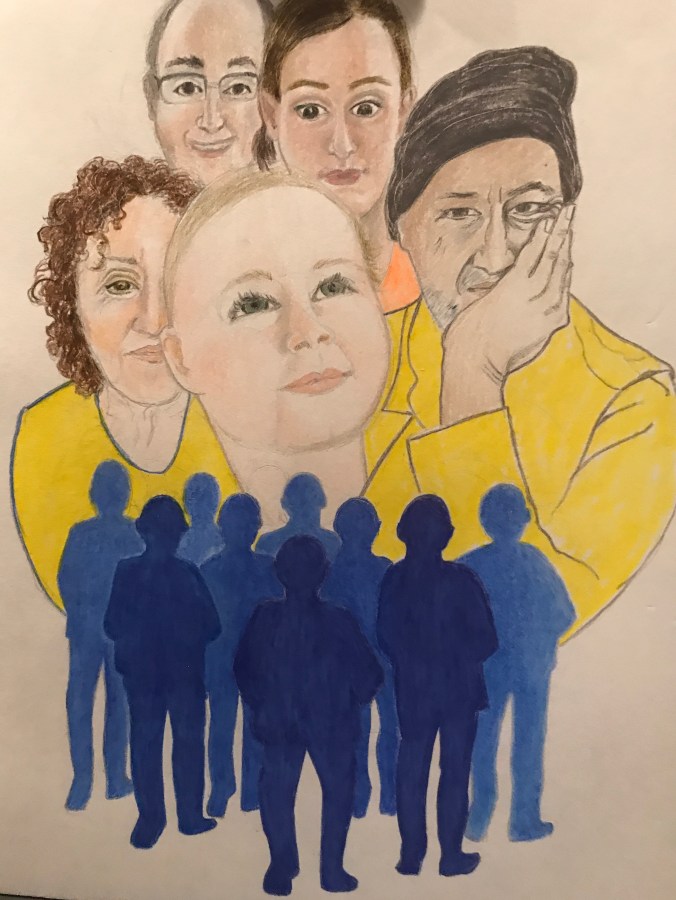 My husband took me to The Alzheimer’s Association support group yesterday. Bless him! My legs felt wobbly walking to the bus but I plowed on. Heaviness and the feeling of a lack of an axis to balance me, is how I can describe it. He steadies me now when we walk together. His arm holding mine, his quick hand pulling me back as I lean into the street to cross. He is becoming more protective. A comfort to me, though the thing he cannot save me from is happening between my ears. Missing my independence and accepting his support, which he gives more freely now.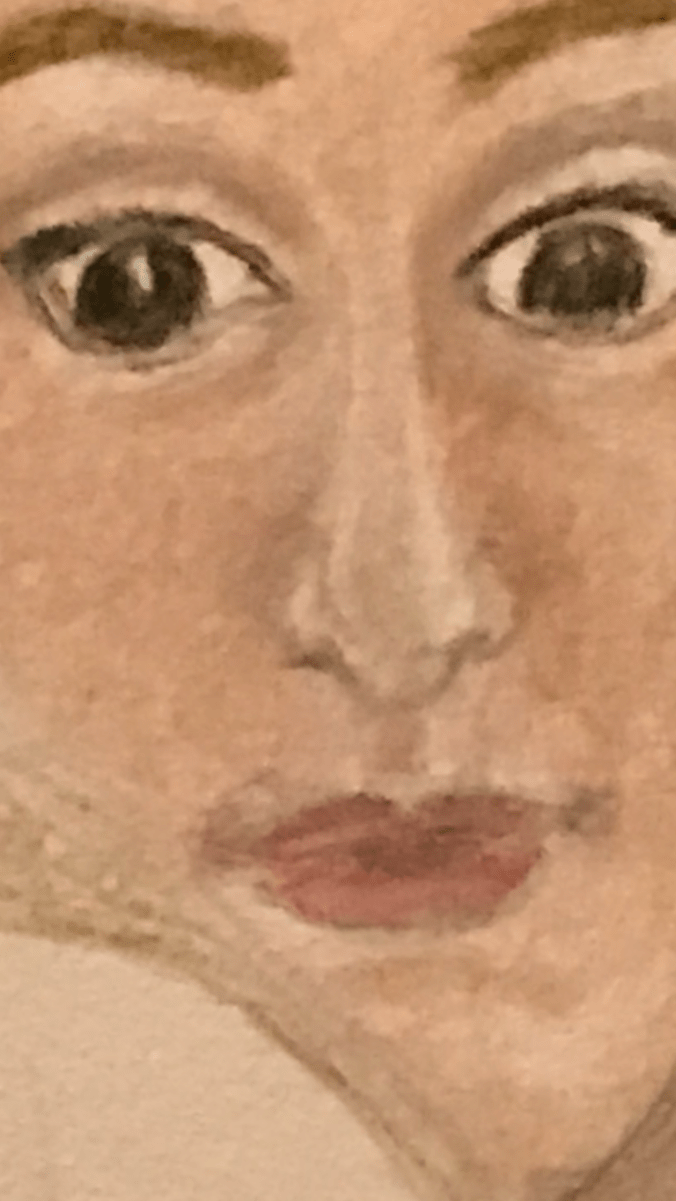
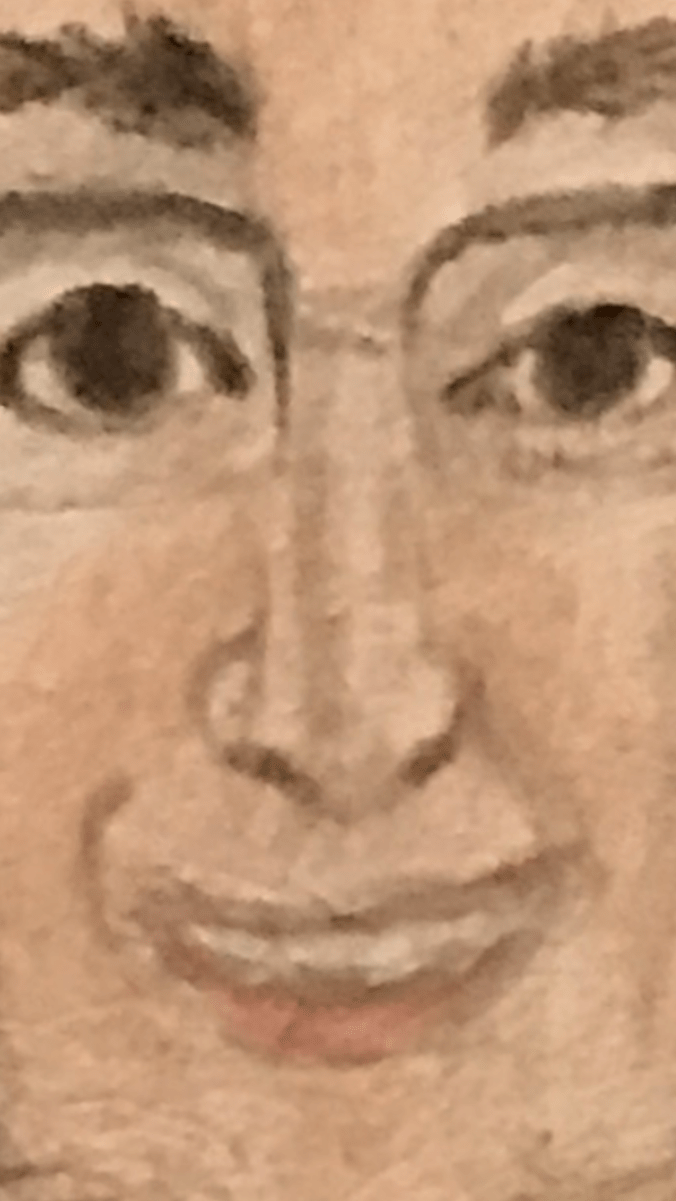 My son is now 36 years old. A lawyer married to a lawyer, and father of a toddler, owner of a house, that is a castle. Member of a family that has extended family that helps them raise their daughter. He is fully launched, unlike my daughter who was far too young to have this happen to her mom and her family. I see his sadness, and the loss and dismay he has experienced in seeing symptoms of this illness in me, and what it’s done to our family.
 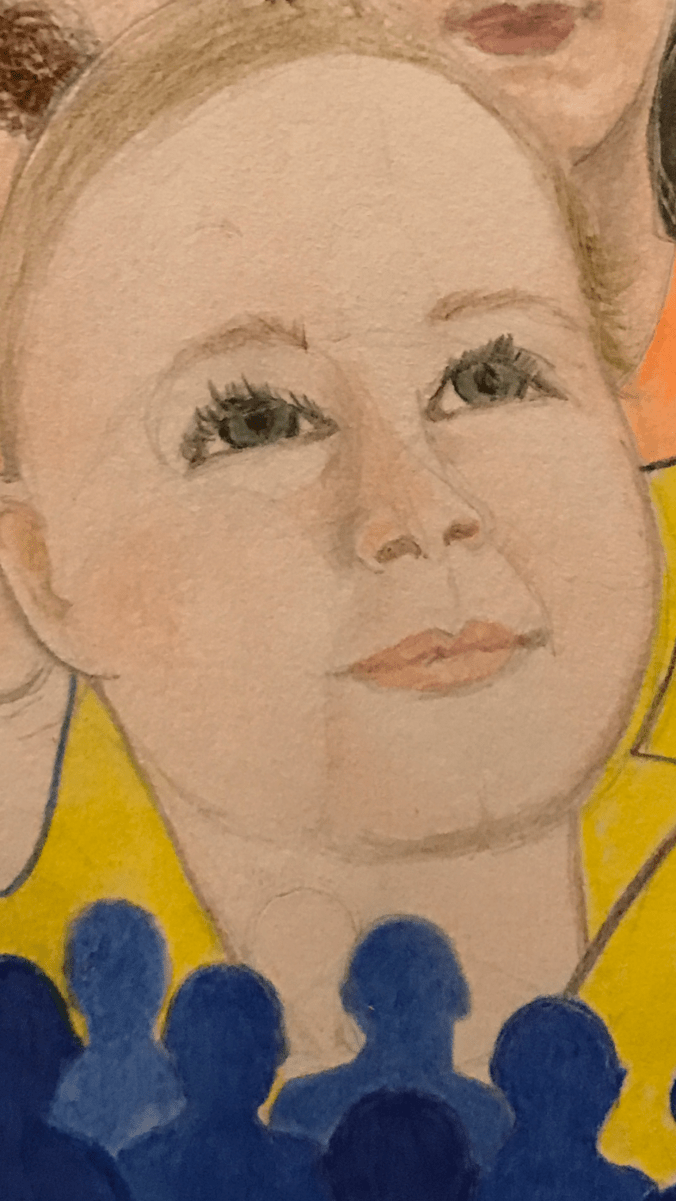 My granddaughter. The next generation. The Alzheimer’s began when she was in her mother’s womb. Now she is two and half, a bubbly effervescent bundle who is smart and strong. Blessed with a family that dotes on her, she beams with confidence. I used to envision myself introducing her to art museums, and fashion and culture. I so wanted to be that grandma. She will be untouched by this.
 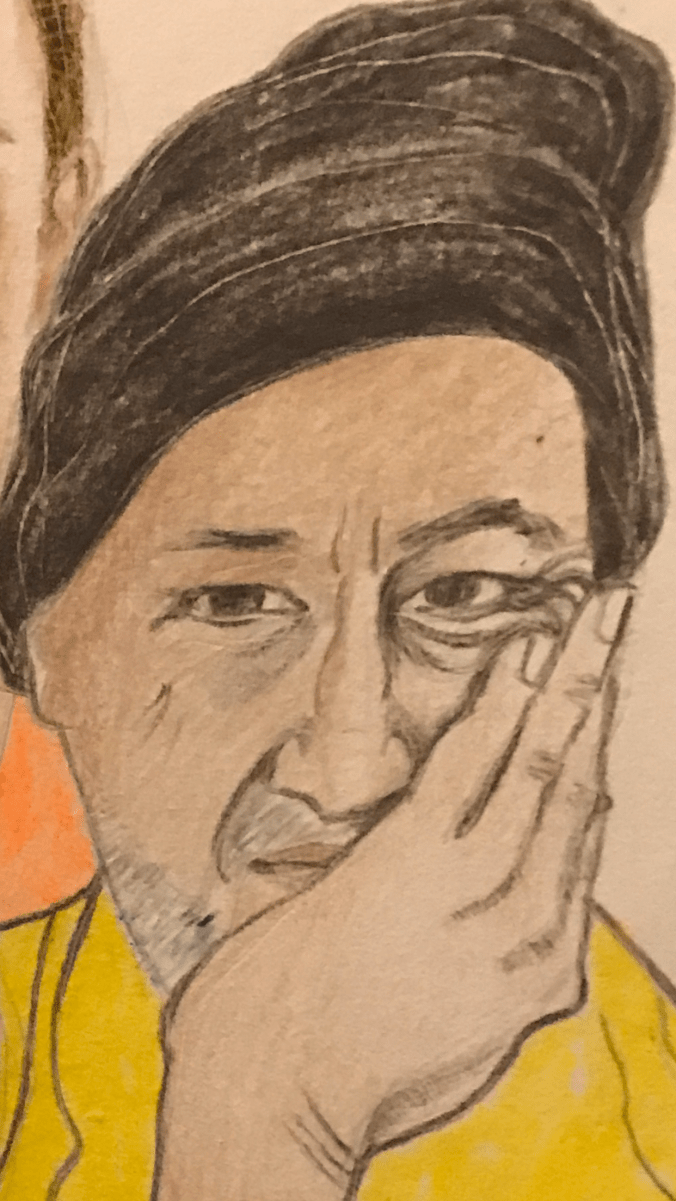 My husband, my soul mate, my caregiver. My back up brain. Weary. Lonely, very sad and tired. Me, his wife of forty one years, and mother of his children, a woman that was his equal partner. Now I am in need of his help and support for the simplest things. He works full time and is far too young to have this happen to him and to us. It has been robbing him too of all the dreams we had for a happy future, a time that we were going to continue to enjoy together. Our partnership. A normal life.
 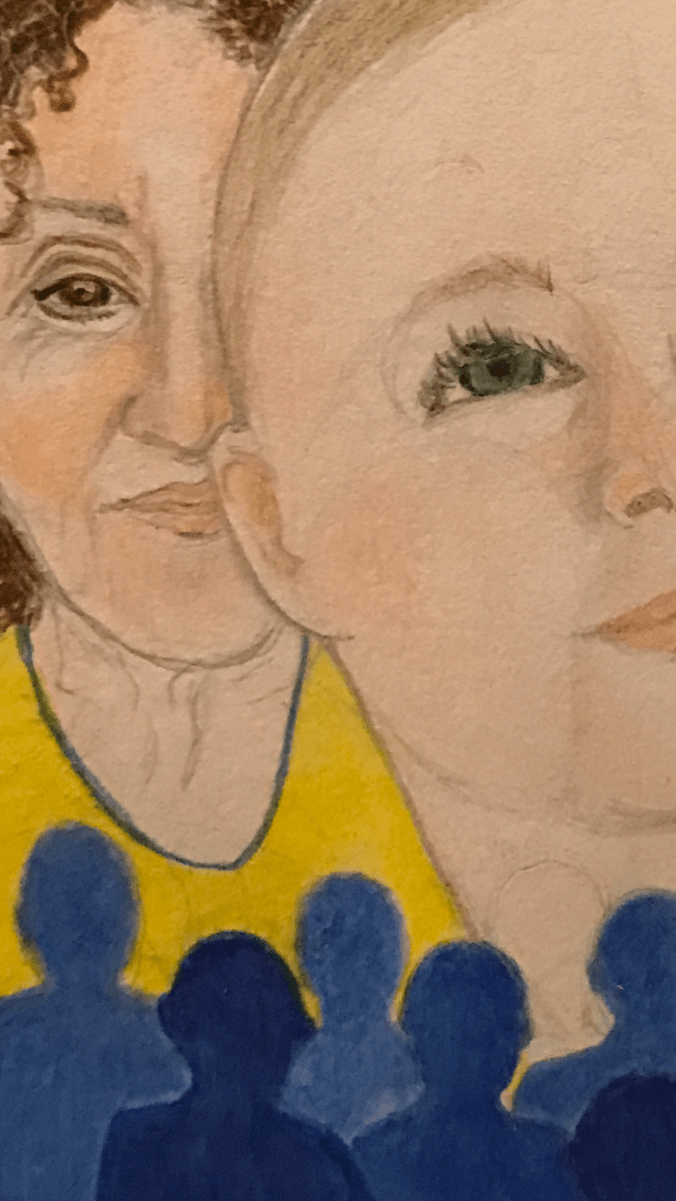 Who are those people looking at my family that are depicted in my drawing? They’re in shadow witnessing the story unfold. Souls, I think. The watchers, spirit guides perhaps. Witnesses. I am fading from view. Eclipsed. My family members are drawn as large heads aggregated into a kind of land form, a kind of mountain. The figures watch. There are the watchers and the experiencers. I think we do this in our lives and it is our journey that we watch. There is a part of us that does not feel the pain. A part that is more evolved than the drama. An inner being that transcends. Witnesses.

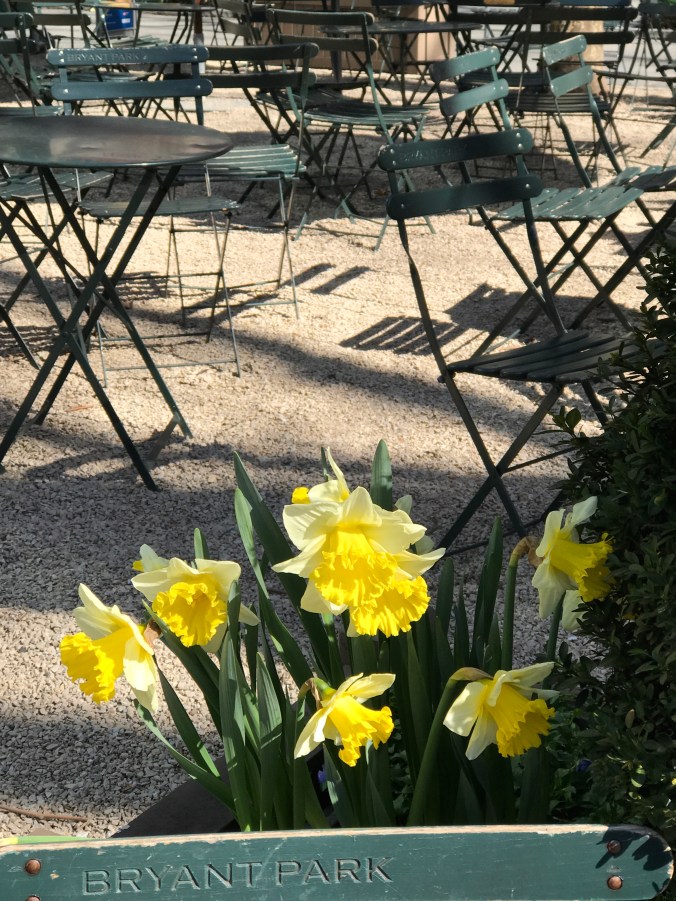
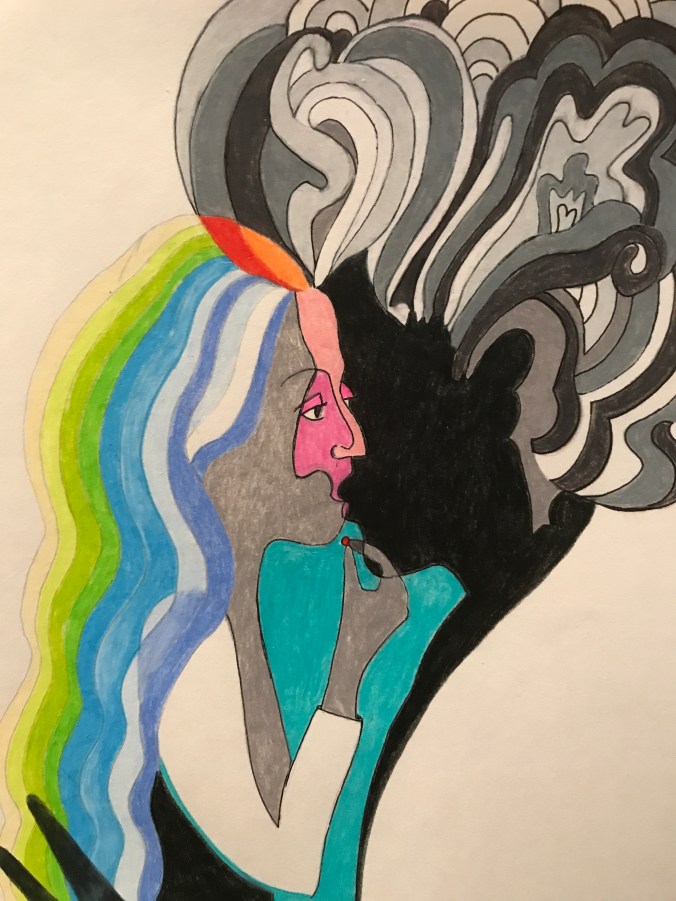


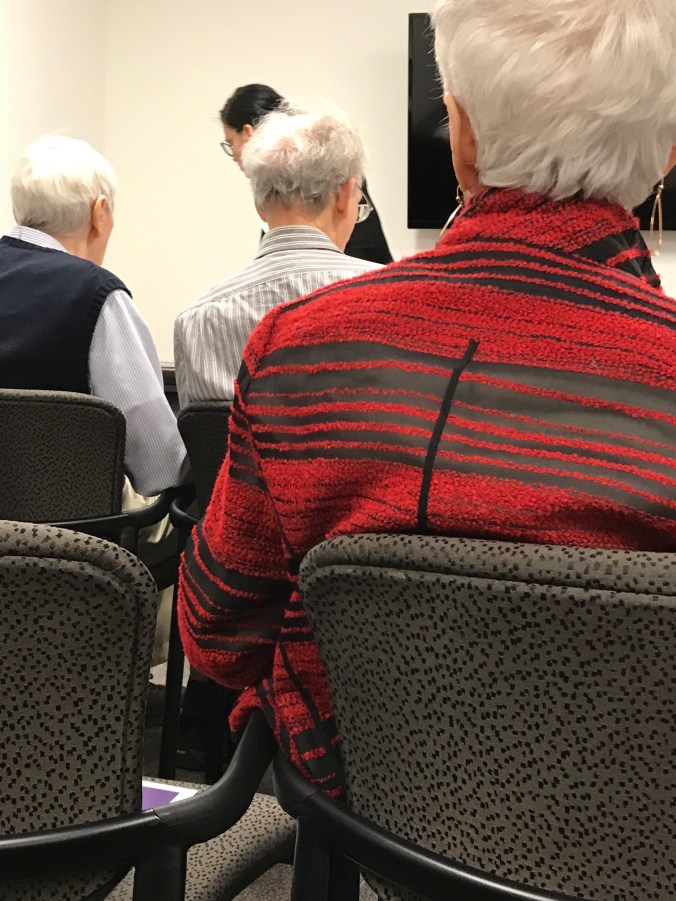 This was the second trip there. The first was the prescreening. This was the first support group meeting. Admittedly, the photos do not look glorious. It’s the feeling I had inside of being able to attend. The crazy sense of victory of accomplishing a journey that I didn’t think I’d be able to make. I didn’t think I would be able to get up at 7am last Thursday, and be dressed and ready to go with my wonderful daughter, who had arrived the night before to take me, but I did it! We got to the bus stop by 9:30am and waited with the with others. It was raining. I’ve been so weird about rain and getting wet, another crazy symptom of this disease, and how it’s affected me, but I had my umbrella open over my head, and my daughter had hers, and it was okay. We boarded the bus together, a large coach with padded seats, and we sat together, she texting on her iPhone, and me playing games on mine to help distract me from what I perceived to be too much stimulation. When we got to the Port Authority, I knew what to do – go out the 8th Avenue exit and get a taxi. This time the cab driver had to take 44th Street, rather than 42nd Street, and I was calm about it, with lots of time to get there, there was no rush. Then the procedure of getting through the sign in process where we had to show identification to gain access to the elevator to the 22nd floor. That was easy. Once inside the Alzheimer’s Association offices, we were greeted by the group leader who led us to a large room with chairs set up for us. For the purposes of respect for anonymity, I have included only photos of the back of people’s heads. Accompanying the people who have Alzheimer’s, were their care-partner’s, mainly spouses.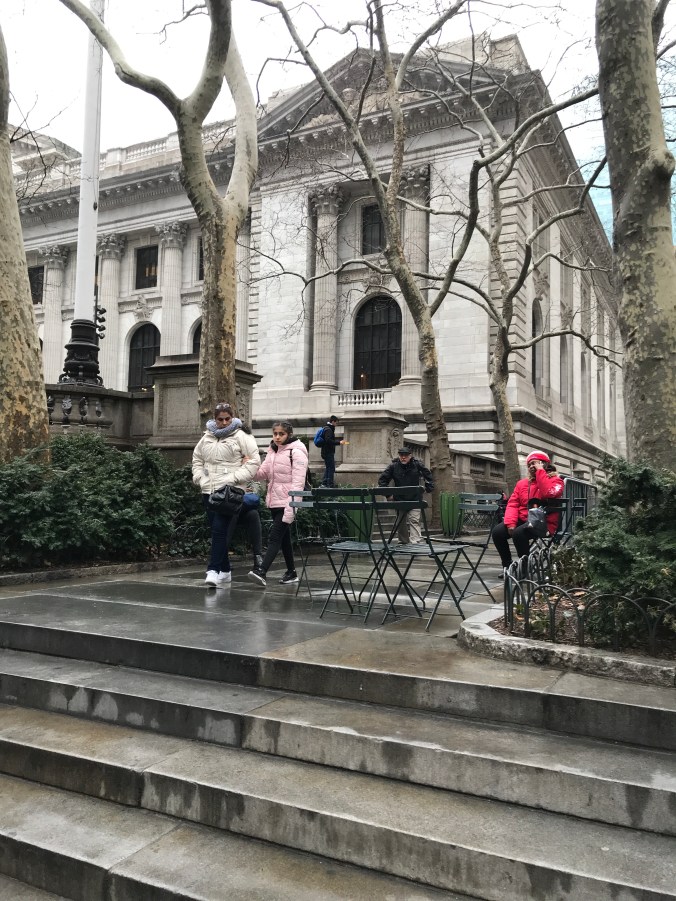
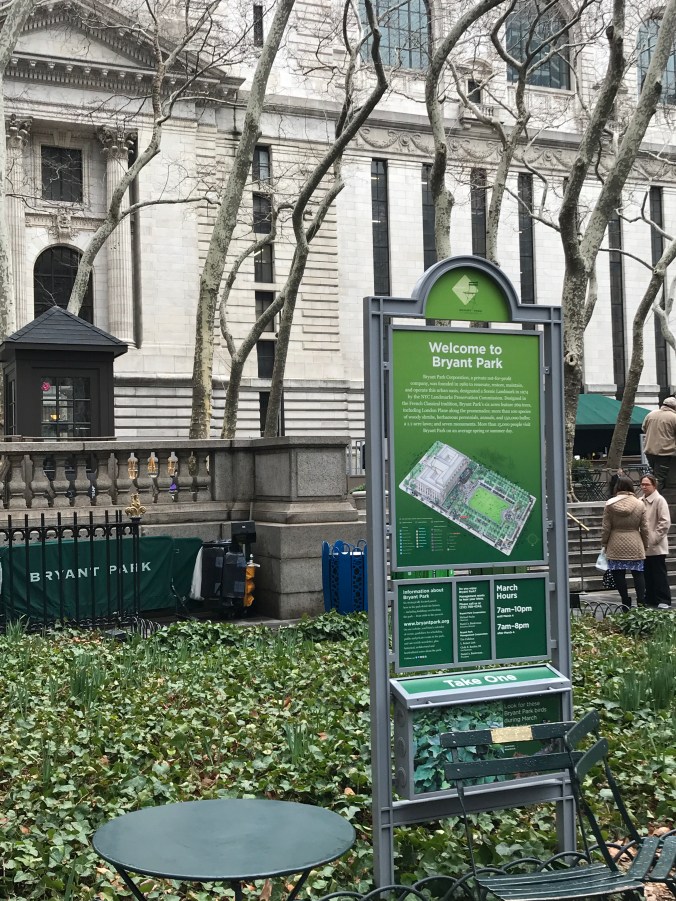
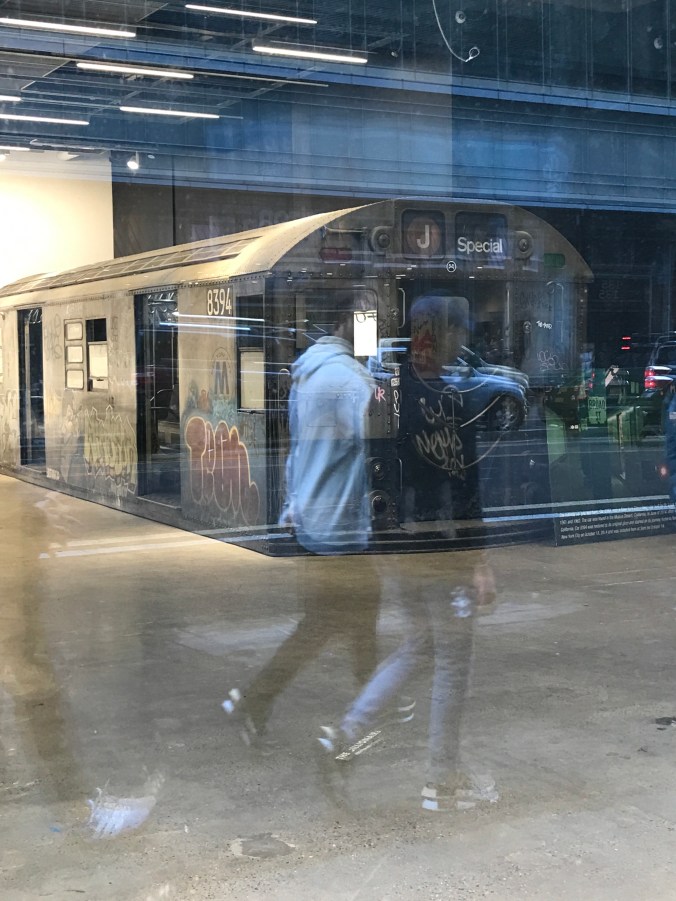
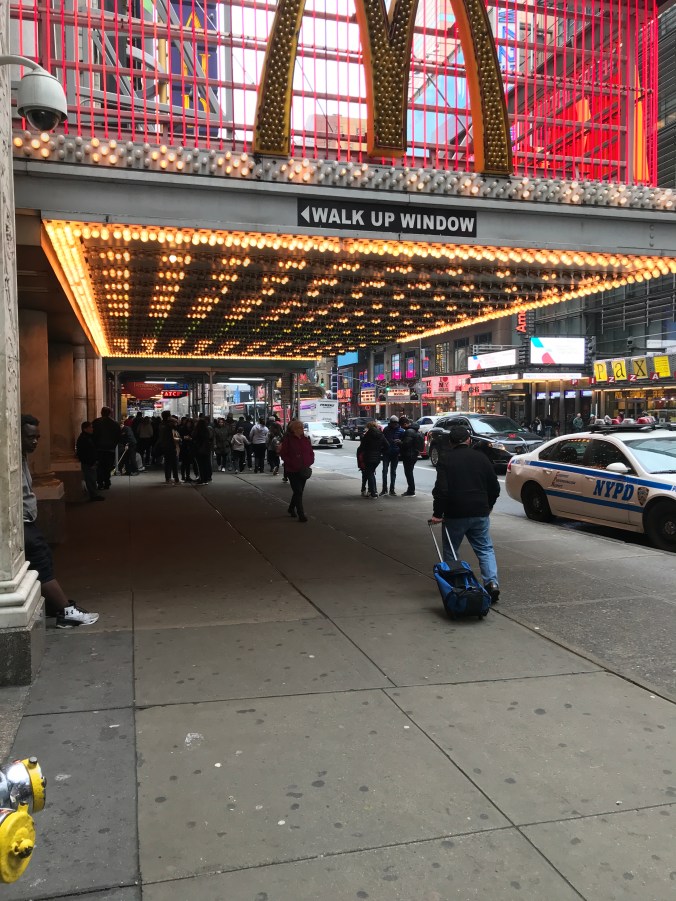
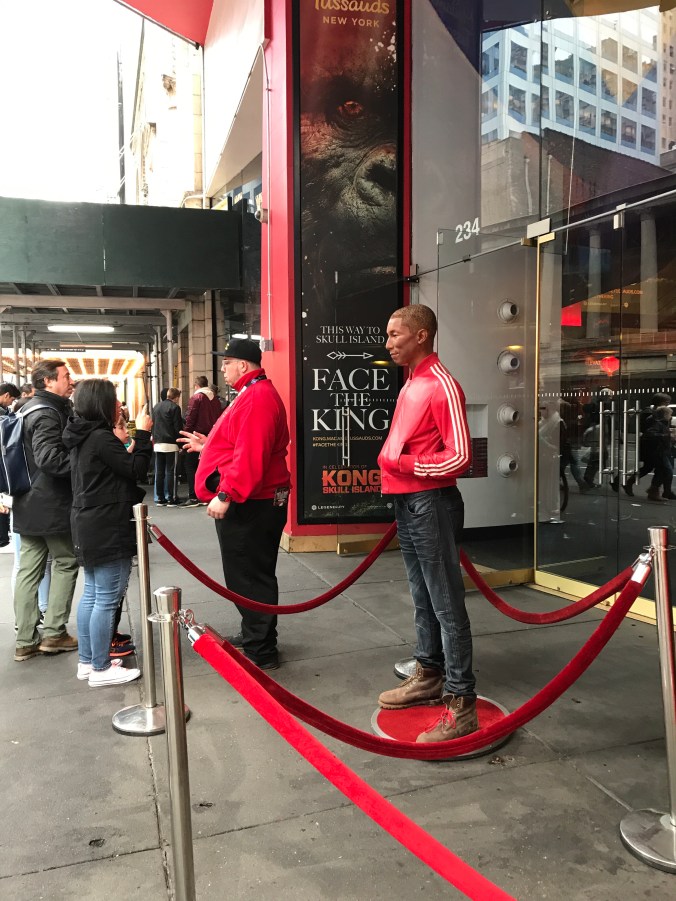 I thought of how this rap song has signaled change in my life. I listened to the twenty four hour version, the upbeat four song minute song played on a loop, with each cycle introducing a new dancer (or dancers) at a different location, in 2013, as I worked to mat dozens of student artworks for an exhibition of historical figures. The song and images of dancers played on an overhead monitor all night long as I worked. I was alone in the art studio and took breaks and would dance in the middle of the room, cheered on by this song. Now when I visit the memorial page for Susan Suchan, a woman I met through Dementia Mentors, who was a huge positive force in advocacy for people with dementia through Dementia Action Alliance and Dementia Alliance International, Pharrel’s song Happy plays continuously. Susan had Primary Progressive Aphasia and died in January after advanced cancer accelerated her journey. She left this world acknowledging how blessed she had been, and how kindness and love were her redeeming factor. She taught me that between diagnosis and death there is LIFE. I came into the dementia world extremely depressed, and Susan told me depression is a cloak she would remove. At that time I did not believe that this was possible. I am sad and I am tired, but I am filling up with love in this part of my journey, and it is because my spirit has been buoyed by those who have held hands with me. Many others have showed me the way, and I want to thank them.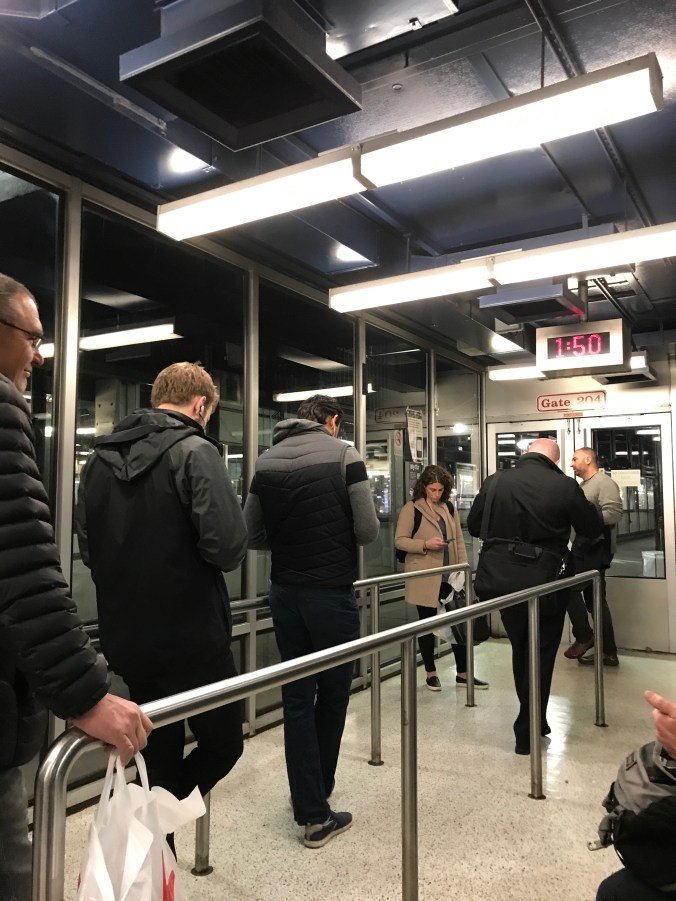
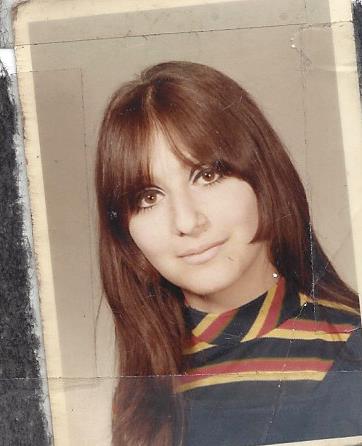


 The magnificent Chrysler building – going East on 42nd Street
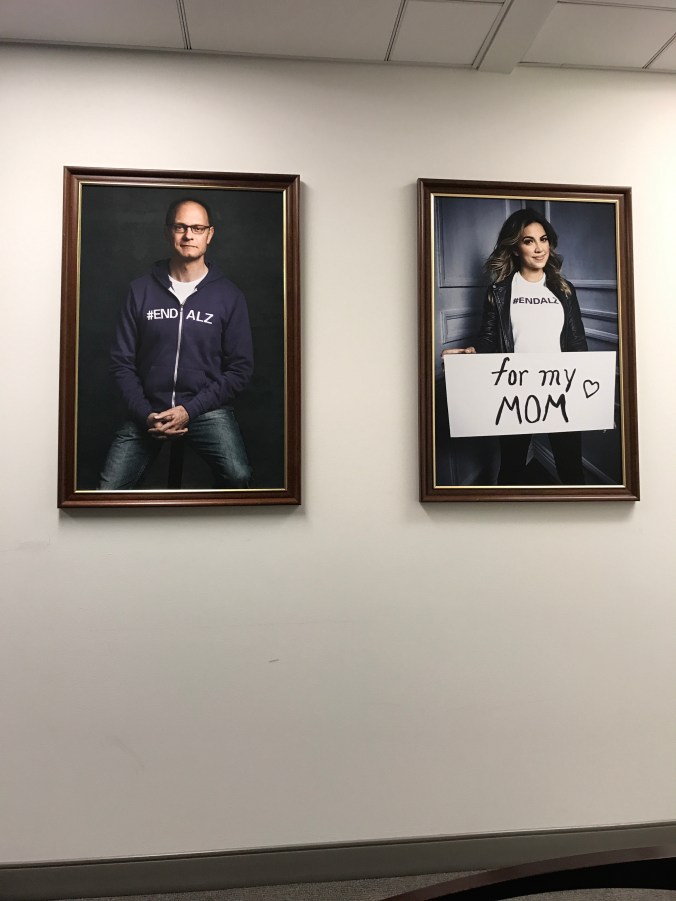
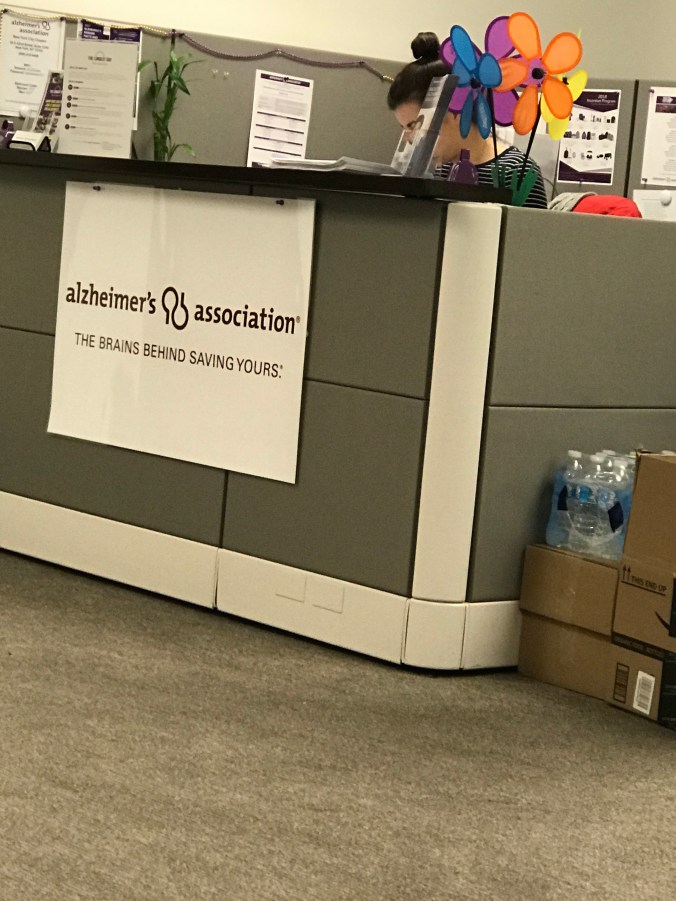


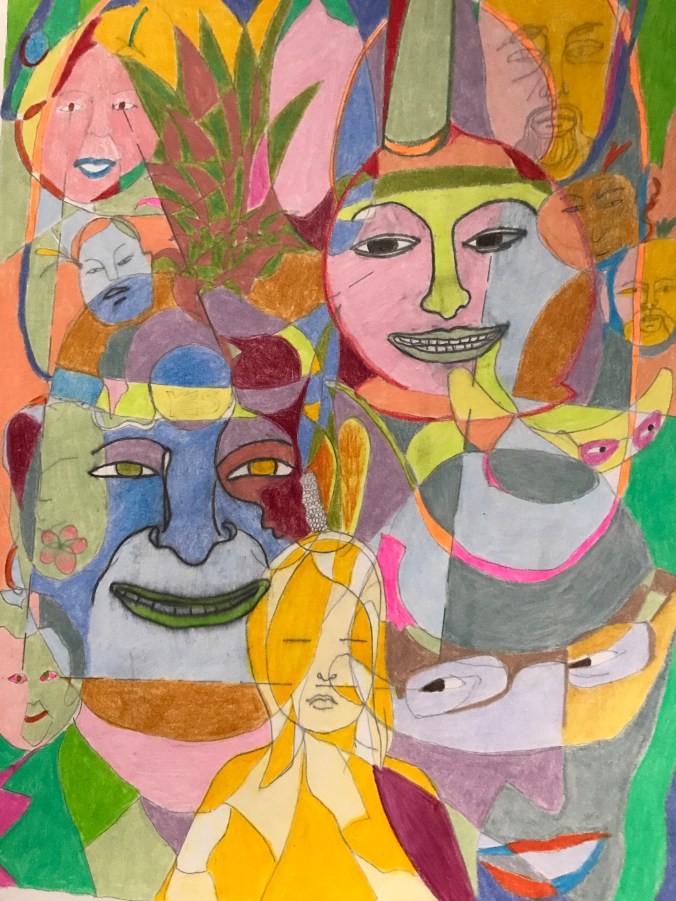
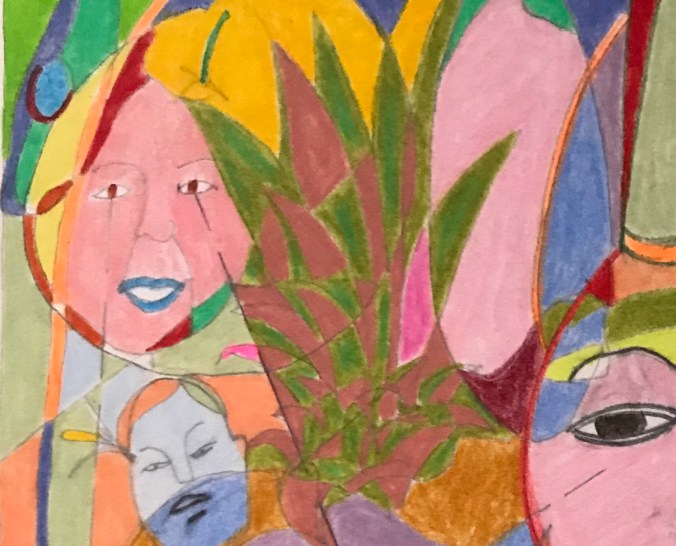
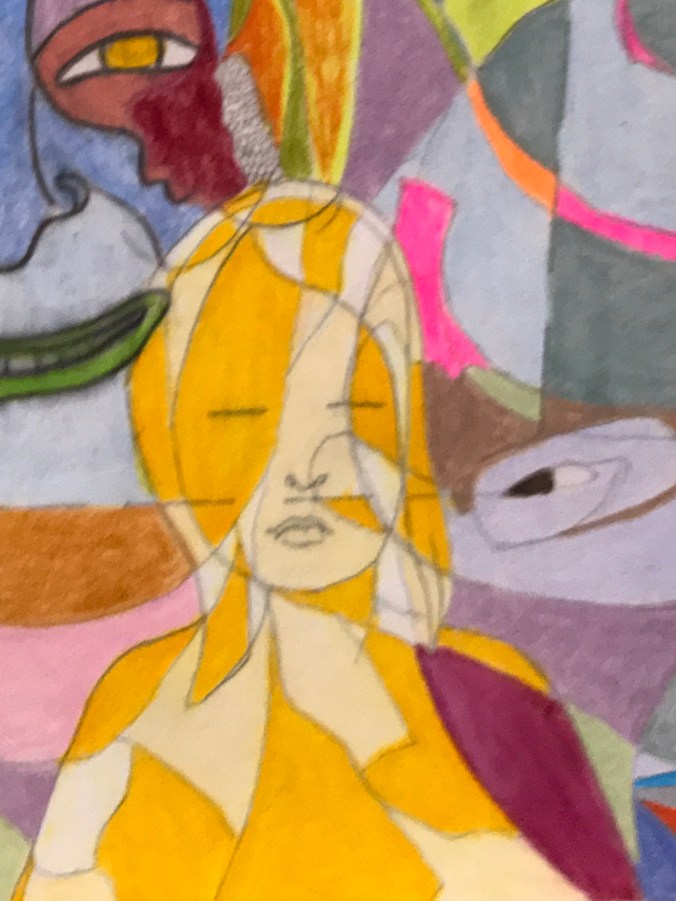

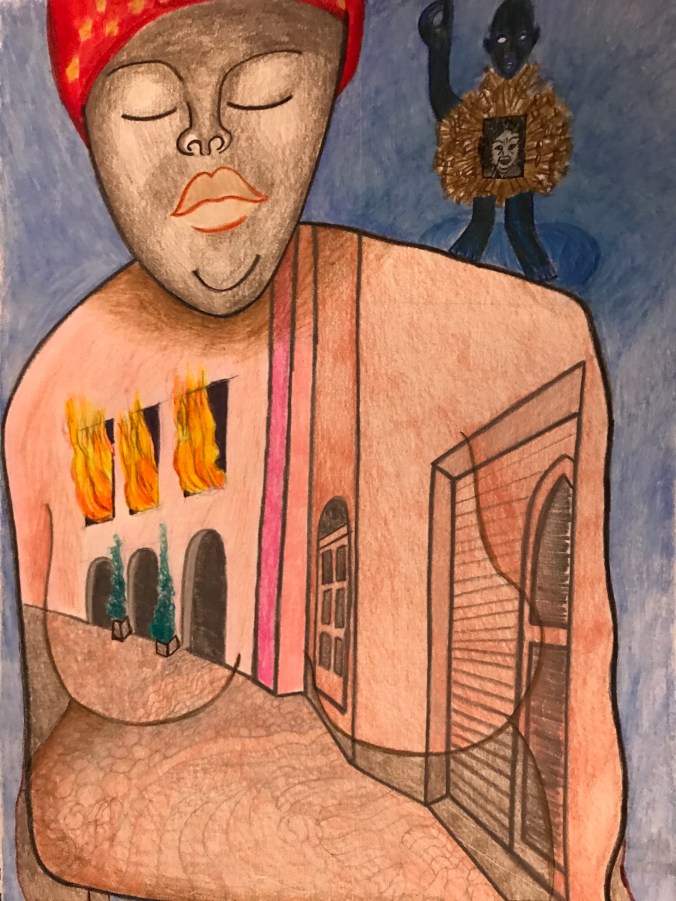
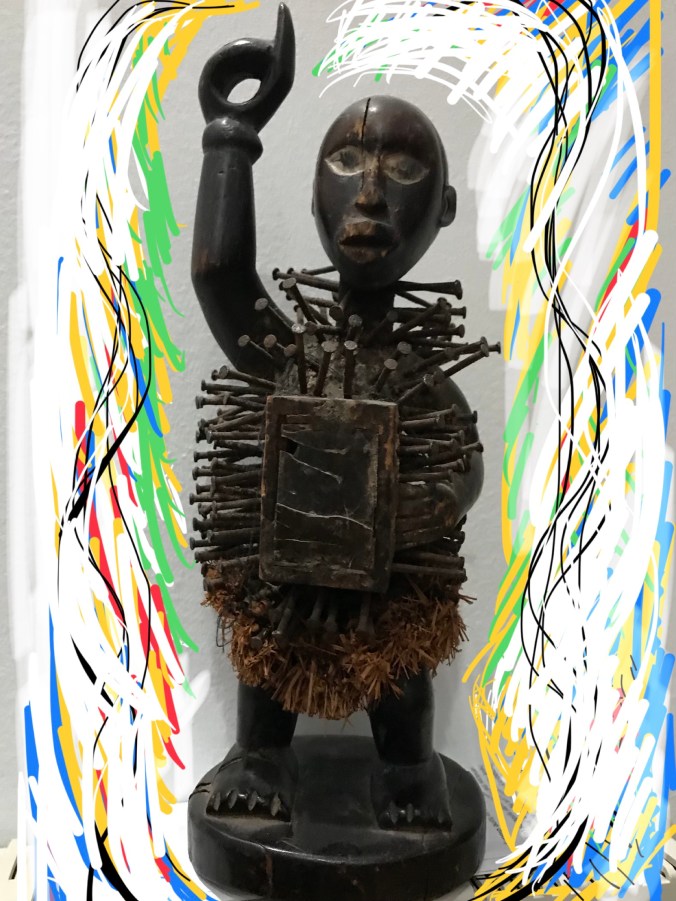
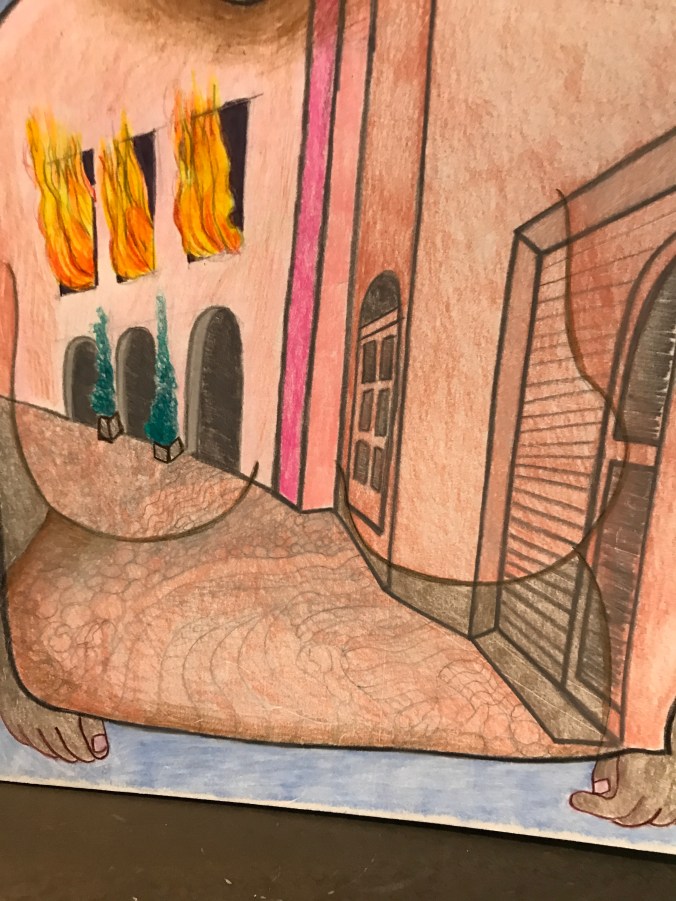
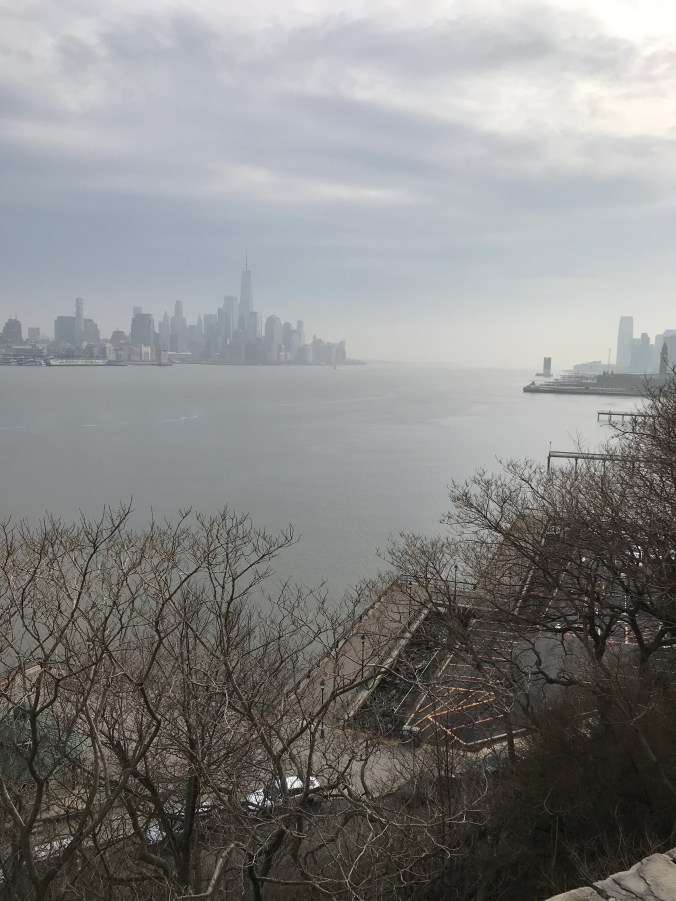 Wow. Imagine that. Walking a few streets requires fortitude now. My feelings of sadness, fear, stress, confusion and anxiety, are discussed with my therapist. I’ve been seeing her for over a year- through the period when I was struggling to keep working. She has held my hand through the losses. She’s been privy to the parade of assistants and home health aides who have come and gone. We talk about my husband and how to best manage my behaviors around him. How to be mindful, despite the fact that I feel insane some of the time, and he has a hard time with my clingy and often times demanding behavior. What a contradiction, being mindful when one is losing their mind.


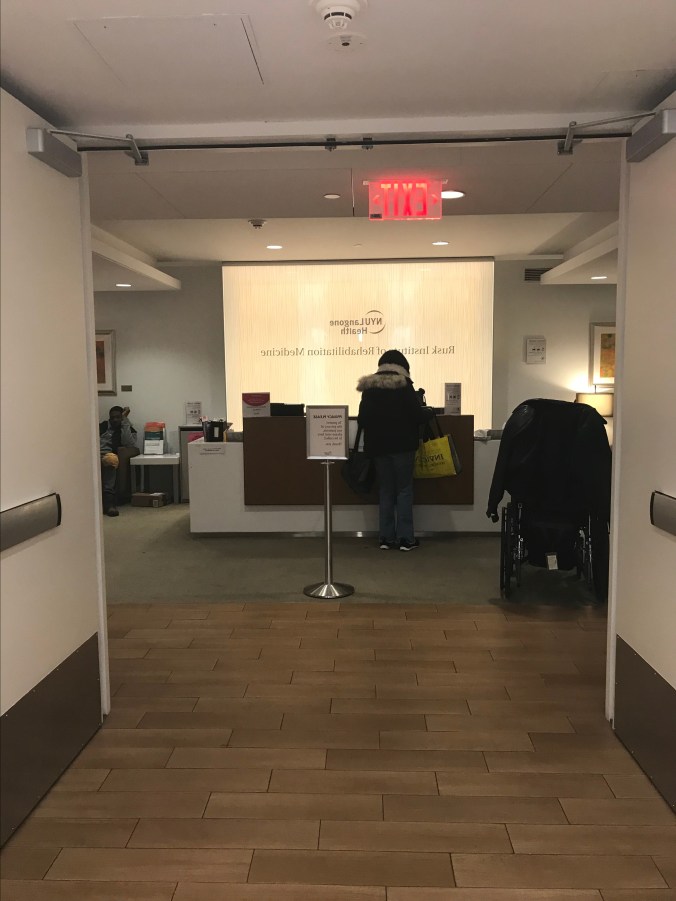
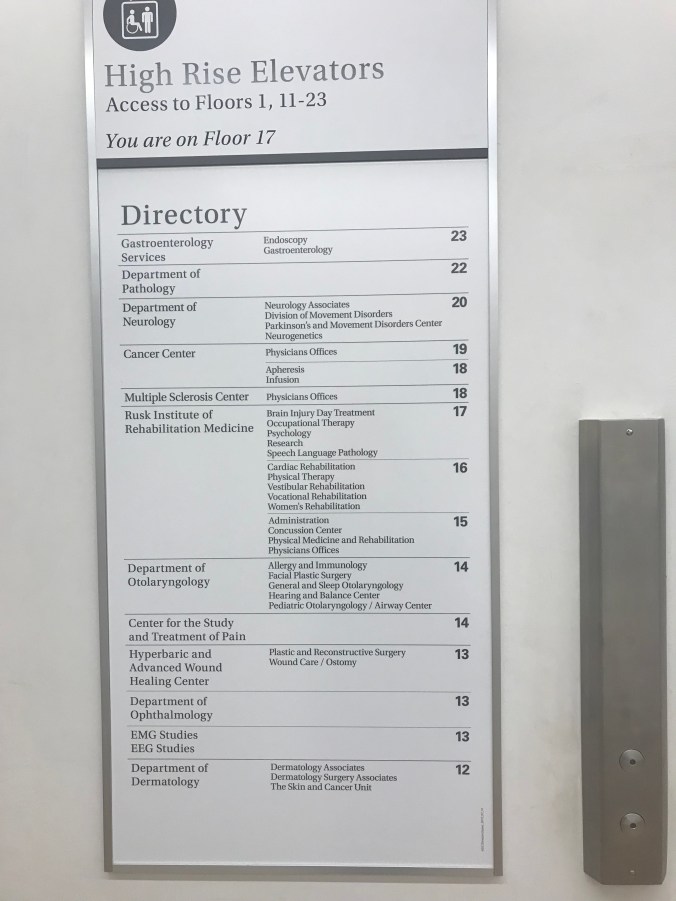
 Homework with the psychologist I was assigned to, was to group items on my list. Clearly she was not intent on helping me. She wrote the words sleep, regularity of schedule, consistency for (looks like an arrow), anx (think she meant to write anxiety) and confusion. My husband canceled the rest of the appointments, after she said she was only meeting with me because she was doing a favor for her colleague, and that she could not help me. She said the best thing I can do is make legal and practical plans for my progression and well, you know what comes after that.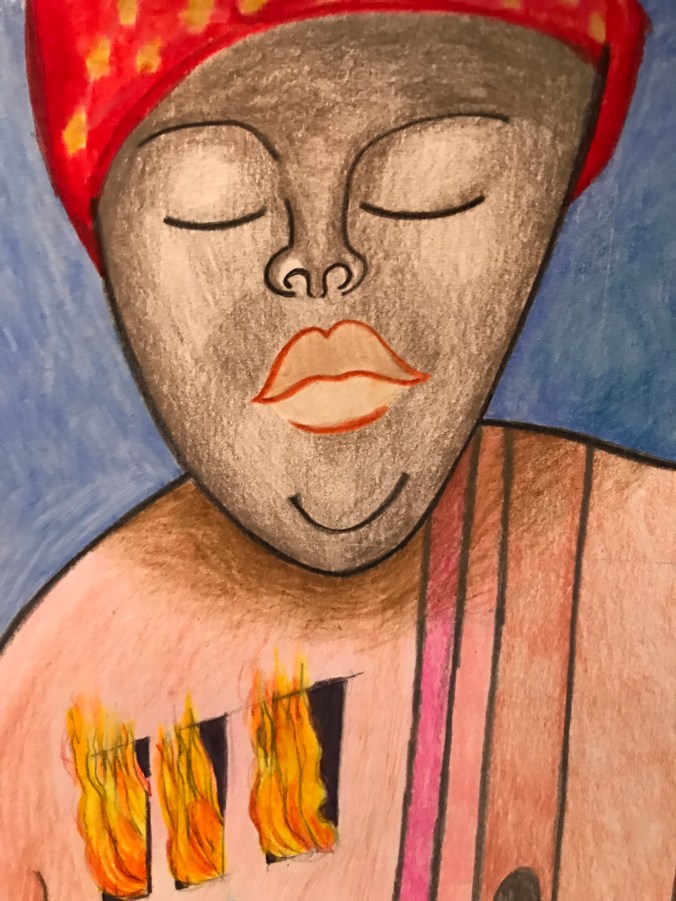
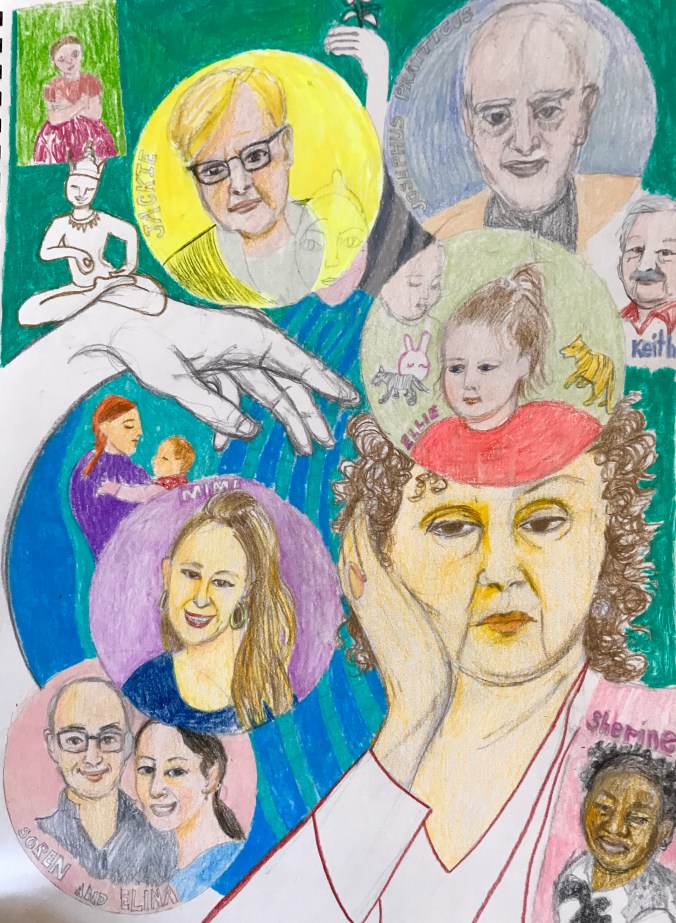



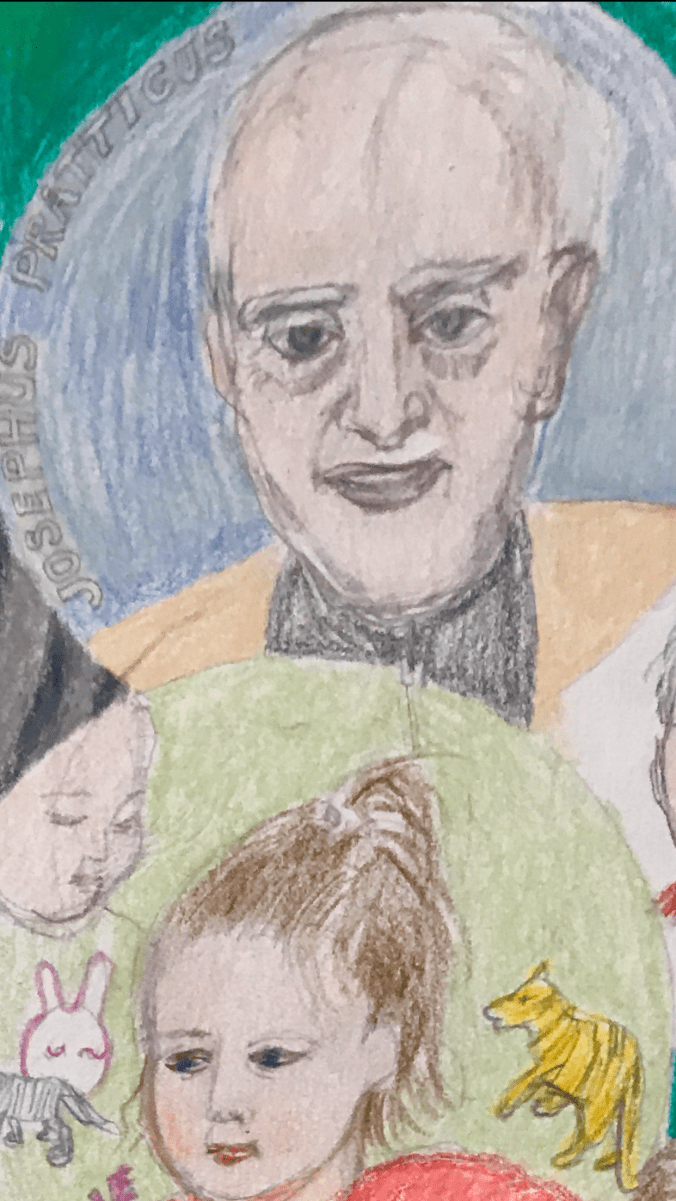
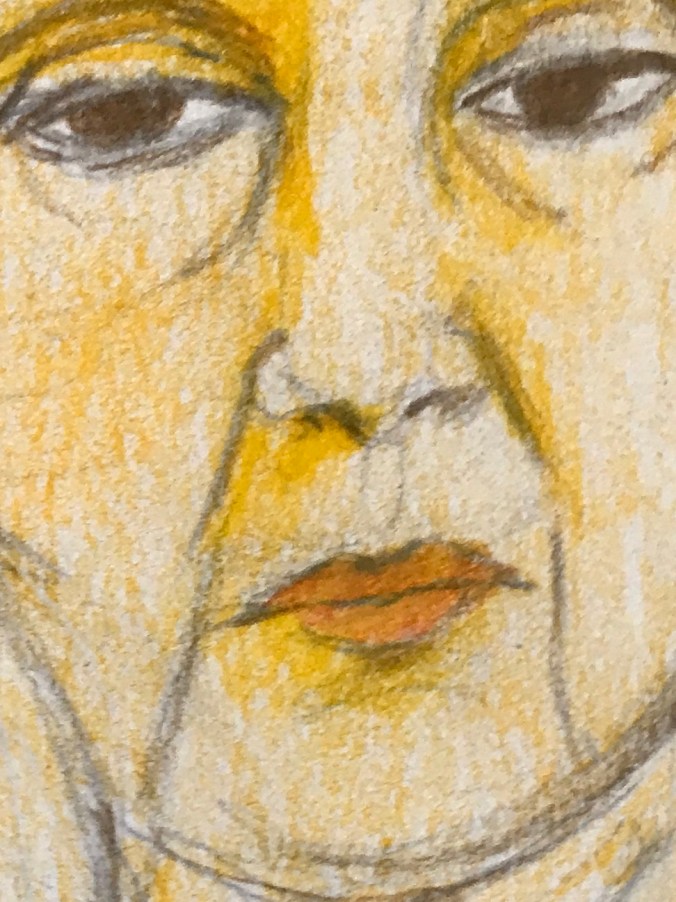


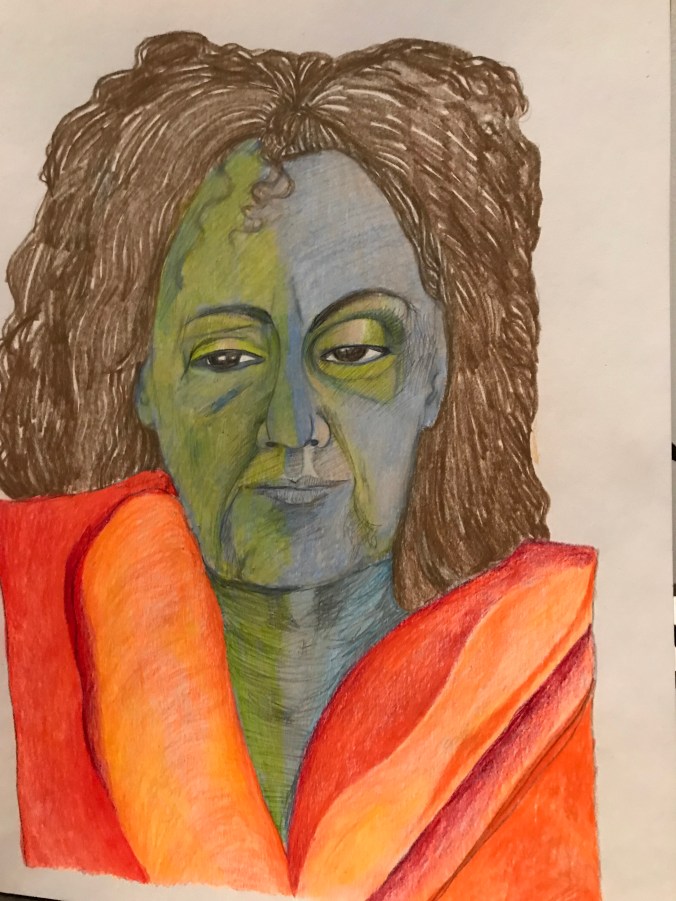 It’s getting somewhat harder to think and write, but I’m the Alzheimer’s trooper that carries on with my stream of consciousness writing, attempting to make sense of a world in which I get confused.
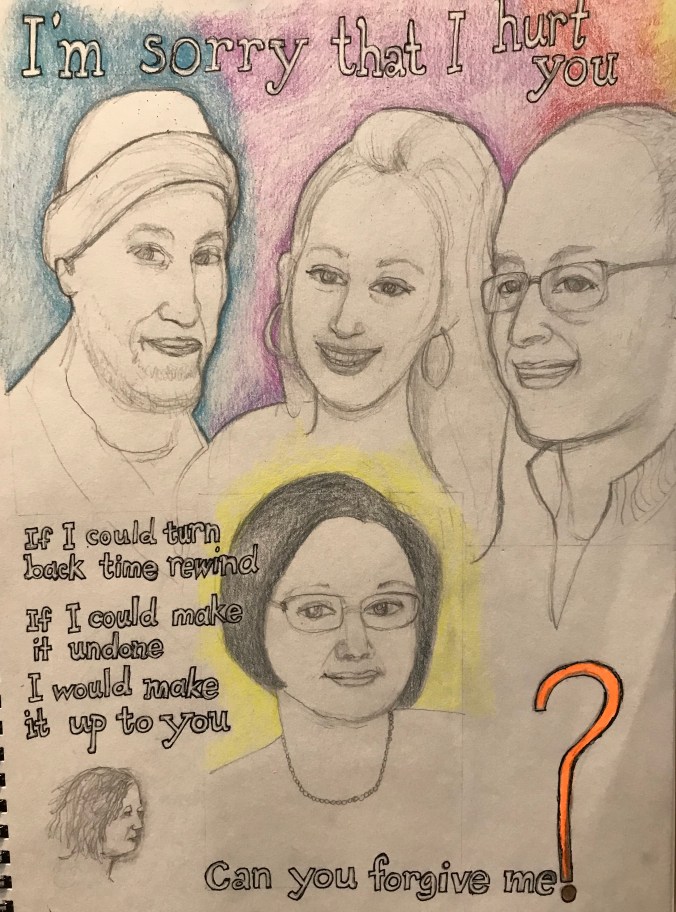 I’m no angel. I’ve hurt people.
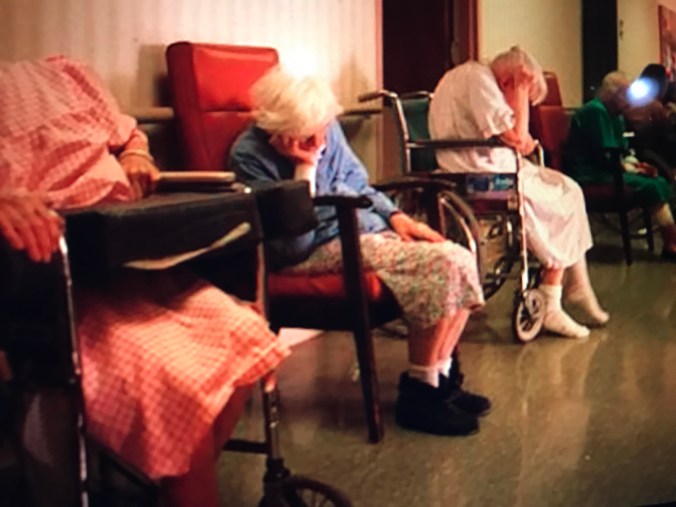
 Suddenly Mad