A bad weekend

For blog- a bad day - caregiver burnoutIMG_2768

It’s Sunday and this is the day my husband shops for food, and prepares for the week ahead.

It’s been a bad weekend. The news is all bad and there’s been another mass shooting. This time in the Texas.

I’m safe and warm in my home while my brain is busy slowly (or not so slowly) atrophying.

My husband/caregiver has been trying to cope, and is wearing thin. We fought last night. There was hardly any food in the fridge. I generally forget to eat, have no appetite a good deal of the time, but I was surprisingly hungry.  Last night, I went to the fridge looking for something else to eat,  when he put the plate of what should have been appealing, in front of me. I made the egregious error of complaining that I wanted something else. He lost it. He threw the plate down on the granite island almost breaking it, and the food went all over the place, and he ran out of the house, slamming the door hard. Fortunately no weapons were involved, just flying rice and a steaming temper.

It’s CAREGIVER BURNOUT!!!

This is the point at which the spouse starts to think the loved one needs to be placed in assisted living or in a nursing home. He’s lonely and utterly exhausted. This is no fun for either of us. I know that wives place their husbands with the disease, but that’s usually when the spouse has become incontinent and doesn’t remember who they are anymore. I’m certainly not at that point…yet.

It’s that I can’t perform many of the instrumental activities of daily living. He and my now grown children were accustomed to me doing everything so well. Now I am 1,2,3, and 4 on the scale of impaired IADL’s (instrumental activities of daily living).  He is burned out and angry. I’ve read on the Alzconnected.org site about the many husbands who are sick of the relentless responsibilities, the loved one’s irritable behavior, the constant repetition, and they do place their wives early in the process (those who can afford the 5-20+ thousand dollars a month). Mine wouldn’t be able to afford it. I have no long term care insurance, and he would have to sell this house, which is pretty valuable. But where would he live? His choice is to suck it up…for now.

When I picture myself being placed in a home with activities like finger painting and Bingo, and a women’s hairdresser who coifs the old biddies, I really do want to croak immediately. Since this is a disease mostly the very elderly. and I’m considered older middle age, that won’t be fun at all. Unless I’m like Julie Christie in “Away From Her”, and find love with some reasonably intelligent old guy, or at least one who still knows how to use the loo and tie his shoes. A fellow whose wife has simply had enough or who is a widower. There’s always hope.

I asked my hubbie last night if he would take care of me when I need the sort of care where one has to feed their loved one with a spoon and change their soiled nappies. He said he’ll hire someone.

At this point, I can’t follow a recipe or food shop alone, and I was a gourmet cook. My coq au vin was mouth watering! I could make a Moroccan tagine from scratch, poached trout to perfection and cover it with a tasty lemon sauce, whip up a peach flambe …

I was the matriarch of the family and a pillar in my community- a professional who had style and wit and was fun to be with, or so I thought. Last I remember, before I started losing my mind, I was rewriting a draft of a great film script.  I had made films and worked with a super talented editor and had filmed abroad with some of Roman Polanski’s film crew. I taught at the same university where my neurologist presides over Alzheimer’s patients and research.

It was wishful thinking. My brain is now so tangled with fried tau that writing these sentences here requires all of the cognitive ability I have got left. I constantly have to correct words and spelling and assess whether what I’m saying is making any sense at all. Recently, I found myself typing a sentence into the center of another sentence.

As for conversation, my dementia buddies don’t seem to mind that much that I am moody and dark, as long as I stay away from the “woe is me” diatribe and I ask questions and nod in agreement. After all, they only have to deal with me once a week, for an hour on Zoom chat.

But how much can a spouse take being read to from online scientific journals about how the brain shrinks and how synapses are disrupted, which I have done incessantly since I was diagnosed? How much Scrabble can a human stand to play with their Alzheimer’s spouse? Watching me grapple for an inordinate amount of time with puzzles made for 5 year olds must be painful to witness. My relentless training with Lumosity games on my iPhone reveals that I am having trouble adding and subtracting double digit numbers now, as I watch my scores plummet. I was never a math whizz by any means, but when the 7’s table became untenable to do in my daily training of Raindrops, a game which tests the ability to perform simple arithmetic operations, I knew I was losing cognition fast.

I do read the news to have something current to talk about with my husband. He’s a news junkie and while I know Trump is president and is ruining this country, my ability to recall much else is compromised, despite reading the New York Times daily. I do remember that not only is Trump president, but the VP is Michael Richard Pence, and he’s the 48th vice president and was the governor of Indiana from 2013 – 2017.

How could anyone including an early Alzheimer’s patient not take note of the violence gripping the country, randomly? The rate of shootings and terrorist driven attacks is escalating. People are losing their minds all over, and it’s not only to neuro-degenerating diseases. People with frontal lobes that are highly functional but are otherwise mentally ill, are planning murders daily. This could be your next door neighbor. Mental illness is exploding insidiously. It must be the stress of living in an exceeding confusing, polluted and G-dless world.  Last month a demon named Stephen Paddock shot 58 people at a Las Vegas music festival, unloading a modified rifle with high capacity to “bump” shoot from 60-100 rounds.  It is considered the deadliest shooting in US history. Five days ago, a 29 year old man from Uzbekistan drove down a busy bicycle path in Manhattan and killed 8 people and injured almost a dozen, yelling “Alahu Akbar” (G-d is Great) as he fled the scene.

Today there’s been another shooting. This time 27 are dead and at least 20 injured,  in Sutherland Springs, Texas. A 26 year old man opened fire in a First Baptist Church outside San Antonio, after the Sunday sermon. Apparently he served in the US Air Force after high school and briefly taught at a summer bible school.

So…G-d bless my husband for doing a great food shopping today, leaving me meals and not letting me go hungry and for not owning a gun. G-d bless him for ordering curry from the best Indian restaurant around tonight, and for coming home after he’s had it again and again, and is at his wits end with grief, despair anger and depression. That’s pretty valiant, and while we are living a living hell of sorts, it’s not all that bad, considering what is going on, comparatively. I can still write about it, and the curry was absolutely delicious.

Mine is not your “Living Well With Alzheimer’s” story. Sorry about that, but I am trying to hang on to my humor, as dark and seemingly inane as it may appear to be.

The great late comedian, George Carlin said it with aplomb. “Inside every cynical person there is a disappointed idealist”.

I’m a disappointed idealist. I think of myself as a skeptic, a realist. I think the cynics are the people who left the gas tank on the Ford Pinto, companies that kill people and just cross them out because they can’t afford to retool. That’s a cynical position. But the saying goes, if you scratch a cynic, you find a disappointed idealist, and that’s what’s going on with me. Down deep and underneath, the flame still flickers. I wish for an idealist, utopic world but the realist in me says it’s never gonna happen because of the way they’ve structured power and money and control and the hierarchies they’ve established.

George Carlin

G-d bless America.

“Der Mensch Trakht Un Got Lacht” Man plans (thinks) and God laughs

image for blog- a mensch tracht und Got lacht IMG_2604 The phrase that a person thinks and G-d laughs means that a person plans and thinks they know how things will go, but life happens, horrible things happen. Yesterday eight people were murdered when an insane man with a death mission plowed into them with a rented truck in Manhattan. They were happily going about their business and they were killed suddenly. A mensch trakht und Got lacht is a sardonic way of saying we never know when our number is up and what will happen to us. One minute we’re fine, and the next, well….

In my little world, the reality of getting this disease has nearly destroyed me. I say nearly, because I am a fighter. I am fighting to stay alive and as functional as I can be. I’ve always been that way. I think I was born that way. I’m a child of Holocaust survivors, so the survival instinct in me is still strong. However this disease is a monster which requires everything I’ve got to keep fighting. I’m still here, and that means I am still fighting to remain alive and be heard and seen. I so want to remain communicative. I don’t know how long I will be able to do that, as Alzheimer’s affects the way we communicate– so while I can I will communicate with conviction, and impart what I am learning about others and about myself.

I met a man recently who is close to my age who has Alzheimer’s. He is in a wheelchair and can not speak. I was told that a year ago he was in a choir, was walking and fully engaged. I went over to him and introduced myself, and he turned to me and tried to say something which I didn’t understand. His name is Michael, and his health aide told me he had been a brilliant lawyer, and had been very successful. It was important to me to try and communicate him in some way, to speak with him and show him that I knew he was a whole person that was deserving of being spoken with. Too often the person who is progressed in dementia is thought of as a non-person. People with disabilities are so often viewed in that way, neglected by others, not spoken to and left alone in their world. It was good for me to be able to reach out to him, as limited as our communication was, and was great to also be able to speak with his caregiver, and find out what happened to this still handsome man, who could no longer speak for or take care of himself.

In two and a half years, I have gone from being a high functioning teacher, filmmaker and professional, with numerous commitments and a life I loved, to a near recluse without a career, an income and independence. I have progressed in this horrible disease, yet I am fighting to maintain what is left of my independence.

I treasured my independence when I was well. Independence now means being able to take a shower and dress myself,  go for a walk myself and be able to know how to use my phone and computer. I can make it to the hairdresser and to my therapist’s office which are in walking distance to my home. Small things but important in maintaining my dignity and independence.

My social life has diminished and friends who were a regular part of my life have disappeared unfortunately. Rejection is commonplace in this disease. People are afraid of it, afraid they may have it, or may get it. It’s painful to be rejected and lose friends, even when one is well. But to be rejected when you have no recourse because of stigma and misunderstanding – is the worst. I gave heartily of myself to others, to my students, to my colleagues, my relatives and friends. I am saddened that at a time when I would so enjoy keeping up with these people, they have decided to cut off relations. I’m still a valuable person with insights and so much to offer others, yet because I am not what I was, these people have disappeared from my life. It makes me sad.

My social life now involves Zoom chats with my dementia mentor, which is a life line as she teaches me what maintaining independence in this disease means. Our regular chats helps me stay positive and loving and connected. I zoom chat with folks on Dementia Alliance International. That’s another life line which has become a mainstay in my routine. Every Thursday I go on Zoom chat and get to share with others who are also coping with the limitations that dementia has had on their lives. These folks have a variety of brain diseases. Some have aphasia (which means that they have loss of ability to express speech, caused by their brain damage), but I know now that even with aphasia these folks can understand and speak. It requires patience in listening. In this fast paced world most people do not have the patience to slow down and listen. Listening is what I am learning now to do. Slowing down and listening is what G-d is telling me to do. Be mindful. They share their tips for maintaining their lives and getting the word out that people with brain diseases are not crazy. They have a disease that is impairing in different ways, but they are still able to communicate. Communication is key. Even the man in the wheelchair, Michael, was able to turn his head and make eye contact and try and speak. It was extremely reduced communication, but he was trying, and I am glad that my acknowledgement of his trying had meaning for both of us.

I remember my late mother, Sonia, when she was in the hospital and in the late stage of what I now know was Alzheimer’s. I thought she was completely unaware of everyone and everything. She was not able to speak or walk. She would lay in the bed until the aides moved her to a chair and fed her, changed her, moved her, turned her. One day I came into the room with my young daughter. Suddenly she called out my daughter’s name loudly.  I knew at that moment that things were registering in my mother, and that she knew what was happening to her. With that one utterance of my daughter’s name she showed us that she was still there.

One most dear friend remains from my past and that is Harry. He was the editor of my films and now he visits me in my home. He is of course aghast that this has happened to me, but he understands well that shit happens. He is funny and is so caring, and we laugh when we’re together.  He lets me talk about the ways in which my life has changed in this disease. He says he is learning about the disease and encourages me to think about what I can still do, and one of those things that is the most important is being able to communicate. Communication is the last thing to go in Alzheimer’s. It terrifies me that my communication skills may go in this disease, but I see that communication can take many forms.

Another very important person who has made time for me is my rabbi. He has come to my home and devoted time to understanding what is happening with me. He’s reached out to others in my community and as a result one lovely woman who I will identify as Z. visited me and brought flowers. The community at the synagogue has ultimately been my source of renewed friendship, and I am hoping it remains a source of support and social engagement.

Last but not least is my new companion, Jill, who is only 28 who my rabbi sent my way. She is a blessing, a delightful young woman who has also been through a lot with illness, that she has recovered from. She helps me get my tasks done. I write a list for the next day every night before bed and she helps me complete these tasks, which include getting out to exercise at the gym. We talk and she understands that I am coping with a lot of anxiety about what is happening to me. I treasure her and hope she sticks around.

I’m still me and can still talk and listen, but I’ve changed. Accept me and love me for who I am now and I will love you back. Understand that I didn’t cause this disease. It just happened.

I’m one of a very small segment of people with early Alzheimer’s. There are around 200,000 younger onset people with the disease in the USA, so it’s extremely devastating to us who were in the midst of careers and active busy lives, to be sidelined with a disease that robs us of our formerly high functioning selves. Understand that it’s a disease.

A mensch trakht und Got lacht. I guess my number was chosen, but I will fight with all I’ve got left. I will dance with this horrible disease until it or something else takes me home.

Here are some tips from an article about communicating well with a person who has Alzheimer’s. I don’t agree with all of them and have interjected some commentary.

Do not argue with a person living with Alzheimer’s. It gets you nowhere.

Ever feel like you just weren’t getting through or able to deal effectively with a person living with Alzheimer’s or a related dementia?

Try some of these tips to see if they help

1. Make eye contact (I AGREE WITH THIS. EYE CONTACT IS CRITICALLY IMPORTANT)
Always approach them face-to-face and make eye contact. Use their name if you need to. It is vital that they actually see you and that their attention is focused on you.

1 Read their eyes.

Always approach from the front as approaching and speaking from the side or from behind can startle them.

2. Be at their level
Move your head to be at the same level as their head.

Bend your knees or sit down to reach their level. Do not stand or hover over them – it is intimidating and scary. They can’t focus on you and what you are saying if they are focused on their fear.

3. Tell them what you are going to do before you do it

Particularly if you are going to touch them.

4. Speak calmly
Always speak in a calm manner with an upbeat tone of voice, even if you don’t feel that way. If you sound angry or agitated, they will often mirror that feeling back to you and then some.5. Speak slowly (ACTUALLY THIS IS NOT ALWAYS NECESSARY. It’s infuriating to have someone speak to you more slowly than normal, so this depends on how progressed they are).
The suggestion is to speak at one half of your normal speed when talking to them. To take a breath between each sentence. They can not process words as fast as non-diseased people can. Give them a chance to catch up to your words is always a good idea. Just don’t be condescending about it. BE PATIENT AND MAKE SURE THE PERSON IS PROCESSING YOUR WORDS)

6. Speak in short sentences
Speak in short direct sentences with only one idea to a sentence. Usually they can only focus on only one idea at a time. THIS IS BS. YOU DON’T HAVE TO SPEAK IN SHORT SENTENCES.

7. Only ask one question at a time THIS IS TRUE. ONE QUESTION AT A TIME OR THE PERSON MAY NOT BE ABLE TO ANSWER OR REMEMBER MORE THAN ONE THING AT A TIME.
Let them answer it before you ask another question. You can ask who, what, where and when, but NOT why. Why is too complicated. They will try to answer, fail and get frustrated.

8. Don’t say “remember”
Many times they will not be able to do so, and you are just pointing out to them their shortcomings. THIS IS MORE BS. NOT EVERYONE WITH ALZHEIMER’S CAN’T REMEMBER. GOOD TO JARR THE MEMORY AND TRY TO REMEMBER TOGETHER.

That is insulting, and can cause anger and/or embarrassment.

9. Turn negatives into positives
For example say “Let’s go here” instead of  “Don’t go there”. Be inclusive and don’t talking down to them as if they were a child. Respect the fact that they are an adult, and treat them as such.

10. Do not argue with them. I SO AGREE WITH THIS. ARGUMENTS GO NOWHERE.

Instead, validate their feelings, by saying” I see that you are angry (sad, upset, etc…). It lets them know that they are not alone.


Visitors and loneliness

Troy - Jill's dog friend

Okay, I’m a weird case. A mixed up mind. A deeply suffering soul. Alzheimer’s will do that to a person.


Before the onset of my symptoms, which were only mildly amnestic, but are increasing in severity, depression and loneliness were the most prominent.

We know that too often dementia and loneliness come hand in hand. No one should feel alone but if people are not properly supported, dementia can be an incredibly isolating experience. It is essential people with dementia are supported to maintain meaningful social connections and continue living their life.

Now I have visitors. People come and go, many have already come and gone, and I wonder how long these visitors will remain in my life.

There is a young filmmaker I met on one of my walks. He was shooting with his camera by the waterfront. I tapped him on the shoulder and asked him what he was shooting. Our connection was instantaneous and sparked with electricity. He walked me home and ended up using the shots he took that day in a composite edit for a short film. He is also a certified massage therapist. In less than 2 months, we have become close. He comes here and spends time with me. He tells me he is here to awaken the lioness in me. I shrug and wonder if what he sees is the past. Certainly there is nothing in my present life that indicates I have power. Yet it is what he sees and I appreciate his vision of me, though I know it is skewed by his youthful naivety. He gives me massages that reduce the anxiety and depression. He was born in India and his being radiates with boundless energy and enthusiasm. He knows depression too. He understands suffering and offers himself as a balm. He is a healer.

Then there is the Alzheimer’s cognitive remediation counselor who is trying to get a handle on what is going on with me. She’s full of suggestions.  For depression, she brought me The Fisher Wallace Stimulator to help with severe depression. I’ve been using it for a few weeks, twice a day, when I get up and before going to bed. She assesses what I can and can’t do. Last week, she watched me prepare scrambled eggs and toast, and took notes. I talked myself through the process, like a live audio for following a recipe. She said I only made one mistake. I left the plate on the other side of the kitchen island and when it was time to put the eggs on a plate, I saw it many feet away. She’s looking for a group for me, maybe a mental health group, with people with depression and some with dementia. I’ve never met a professional in this field who would tell her client she loves them, and will stick by them, as she has done. That is rare. I look forward to seeing her, and am grateful when she comes to my home.

A young woman now comes here, who my husband hired to visit me several times a week. She is 28 years old. She suffered from a horrible reaction to the drug Klonopin in which she was not able to speak or walk for 4 years. This has sensitized her to the plight of others who have been damaged by drugs, and who suffer from the consequences of disease. Originally my rabbi contacted her, asking her to consider visiting me. She is someone who performs mitzvah’s (good deeds) and has visited elderly or older people in need of support and companionship. She was told I have memory issues. My husband liked her and called her to negotiate a salary and entice her to become a regular visitor and helper, when he is at work. Initially I was angry with him for turning this mitzvah into a job. The rabbi contacted this woman not to be a hired employee, but as someone who was selflessly interested in helping an older person in need from the community. Now I am resigned to the fact that I need this help and understand, as my husband pointed out, that everything is economic. If companionship and oversight is part of the equation to help me from feeling isolated and lonely, make sure I do not forget to eat, make sure I walk and exercise, then I welcome this visitor, and hope it works out. If my husband feels that he can gain better accountability by paying her, so be it. As long as he can afford it. She was here last week and brought a beautiful dog that she dog sits. I loved Troy instantly.  The young woman is coming for a few hours tomorrow afternoon. My husband left her the standard booklet that details caring for the Alzheimer’s patient. She says she sees that I am trying to cope. She sees my darkness and is not afraid. That’s a good thing. The darkness has to be extinguished with light.

I have a therapist who I visit twice a week. I have been a big disappointment to her. She hoped I could continue to work. Now she sees me sinking. She’s a pastor as well, and a businesswomen with a growing practice. I go to her office, a mere stones throw my home. I am spurred by the motivation to get out of the house and out of my shell. Most of our sessions are dismal. She has told me I lack grace. When she is not looking like she is falling asleep, bored by my refrain – she is watching the clock in her office. I read in her face the futility of our endeavor (people with Alzheimer’s are often particularly sensitive to facial expressions and body language). Her father had Alzheimer’s and she knows where this leads. The hope inherent in the therapist for the patient to have insights that are healing and restorative are missing here. I have spent many years analyzing myself and probing the reasons for my depressions and maladjustment. Treating a woman whose brain is changing, who struggles with being confused about performing the activities of daily living, is beyond the scope of therapy. Yet I go, and remain grateful for the opportunity to have a trained therapist listen to my rants. She’s a big proponent of psychiatric drugs for me, and despite my sending her numerous articles about the drugs that have been prescribed for me by a psychiatrist, with their devastating outcome for people with neurodegenerative disease, her toolbox does not favor a non-pharmacological approach for me. I am not encouraged and I sorely need to be.

Fortunately I have a dementia mentor who is hanging there as a beacon of light. We meet on Zoom chat once a week. She is less progressed physically, is younger, and has an wonderful family that makes her feel included. Cognitively I think we’re similar. I see her struggling with word finding, stammering at times. She is a morning person so we meet then, which is my worst time of the day. Our relationship has evolved beyond mentoring, and she tells me about the underbelly of her life with Alzheimer’s and FTD- but the roles are clear. She is there to offer advise for how to live with this disease.  I appreciate her honestly. I appreciate her tenacity. I soak it up as best I can to carry on.

Wikipedia states that loneliness is a complex and usually unpleasant emotional response to isolation. Loneliness typically includes anxious feelings about a lack of connection or communication with other beings, both in the present and extending into the future. As such, loneliness can be felt even when surrounded by other people. The causes of loneliness are varied and include social, mental, emotional and physical factors.

Research has shown that loneliness is prevalent throughout society, including people in marriages, relationships, families, veterans, and those with successful careers.[1] It has been a long explored theme in the literature of human beings since classical antiquity. Loneliness has also been described as social pain—a psychological mechanism meant to motivate an individual to seek social connections.[2] Loneliness is often defined in terms of one’s connectedness to others, or more specifically as “the unpleasant experience that occurs when a person’s network of social relations is deficient in some important way.

I’ve turned into a caricature of Eleanor Rigby. How can I, a formerly vibrant, inquisitive, warm hearted and ambitious woman and mother (and now a grandma), have descended into the darkness of depression, abject loneliness and the forgetting that is the hallmark of this disease? I never saw it coming. Unlucky I guess. My number has been selected. No way around it.

All the Lonely People

(lyrics by John Lennon and Paul McCartney)

Ah, look at all the lonely people

Eleanor Rigby picks up the rice in the church where a wedding has been
Lives in a dream
Waits at the window, wearing the face that she keeps in a jar by the door
Who is it for?

All the lonely people
Where do they all come from?
All the lonely people
Where do they all belong?

Father McKenzie writing the words of a sermon that no one will hear
No one comes near
Look at him working, darning his socks in the night when there’s nobody there
What does he care?

All the lonely people
Where do they all come from?
All the lonely people
Where do they all belong?

Ah, look at all the lonely people

Eleanor Rigby died in the church and was buried along with her name
Nobody came
Father McKenzie wiping the dirt from his hands as he walks from the grave
No one was saved

All the lonely people (Ah, look at all the lonely people)
Where do they all come from?
All the lonely people (Ah, look at all the lonely people)
Where do they all belong? 

source: https://www.lyricsondemand.com/b/beatleslyrics/allthelonelypeoplelyrics.html


Where this leads

Leaves on a Jewish man

The weather is changing now and the leaves will soon turn red and gold. Its the beginning of the Jewish New Year, Rosh Hashanah and Yom Kippur have passed and Succot and Simchat Torah are upon us.

I pray to G-d for mercy and solace. I am losing myself and trying with all my might to hang on to the remnants of a self that is disappearing. The feeling when I wake is, OH NO! What will I face with an impaired brain today? A brain that is changing everyday. A brain that is dying. I am so alone with this. Each night I prepare a list for the next day, and forget to check what I have to do. Eat. Take medication. Wash, groom, brush teeth and dress. Walk. I write on a list telling myself to walk. I tell myself to write. Each thing is checked off as I get it done. The list gets repeated daily and I find myself copying over the last days dictates as I get less and less accomplished. It’s disheartening. I was never like this. I prided myself in accomplishment and accountability.

Writing is intended to communicate what is happening to me as this disease attacks my brain, makes it shrink and kills nerve cells. Each Alzheimer’s person is different they say, and I see that I am cycling out to a place of such profound aloneness where there is no coming back. Greg O’Brien calls it Pluto. He is a pioneer and tells of how he lives with the disease. Yet the unpredictability of it’s course in each person provides no timeline for when the other shoe will drop. One person can remain in the early stages for many years. Another can go in as little as a year or two.

I have described the progression I’ve experienced as being fast. In a little over two years since the insidious onset of symptoms my short term memory is almost gone. My long term memories intrude now.  There is a mashup of thoughts and actions. Often I find myself with my laptop in my lap, my phone in my hand and the television on. I forget what I am doing and what I am thinking. I am becoming profoundly confused.

The act of writing this blog, is my attempt to create a chronicle of my own experience. My behavior and personality have changed completely and I wonder at my face in the mirror, who I used to know as myself.  I do not recognize myself. I was a capable person. A filmmaker, a teacher, a valued member of my community. Now I struggle to think and do much of anything. The act of getting dressed is a task that I am now proud to complete. I check off the things on the list, with a relish that I am still here able to go through the motions of keeping myself alive.

The anxiety and depression are relentless. I went back to the psychiatrist who prescribed Risperdol, the antipsychotic, which I did not take. He said at the appointment that had I taken it I might still be working. That was the rub. I feared having a stroke as the drug is black box warned against for people with this disease. When he prescribed it he said this may help or make you much worse. This is not a man I would trust when I was well. He is 69 and looks 80. He is the guy who developed the theory of the stages of Alzheimer’s. He gave me another mini mental test and I got 29 out of 30, proclaiming that I did not have dementia. Again the diagnosis from the FDG PET CT and Volumetric MRI were completely ignored. Again he said I have flight of ideas and loosening of association. He said I am bipolar, that I have hypomania. He said if he had a brain scan that it would show hypo-metabolism of his temporal and parietal lobes. The second drug he prescribed is Lamotrigine which is the generic of Lamictal. The possible side effect that is terrifying is a fatal rash that can lead to Steven Johnson’s syndrome. I didn’t take it. This time he prescribed Valproic acid (Depakote), which I have not yet taken. I researched the use of the drug, and saw in a Phase 3 trial that enrolled 313 patients with moderate AD that the drug was used for a two year period and the treatment group had more side effects such as gait disturbance, tremor, diarrhea and weakness. Volumetric MR imaging in study participants found that patients who took valproate had more brain volume loss at one year than did those on placebo, and this finding correlated with indications for faster cognitive decline.

So what do I do? Let me know what you think.


MINDFUL CONNECTIONS

IMG_2464My daughter enrolled us in Mindful Connections at The Rubin Museum, a program for people with dementia. Trained museum guides facilitate a gallery experience designed to promote conversation and engagement with works of art and each other.

Above is a photo I took in the gallery of a gilt copper alloy sculpture of Buddha Shakyamuni, from the 14th century.  The sculpture of the historical Buddha shows him with characteristic lotus wheel marks on his hands and feet, wearing monastic dress, and performing the gesture of touching the earth, a reference to his enlightenment.

I knew to expect a range of much older people in the group, and different levels of progression of dementia, as I’d seen at the support group. I understand better now that dementia is generally seen in much older people than me, and that the spectrum is broad. There was a striking older couple fully mobile and alert, several old men with their health aides, a well groomed woman age 70, in a wheelchair with her aide, a seriously infirm and very old woman of color with a caretaker. I think this was her daughter. The woman’s gray hair was braided so neatly and she was well cared for. It looked like she was doted on with love. Her eyes had the look of not being there, but she was alert enough to hold herself up partway in her wheelchair. She was present as much as she could be. I observed a certain dignity in her presence.

It turned out to be the best day I have had in a very long time.


We met in the cafe, where tea time is arranged for the visitors. The amiable guides introduced themselves, and separated us into two groups and brought us up in the elevator to the floor where masterworks of Himalayan art were on display. We looked at Buddhist sculptures and paintings from the 14th to 18th centuries, and our docents spoke about each work and asked us questions. One man (repeatedly) said he had been to the Stupa of the Tooth, during WWll. This is a sacred temple in Sri Lanka which houses a tooth of the Buddha.

As we walked around the gallery, I spoke with Jeremy, our docent, and told him about my diagnosis. I told him I had taught art history, but had never been an expert on Eastern art, and was so was glad to be learning from him. He told me about how much he loved Buddhist art and how he was a practicing Buddhist. He talked about his own meditation practice, and how  the museum has a Wednesday evening meditation class. He encouraged me to attend. I wondered to myself, how in the world I would get there on a Wednesday night, when I haven’t been able to travel alone even in the day, for some time. Yearning to be normal again strikes at unguarded moments like this.

Here is a photo of a Nepalese sculpture of the Vajrasativa, a personification of the vajra, a symbol of the enlightened mind. The gilt copper figure sways gracefully at the waist, combining feelings of movement and stability.

Vajrasattva for blog IMG_2468

Movement and stability:  I’ve been looking for a way to live with Alzheimer’s. It is extraordinary hard. There is no roadmap to live with the limitations of a changing brain.

I do not seem upon first meeting to be a woman with Alzheimer’s pathology. Dressed neatly, walking and talking, still in command of a reasonable vocabulary, and ability to interact, it doesn’t seem like I have this disease to others. I do not fit in easily with any group. Little did the docent know, how I struggle, it’s not apparent to anyone who sees me on the street or in a place like this. But my daughter, who accompanied me to this museum, knows only too well.  I no longer can take care of all my own needs. My baseline has changed, and I am desperately hanging on to a self I can recognize.  People with Alzheimer’s dementia in the early stages have to fight the disease, and not give up. I have nearly given up many times. I am hanging on by chronicling my journey for as long as I can.

I loved art and films and the world of the creative spirit. I created films and spoke confidently in front of audiences. I used to travel to the city every week, seeing art and film and immersing myself in contemporary culture. I was a culture vulture. Now going anywhere in New York requires help. Support. I become disoriented in the street. Crowds irk me and cause so much anxiety. The city streets, with cars honking and the noise and bustle unnerves me.

Lama performing a long life ritual IMG_2472

Here is a painting of Lama Performing a Long-Life Ritual. A dramatically twisting rainbow light winds up from the offering table, where he presides with his large body over the scene. Wealthy people would commission these paintings and pay for the merit of having the painting made for them.

Vajrayogini for blog IMG_2449Vajrayogini, a brass and gilt figure of power, steps on human heads, as she dances nimbly through space. She is a Tantric Buddhist female Buddha. Her essence is “great passion” (maharaga), a transcendent passion that is free of selfishness and illusion, and intensely works for the well-being of others and for the destruction of ego clinging. She is seen as being ideally suited for people with strong passions because she provides the way to transform them into enlightened virtues. She is the feminine manifestation of divine wisdom, naked to the world. No shame. Her mantra is an open secret that requires instruction by a Buddhist teacher.

oṃ oṃ oṃ sa rva bu ddha
ḍā ki ṇī ye va jra va
rṇa nī ye va jra vai ro
ca nī ye hūṃ hūṃ hūṃ pha
ṭ pha ṭ pha ṭ svā hā

((((((((((((((((((((((((((((((((((((((((((((( Henri Cartier Bresson ))))))))))))))))))))))))))))))))))))))))))))

After the program which focused on these examples Buddhist art of the Himalayas, I looked around for the other participants, but they had all disappeared. Except for the old woman with the neatly woven gray braids.  Sitting in the cafe, over lunch, I saw her with her caregiver, who was feeding her with a spoon.

My daughter and I ventured upstairs, and found the exhibit of the photographs of Henri Cartier – Bresson: India in Full frame, curated by Beth Citron. The photographs capture a decisive moment when photojournalists and magazines still had the power to define how we see and understand other cultures and globally-significant events.

Here are several that resonate.

Cartier Bresson - Women praying IMG_2483Women praying in Srinigar, Kashmir.


Cartier Bresson - Laundry drying on a Tree IMG_2484Drying laundry on a tree.


Lord Montbatten and Nehru IMG_2481Top: Lord Mountbatten and his wife, Edwina Cynthia Annette Mountbatten, Countess Mountbatten of Burma, joking around with Jawaharlal Nehru, the first prime minister of India, who later emerged as the paramount leader of the Indian independence movement under the tutelage of Mahatma Gandhi.

Bottom: Vallabhbhai Patel the Minister of the interior and later deputy prime minister who led country’s struggle for independence and guided its integration into a united, independent nation.


Cartier Bresson - Rubin museum for blog IMG_2486Crowds gathered for Mohandas Gandhi’s funeral. Affectionately known as Mahatma, he led India’s independence movement in the 1930s and 40s by speaking softly without carrying much of a big stick, facing down the British colonialists with stirring speeches and non-violent protest.

Gandi cremationon the funeral pyre - Rubin museum blog IMG_2489And finally, Cartier-Bresson was allowed him to photograph Gandhi alive and dead. Here is Gandhi’s funeral pyre after his assassination.

Made me think of the children’s nursery rhyme, Ring around a rosy, a pocketful of posey, ashes, ashes, we all fall down.

IMG_2479

We left the museum, and walked around the block.


The good, the bad and the ugly about EARLY STAGE support groups

Blog photo sunflowers

I  belong to several support groups for people with early stage Alzheimer’s, FTD and other types of dementia. Until yesterday there were 3. Now there are 2.

Dementia Alliance International https://www.dementiaallianceinternational.org/ is the brain child of Kate Swaffer and a number of other distinguished vocal dementia advocates from all over the globe. People meet online over Zoom chat in large and small groups. Informative seminars and webinars consist of topics as diverse as the Bredesen protocol and the MIND diet and dementia advocacy.  I have found a good deal of friendship, compassion and humor, as well as tons of up to the minute information pertaining to our lives and well being. It’s peopled by many talented minds, people who were at the height of their careers, and were taken out of the game by FTD, Alzheimers, Vascular dementia, Lewy body dementia and the subgroups within these. I’ve been attending the 2 online Zoom chats on Thursdays, and find it to be a lifeline of support and good will.

I first joined Alzconnected – www.Alzconnected.org before my diagnosis. My daughter the avid researcher and producer, introduced me to the site, and I trolled the posts for months, reading, and then came out and introduced myself, and told the folks what had happened to me. I went through the horrible ordeal of the diagnosis with a good deal of support from others, intelligent suggestions and compassion from those who responded to my posts. Sponsored by the Alzheimer’s Association, it’s an online forum that depends on posting topics, with others responding within the thread. The Younger Onset forum is the most active for those with diagnoses and those newly diagnosed. This is my go to forum and is where I read posts and comment, but I also read the caregiver and spouse forum, which is big eye opener. The struggles expressed by caregivers are very real, and the reality of the later stages that they are witnessing in their loved ones is grim and often difficult for me to read about. Reading the caregivers forum, one can’t get away from the reality that the disease ends with death, and that it can be fast, and is preceded by a tumultuous decline in behavior, cognition, functionality and compromised immune system and failing health. Several members with diagnoses have posted for a long time. I’ve read the most eloquent posts by members, some of whom have become online friends, a few that I have Zoom chatted with, and had good telephone contact with. While the element of a live regular Zoom chat is a missing element here, and I have no idea what most of these people look like, the immediate availability of the forum, being a place where one can go and read and post at any time, is important. The site is a little awkward to navigate for people with memory issues, the topic sometimes morphs and gets changed in the thread, but it’s as good as it gets for an online forum.

I felt the most important support group was one I could attend in person.

How wrong I was.

My experience and track record in accessing and being a part of a real time-in person early stage Alzheimer’s support group has been dismal. First I patiently waited eight months to gain entry, and was interviewed twice by the program of Caring Kind. I was not allowed to join. Whether it was actually because I am not as progressed as the others in the groups there, as the program director suggested, or because she simply did not like me and my outspokenness, or a combination of the two, I will never know. I do know that I felt and feel penalized to not be able to attend groups at Caring Kind, or meet anyone from their groups. Hey, I was raised in New York and went to high school several blocks from this location. It’s simply unfair but I am powerless to change this.

So I was thrilled when I was accepted into a group, at the hospital where I was diagnosed. I attended twice. Then yesterday, when I was told I am not as progressed as the others in the group, where I finally was accepted to a group, and was not invited back, I got pretty damned upset.

Yes, I was shocked to be in a room with all over 80 and 90+ year old Alzheimer’s patients, many with walkers and most having been accompanied there by home health aides. I was perturbed by some of these old folks being like The 36 Hour Day text book Alzheimer’s patients, saying things like, I wanna go home. and several appearing rather mute and extremely withdrawn. I felt silly tapping the balloon and beach ball to each other around the seminar table at the end of the session. I was annoyed when the social worker commented that the date was not important to know for those who no longer work (I know it’s important for people with dementia to orient themselves and knowing the date is part of that).

So after the first group, I wrote an email to the social worker, about my impressions. I asked her why it is that there are no support groups for people closer to my age and level of cognition and if she was to create one, could I be a part of it. I told her I wanted to stay in the group, but was writing to her to clarify what my level of communication and cognition is, and how that didn’t seem to match anyone there (although I did meet one woman in her early 80’s who lives independently and takes care of herself, shops and cooks and even does her own taxes).  because there is no other live support group for me to attend that contains people my age with my concerns. For me the action of going, walking, traveling and simply showing up and belonging, and socializing with those who can, was important for me. In hindsight, sending an email to her was a big mistake. After she finally read it, and responded a week later by calling me and telling me that I am no longer in the group, I tried to understand what had happened.  I do understand now that this is about stigma and keeping control of a group of Alzheimer’s patients. Don’t mix varying stages. That’s a no no in a group. But we’re all different, even those close in age and already diagnosed. We’re human and are as different and unique as snowflakes.

I outlined my concern in an email, and she booted me out of the group for being too smart  (which is pretty questionable seeing how things keep turning out for me), and for being able too articulate. My reaction to her telephone call was terrible. I defaulted to begging her on the phone to let me stay. It was humiliating. When will I learn that when I get upset I must breathe and listen, and not speak? The disinhibition that spews out if me when I am raw and hurt or misunderstood, loosens my hinges.

Now I am coming to understand the immovable mountain that is comprised of neurologists, psychiatrists, social workers employed in the Alzheimer’s and dementia service industry. A no is a no, and Alzheimer’s patients need to be pretty easy to deal with to be in a real time live group. There can’t be any challenges. I am the woman who pulled out her iPhone and googled a song to play for a patient who wanted to remember a lyric. The sort of thing, acting kind of normal and engaged, is not welcome in a group where 90% of the members don’t  and maybe can’t use a phone.

My cognitive remediation counselor, who I adore, is sticking by me and instead of the group, we are going to have lunch in the city tomorrow. Since I have not done something like this with anyone but my husband in over a year, it will interesting to see how I handle something that I would normally have done with a friend several times a month.

I was really devastated to not be able to have this group as my regular destination, but she is helping me to roll with it, build resilience, she calls it.  I am mad as hell that I do not have a real physical place to go to and be in a group and have this be part of my weekly routine, as I build a life for myself as a woman with early onset, recently resigned from my career and job. It was disconcerting to be the only non geriatric person in the room, and younger than the social worker leading the group. But worse is being told I can’t attend and do not belong.

The following is from a post on Alzconnected. org on the importance of best practices for people with dementia.

I’ll take the best and leave the rest.  What can I do? Am I sickened by not only having a progressive terminal brain disease, and not invited to participate in a support group explicitly for the disease? I am mad and know I am right. But as an old acquaintance once said to me, Do you want to be right or do you want to be happy?   I have to choose my battles more wisely, and learn to roll with it.

Mediterranean Diet  (my friend Paula, the famous food writer who has a spectrum of this disease, and who I meet with on the DAI zoom chat, says the Mediterranean diet is not the best one for Alzheimer’s, and she and others are incorporating much more fat in their diet, as per Bredesen protocol and David Permutter Grain Brain diet http://www.drperlmutter.com/grain-brain-scientific-validation/)

http://www.sciencedaily.com/releases/2007/09/070910162411.htm

Exercise

http://www.physorg.com/news205430929.html

Staying Mentally Active

http://www.alz.org/we_can_help_stay_mentally_active.asp

Socializing

http://www.aarp.org/health/brain-health/info-11-2008/friends-are-good-for-your-brain.html

Blog photo - sunflowers

Tangled


BLOG Photo -Tree roots

“Be proud of what I can do”, the woman on the Zoom chat said. “Get rid of one piece of negativity today”. “Change my attitude. I am capable of it”. “The best part of learning is listening, and I don’t do that”.

That is something I want to remember. The best part of learning is listening.

It’s extremely difficult for me to detach from the anxiety, the fear and panic, the lethargy and apathy that encase all of my life in a hard shell. This is what is known as the neuropsychiatric behaviors and symptoms of Alzheimer’s. Some argue that this is supposed to come later in the disease.

I’m in my early sixties and suddenly I’m not the master of my own brain. I used to rely on my brain. Now I see myself do the odd things. This week I put the Pom juice in the cabinet with the glasses. I started to type my thoughts in a sentence and see that I am writing in the middle of another sentence. The connections in my brain are interrupted. The lights are flickering. The awareness is in and out. The disease progresses daily, weekly, monthly.  It marches its way through my brain like a Packman devouring what is in its path.

eeeeeeeeeeeeeeeeeeeeeeeeeeeeeeeeeeeeeeeeeeeeeeeeeeeeeeeeeeeeeeeeeeeeeeeeeeeee

A man in his mid-fifties with the disease said to me, “don’t sweat the small stuff”. Being the drama queen I am, I do very much  sweat the small stuff. I worried and lamented  when I was normal, and I am doing it now in dementia. I wish I were so laid back as this fellow who wears pajamas all day and dances with the disease in his own way, advocating for the Alzheimer’s Assn. and being one of the public faces of the disease.

Another man my age with dementia had owned houses and worked as a top software salesman  He  lost his job, his houses- all of it and went bankrupt. He now has submitted his application to McDonalds. That’s a case of the cup half empty, or the cup half full. He can be proud of what he can still do.

We who have dementia sustain losses. Loss of pieces of ourselves.

The lovely woman, the famous food writer that I met online who is 16 years older than me and has a form of this disease. She said, “What are you gonna do, cry about it”? 

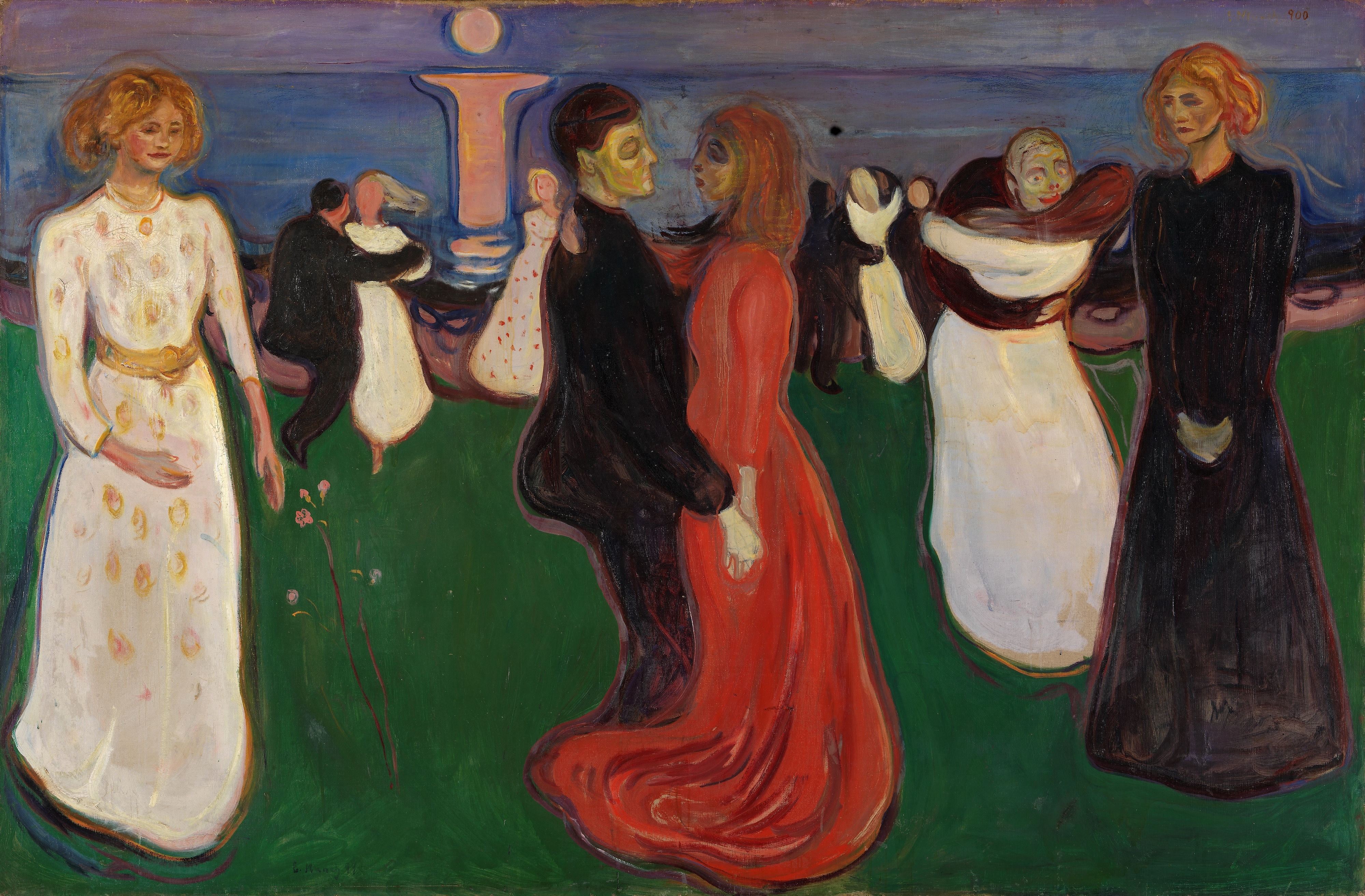
Edvard Munch, The Dance of Life, 1899


I resigned from my teaching job.

The confusion and anxiety were too much. I could not get there without massive support getting ready and out the door, where I would walk the short distance to work. Bad weather felt like a tsunami. I would have had to be responsible for their young lives. I couldn’t risk that.

As far as the quality of my teaching last term, the students were not receptive to my dour mood and ineptness, which I laboriously tried to cover up. My insecurity and fear were activated every time I tried to teach a class. I could not remember names of students. I could not remember names of colleagues I had known for decades. I could not remember content. I had trouble handling the art materials, and grew an aversion to clay.  Somehow I did it for a full year. I had an assistant who now will likely go after the job. I have to learn to accept this. My ability to be a regular contributing member of society as a teacher, is gone.

This is the time when the announcement is heard over the intercom of the airplane. We are about to make our descent. Fasten your seat belt, it’s going to be a rocky ride down.

Grief. More grief. Inconsolable grief. I am sick of it. Sick of dying in this way. I am no longer living a life worth living. The mountain of losses is mounting. A person can only take so much.

The great late actor, Paul Newman said ““Bette Davis said it best of all: ‘Getting’ old ain’t for sissies,’ “ he said eventually. “I mean—suppose, to do it right, it ain’t for sissies.”

https://i0.wp.com/weheartvintage.co/wp-content/uploads/2012/06/4547437970_72f02896d3_b.jpg

I am not doing it right. I’ve turned from a brave and tough lady into a sissie!

You are not interested to know that I can still boil water in the kettle and make tea. I can do dishes.  My life is reduced to a list of what I still can do, which ain’t much. Paul Newman, I need some of that cool you had. I have become very uncool in this disease.

Where has my courage gone? I do think of The Wizard of OZ and the Scarecrow who only needs a brain, the cowardly lion who needs courage, the tin man who’s heart is rusted and needs a new heart. I need courage to face this disease, I need a better brain, I need a heart to care about others and show it.  I am sick of myself and my rants, and so are you.

What you want is a story like that of Aron Ralston, a man who lost his arm mountain climbing in Utah, when a boulder fell on it and he had to cut off the limb with his pen knife, after laying pinned down for five days with only a bottle of water.

https://suddenlymad.com/wp-content/uploads/2017/08/82e49-ralston_2.jpg

People love the triumphant spirit, carry on in greatness and ecstasy, despite pain and agony.  The romance of daring. Not this. Not Alzheimer’s. Not me in Alzheimer’s and how it has affected me. I have so little of that. It’s triumph to get dressed. There is no cutting away a part to get free. There are no prosthetic brain parts to replace or repair what has been damaged.


I identified with the homeless man I saw today, sleeping inside the empty store front by the door on the main street. With a failing appetite, I have likely eaten less than he has today. I live in a house where my husband keeps me fed and provides me with shelter and food. This was the house in which I was a normal energetic mom, a teacher, and artist, a filmmaker and a friend. Now there is none of that. No job, no social life, no cure.

That poor homeless man who was laying there amidst debris, is not loved. He is simply a sad case. With Alzheimer’s that is the metaphorical me – sad case – turn the page.

I will never be famous, and I will not be remembered for much, despite how hard I worked and how much I loved and how very creative I was. I will be forgotten. many are called but few are chosen.

My family will go on without me. A hole in their lives for a time, and then a healing. They will enjoy a future I will not be privy to. My young daughter won’t have her mom there when she starts a family of her own, if she chooses to do that. I won’t see my little granddaughter, the offspring of my first born, my son, grow up. I won’t be here, and chances are I won’t be fully here for a good long time before I die. The late stages of the disease are the eraser of everything and everyone.

So I write furiously. Not the brilliance of a great writer, I know that, but this is a chronicle of what is happening to me. I have lost my career, and I am increasingly facing a life without meaning. I do not want this life. Whatever meaning my life has, I am aware of how marginalized I am now. The powers that be (therapist, neurologist, cognitive remediation counselor) all tell me not to broadcast that I have Alzheimer’s. My husband is a loner and very private. He does not want me to tell people.

Alzheimer’s makes a person crazy, and those who do lose their minds this way, go in pieces. First the short term memory and then the long term memory goes. walking gets harder. Thinking and reasoning is a thing of the past. My brain is a computer with a dying battery and loss of memory. There are sometimes good days. Passable days and a reprieve from the torturous losses and impairments. They are few and far between.

The most dreaded disease of all. I am losing my mind and aware of what is happening and I am not supposed to tell people I have it.

While I thought an Alzheimer’s support group would save the day, offering me friends with the diagnosis, and a way to be able to travel alone to New York, I see that there absolutely no one who can save me.  The anticipation to meet others with the disease has been eclipsed by the reality that each person who has dementia, of one type or another, is different, and hey, each are dying too. These peaple range in age from their forties to late seventies. The personality we each have is affected differently. Some become dotty and lost. Some find a way to keep pushing and exercise and make a good routine that works. The famous ones like Pat Summit are dead. Greg O’brien is able to write beautifully and fights the disease that way.  Some just fade away. Some run after their caregiver spouses with weapons. No two people experience the symptoms of the disease in the same way. One lovely woman in the Zoom chat support group is a famous food writer. She’s 79 and has a full life. She’s not a whiner or complainer. She does yoga and Qui Gong and carries on. She practices a ketogenic diet. She told me to find a publisher and write a book. She is a beacon in the darkness. She laughs.

I have lost everything now. My teaching job, my career, the love of my husband, the respect of my children, many of my friends. The very word Alzheimer’s breathes terror into them and they run away. I guess I did not choose the right friends. Or maybe it is that I was not a very good friend. OR maybe it is that people are crappy and they are afraid. I choose to believe the latter. People are afraid.

If it were ancient Japan, I would be compelled to commit Hara- kiri.

Hara-kiri is a ritualized form of suicide with roots in 12th century Japanese samurai warrior culture. Rather than be captured, a defeated swordsman would stab himself in the left belly, draw the blade to the right, then pull upwards. Encyclopedia Britannica adds that “it was considered exemplary form to stab again below the chest and press downward across the first cut, and then to pierce one’s throat.” Obviously, bleeding to death from a gut wound or suffocating from a throat wound is a slow and miserable way to die. As practiced by defeated samurai, it was meant as atonement. It also demonstrated enormous psychological courage, which was a way of winning back some measure of honor even in defeat.

I would at least be able to die with honor. There is NOTHING honorable and dignified about dying from and with an atrophied brain.

I live in a community that I’ve lived in for 40 years. I was respected. Now I hang my head and go down the side streets. Even that is a triumph over sitting in a chair in my house for 10 hours or more a day.  I am no longer proud but I’m here despite that.

The photograph of the New York skyline is near my location. Zero in on me. Use your navigator. I used to be funny and had an edge. I am boring now. Tell me that if that’s what you feel. Be honest with me.

experience of going throguhnyc view minnahow not to be sadHe still takes care of me, but with great resentment. He screamed yesterday, “I am glad I am going to work tomorrow so that I can get away from you”.  The man I married, and devoted my whole life to…the man with whom I bore two beautiful children- a handsome and talented son, and a beautiful and talented daughter, and tried my best to create a good life for them and with them–that man, my husband who screamed yesterday,  I am not your husband anymore, my caregiver, hates me and will be free only when I am dead (or in a nursing home, whichever comes first).

My daughter says I am dark and mean.  How can a person gets as sick as I have become, and be hated by the very people needed to love and care for them?

My daughter does not reach out to me and try to console me with a call:

Hi Mama, how are you doing today? Are you making sure to walk around so you remember how to walk? Are you drinking water and eating so you don’t lose too much weight and become dehydrated? Are you lonely, mama? You must be very lonely, I know that your friends have turned their backs on you and that very few people care now.  I am calling you to cheer you up and tell you some stories about what I have been doing. I love you mama, and as long as you are around, I will honor you and cherish you.

Fat chance of that sentiment happening.

I  walked into the school and told the director that I am undergoing neurological tests and my doctor says it’s too stressful for me to work.

I myself had to make the decision to resign from my twenty year career. I feared for the students and feared for myself. I worked with humans, not a computer only as is the case with so many afflicted with younger onset. I could no longer do the work of teaching young students, because of the impairments. I could no longer get up and be ready to go and have what I need to function with me. I can not function as a teacher five days a week, with a diminished brain and hyper excitable, partially atrophied brain.

A man I met told me that the numbers of Alzheimer’s and other dementias are increasing because the prions that cause these diseases are in the water and environment. He thinks the disease is contagious. Maybe it is and eventually this weeding out of humanity will eliminate those of us who carry the gene.

In the meantime, I still wake up every day, and do not know how to live my life. I get confused about what to do first. I go on and on with writing, saying nothing, because it is nothing that is replacing the stuff between my ears.

Rinse and repeat. This torture has got to stop. I quit my job to protect myself and the students. I miss the room I taught in. I miss seeing my colleagues. I miss the vibrancy of life.

Squirrels and a Wassily chair

Squirrels

I was sitting in one of the Wassily chairs. The squirrels appeared suddenly against the summer sky.

2 frisky teenage squirrels about to make a 3rd.

I was on the phone with my husband. He goes to work in another state on Tuesday, Wednesday and Thursday, and we stay in touch by phone and texting. He is here from Friday through Monday, and that too has not been a piece of cake. Our relationship has been tested to the max. I’m not really a partner any longer. I realize that. I’m his wife still, but I have  Alzheimer’s and my neuropsychiatric symptoms are more than either of us can handle.

My dear husband has become a care partner and is stressed to the max with the relentlessness of it. He has so much to do to care for me, and he doesn’t want this responsibility. He is not a wife. He is a husband who wants to lie down and rest when he comes home. Instead he cooks and prepares food for me for the next day when he won’t be here and is at work. I am grateful. I must be even more grateful. I’ve lost many of my ADL’s (activities of daily living), and the ability to cook or follow a recipe is one of them. I do not go food shopping alone except for one or two times in which I bought 3 items, one of which was flowers. Supermarkets with bright lights and their cacophony of sounds, are now too much for me to be in, particularly if I’m alone. I can write, but I can’t cook or follow a recipe. That is how weird this disease is.

There is an observer inside me who is seeing how this is happening to me. Seeing how I can’t sequence and order my thoughts and actions. How I forget what I am doing and go from one thing to the next, leaving a trail of incompleted tasks. I also see the regression, the outbursts, the panic and anxiety. As a result of this horrible disease, I cannot be an independent adult in this world any longer. I am aware of it. I have been watching the process unfold.

Writing this blog is a discipline to help fight this predatory brain disease. As long as I can post here, I am still here.

Two weeks have passed since I took the photo of the squirrels, and I am still parked here writing this post. I do not have much oomph as they call it. My prana is dissipating.  My husband and daughter and just about everyone says it’s depression. If only it were that simple. At this point, it’s a changed brain I am living with. The master of my body is my brain, and mine is disappearing. Wild mood swings, panic, anger, mournful grieving and yes, depression, are all part of this.

%%%%%%%%%%%%%%%%%%%%%%%%%%%%%%%%%%%%%

Composition with Squirrels.

Anyway, it’s neat that even in my condition, which is relatively progressed in the having lost her mind department, I could still have a modicum of fun by myself. Since I am sadly left to dement alone, no buddies around to share good times any longer, I have to find ways to amuse myself.

Finally, I had to move out of the Wassily chair with its 70 degree angle. Day after day, I sat and it was killing my back and causing cramps and spasms at the tops of my thighs.

It’s not laziness I am told by the expert with the joyful name. It’s a product of having this disease, she says. MCI and early Alzheimer’s make me sit. This is a bi-product of the way that the disease is affecting me.

My life is irrevocably changed.  It doesn’t feel like a life now. I am home alone most of the time. I sit a lot. I play cognitive games on my iPhone to help me focus. I play them for hours like an addicted adolescent. I am extremely lonely during the day when my husband is not here. I am also extremely lonely when he is here asleep. I am extremely lonely in this disease. I have lost most of my friends.  All of my relationships have changed since I began losing my mind. The relationship with my adult kids is forever altered by what has happened to me and how I have behaved since the symptoms began.

I know this now. I did not see it then, not at the beginning, but I now understand that my behaviors have been insane. I look back and retrieve memories from the progression of this. The initial depression that was more intense than ever before, the unravelling anxiety, that would not quit. The behaviors followed the moods. The impairments arrived later.  I’m two years into the symptoms.

They say if you’ve met one person with Alzheimer’s, you’ve met one person with Alzheimer’s. But have I become my mother at a much younger age. Helpless, dependent, insane?

She did not have younger onset Alzheimer’s, but was never really diagnosed. She died in 2001 two weeks before 9/11. Alzheimer’s was not a word we used to describe her behaviors. She was crazy and she got crazier and meaner as time went on. Late in the process, I heard her call my father by her deceased cousin’s name. I knew she was in her own world, but confusion came late in her dementia.

She used to say in Yiddish, “der zelba, der zelba”, which translates into the same,  the same. Everything was the same, she never went anywhere. No wonder it all seemed the same and she was depressed. She was bored. Boredom can lead to depression. She was in a bad relationship with a man who she was dependent on to care for her. Her life was empty. She hardly read. She survived Hitler and Stalin. She had few social skills and after the move to Florida from New York City, and she really didn’t have friends. In her late 70’s and early 80’s, she would get up at in the middle of the night and pace and talk and talk, while everyone was trying to sleep. Who was she talking to? I had to hold my ears to block out the sound to get any rest.

The rich inner world of her dream life was one thing I did love about her. The seer. That made me feel her depth.

In the end she was a fragile old lady with dementia, and she did not have a chance once they started the Haldol. The Haldol pushed her into the far edge of late stage. She became a vegetable I would say, but she was still in there I know now. One time I brought my daughter to Florida and we visited her at the hospital together. My daughter was about 8 years old then. My mother had not uttered a word for months, but she called out my daughter’s name when she saw her. She was in late stage for over 2 years. Then she contracted pneumonia, and that was that. It was horrible. It was extraordinarily horrible. I suspect now that she was in what one would call very late stage Alzheimer’s.

A woman I met last year in California, told me about her own mother who had Alzheimer’s. How she was crazy as a beezle bug, and never slept at night. I seem to be following in those kind of footsteps. She said her mother would stand in a doorway all night yapping. I am on my computer for much of the night, trying to make sense out of what is happening to me.

I am progressing.  I am aware of, and see the thing unfold. It’s  a monster in my brain, shrinking my ability to negotiate with the world.

**********************************************************

My life is irrevocably changed.

I am home alone. I play cognitive games on my iPhone. I have no discipline. No routine schedule. My appetite and sleep are deranged. I am hungry late at night but not during the day. I get tired, but not so much as to actually go to bed until well past 1 am. Sometimes as late as 3 am or later.

I am dementing and I am watching myself disappear.

https://i0.wp.com/www.daniellaondesign.com/uploads/7/3/9/7/7397659/8470919_orig.jpg


A Summer Day in Alzland

Today was supposed to be different. We were going to go to a nature preserve to do some hiking.

It didn’t happen.

My husband made breakfast but I wasn’t hungry. It was already afternoon. I ate some of the cut fruit, and went to sit and play the games. I have an addiction to the games.  I have an addictive brain, what is left of it.

I played Trains of Thought, a few dozen times. My brain got locked in the repetitive challenge on the screen.  After all, the neurologist recommended Lumosity. Helps cognition. Of course, he did not envision me sitting, playing these games non-stop for three hours.

Depression in Alz? Avolition, (a term my therapist uses)?

Behavioral alterations such as avolition, apathy, social withdrawal and emotional disengagement appear to be commonly found in patients suffering from Alzheimer’s disease. A consistent research finding is that negative symptoms in dementia cannot be solely accounted for by depression; they represent a separate symptomatic cluster.

This is from PubMed.

It is what it is. A separate symptomatic cluster.

We ended up going for a hike up the hill, and then D-O-W-N the steep wooden steps to the waterfront. We walked along the straight then curving drive, with cars whizzing by.  We peered into the cave, that punctuates the walk. It was a spot of high amusement with a natural spring , where visitors would gather for a glass of the elixir in the 1830’s.  Later it was the site of an unsolved murder mystery.

cave 2


Harlequin calms the agitation that plagues me early in the day. My daughter says it’s medicine. My husband says it makes me less OCD.  My email friend, who has the diagnosis too, and who has been experimenting with CBD oil and Purple Kush, asked why I ration it so, if it helps. So I let myself smoke it.

It has inspired me to start drawing again.

A self-portrait in early Alzheimer's

A self-portrait in early Alzheimer’s.


Early in my art studies, I was inspired by the great Ed Ruscha. He is very good at finding just the right words and detaching them from their context. They take on a more potent meaning on their own.

https://i0.wp.com/happyhotelier.com/wp-content/uploads/Tool-and-Die-Ed-Ruscha-2005-Biennial-Venic-IMG_0464.jpg

This one says it all. Plus my late father was a tool and die maker, so this image has a double meaning for me.


drawing 2

Another self portrait. I dedicate it in homage to Auguste Dieter, the first patient diagnosed with Alzheimer’s. Dr. Alzheimer locked her in an isolation room for a while. When he released her, she would run out screaming, “I will not be cut. I do not cut myself”. She was frightened, obviously.

I am looking for a path, a way to not be so afraid. A way to not be so alone. A way to go on living. A way to be with myself. To find meaning in and solace in the rhythm of life. I’ve lost contact with most people I knew. I have been rejected by many. Friends have closed the door. There is no way back to them. I will walk alone.

I was one person before I got sick, and I am fully another one now. The clothes fit the same. The people I see are the same. But I am different. I have dementia, Alzheimer’s type and there is no going back.

I’m looking for inspiration. A thread to a better day. To adapt to whatever I need to adapt to in order to go on living. I was an artist. A creative thinker. How to become a creative thinker again? I want to make sense, but I don’t. I am meandering. It’s not a straight course. I struggle now to find the words to express what I am going through. There is -Isolation. Depression. Loneliness.

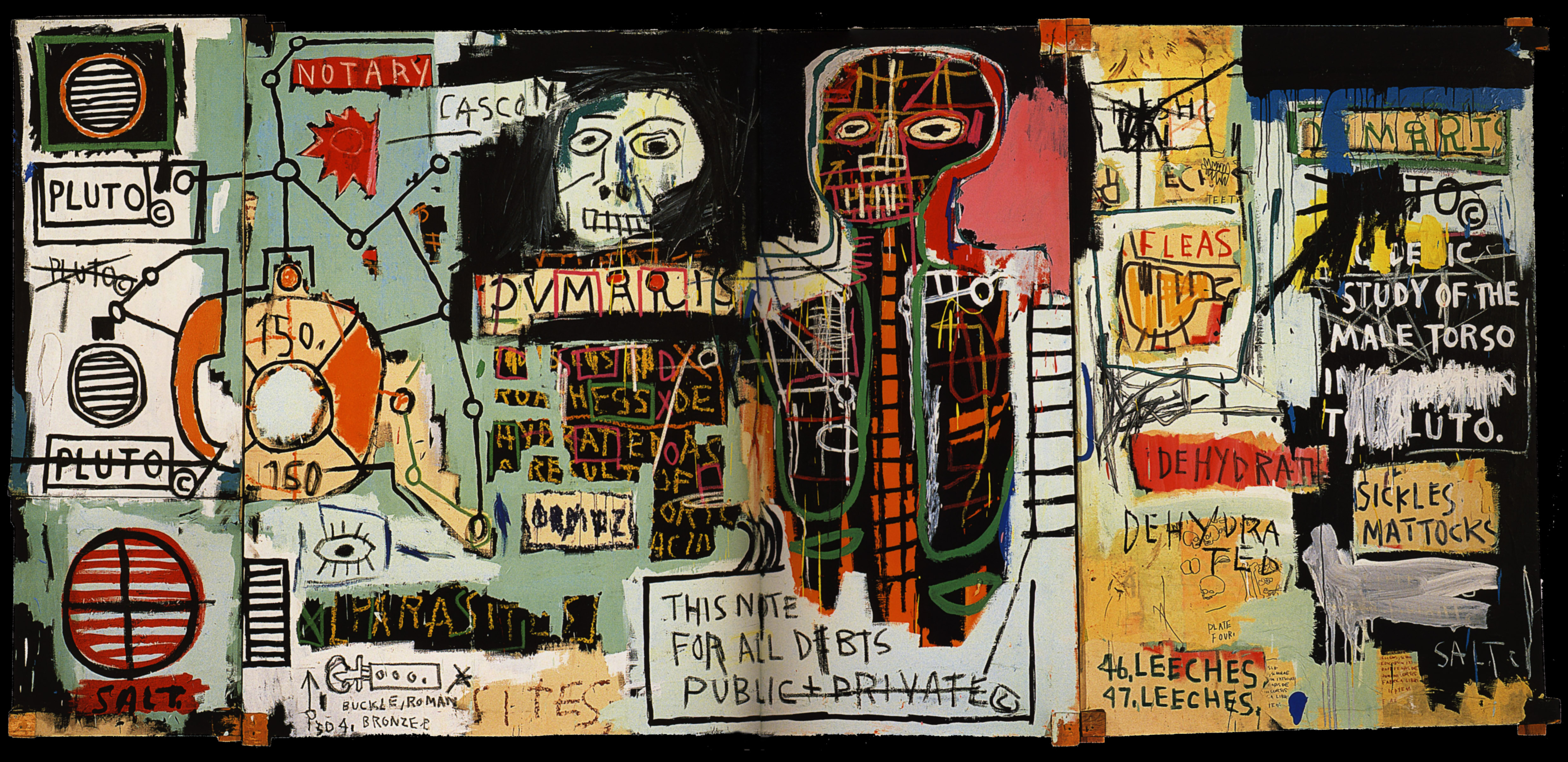
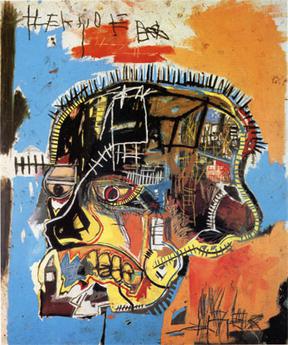
I look to the paintings of Jean Michel Basquiat, the artist who died of a heroine overdose at the age of 27. There is such immediacy in his work. His Skull painting fetched over 110 million dollars at auction after his death. Dead at the infamous age of 27, like Janis Joplin, Jim Morrison and Amy Winehouse. He must have been laughing at death. Or growling at it.

I am still inspired by his paintings. I am just a nobody now, but I can still look at art and get it. He was fierce.

https://uploads6.wikiart.org/images/jean-michel-basquiat/notary.jpg

https://upload.wikimedia.org/wikipedia/en/e/e1/Untitled_acrylic_and_mixed_media_on_canvas_by_--Jean-Michel_Basquiat--%2C_1984.jpg


I am now one of 200,000 or so diagnosed under age 65. A notch in the statistic of early onset. I will likely be here tomorrow. I will graciously accept the gift of whatever life I have left.

drawing 1This is a drawing I made of my daughter two days ago as we sat in the garden. I am grateful she visits me.


cave

The cave I find myself in- I’m alone with this but-

Fortunately there are blogs and writing by those with early stage Alzheimer’s. I read these blogs voraciously  and find new ones, and books by people living with the disease.  These trail blazers show me the way, when I get so lost in myself. When hopelessness is all I can see.

I may not make sense as they do. My style of communication, my writing, may be unclear and not offer the resolve and clarity of many who are saner than me. But I am going to try and convey what it is that I am going through, anyway. I will write, draw, and take photos. As long as I can.

We are all going home. My life has changed. I can not do and be who I was. But while I am here, I am still on the journey.

door


Homeward.

sky