Earth Angels

Angel for Susan - full frame - Minna PackerThis post is dedicated to Susan Suchan who died at 4:30 am last Sunday, January 14 and Thomas DeBaggio who died eleven years after being diagnosed with early onset Alzheimer’s in 2011.

I completed this drawing a few hours before Susan died. Born in 1957, Susan had been diagnosed with early onset Alzheimer’s, around ten years ago, then was re-diagnosed with Fronto Temporal Dementia, and Progressive Primary Aphasia. She was a beautiful red head with a broad smile, and possessed an urgency to communicate her wit and intelligence, despite the aphasia that fragmented her speech. When I met her online, I told her about my depression. She explained that for her, depression was a cloak, a heavy cloak, she would remove consciously. She always aimed to find a way to live positively and with dignity. I am grateful for her gifted writings which contain a salient wisdom about what it means to live with neurodegenerative disease. She advocated for people with dementia all over the planet, showing with great determination that she could still enjoy life, and have meaningful loving relationships with friends and family. She shared her tools for living, smiled, laughed, and touched many with her insight, her humor and grit. May her memory be a blessing.

This is the link to her powerful blog  https://susansuchan.wordpress.com

__________________________________________________________________________________________

I am reading Losing My Mind, by Thomas DeBaggio, who was diagnosed with early Alzheimer’s at age 57 and died after a 12 year battle with the disease. He wanted to bravely display what Alzheimer’s does to a person as it ravages the brain. In the early stage right after his diagnosis he wrote two books, Losing My Mind and When It Gets Dark: An Enlightened Reflection on Life with Alzheimer’s. He wrote about his life with his wife, and recounts memories of his life intermixed with the shock and despair as he manages to think, function and survive through the early stages. Today I read a page where he describes going to the grocery store and being upset when he came home that a chair was moved. I can relate!  A renowned herbalist, he had authored many books on gardening, among them; The Encyclopedia of Herbs; Basil an Herb Lover’s Guide. He took his battle with Alzheimer’s to the world to show people what the experience of this vulture of a disease does to a person. In the later stage, he lost the ability to speak, feed  himself, or use his hands, or legs. His devoted wife took care of him for the first ten years, but then was overwhelmed and placed him in a nursing home the last two years of his life.

NPR (National Public Radio) recorded him and his family over the course of the his disease.

The last visit they made began with a question to his wife Joyce: “Would he want us to see him?”

“I know that’s what he wanted,” Joyce says. “Till the very end, he wants for people to know. We just discussed it endlessly. He wanted to throw it in people’s faces basically, this is Alzheimer’s.”

https://www.npr.org/templates/story/story.php?storyId=127857149

____________________________________________________________________________________________


The Naked Truth


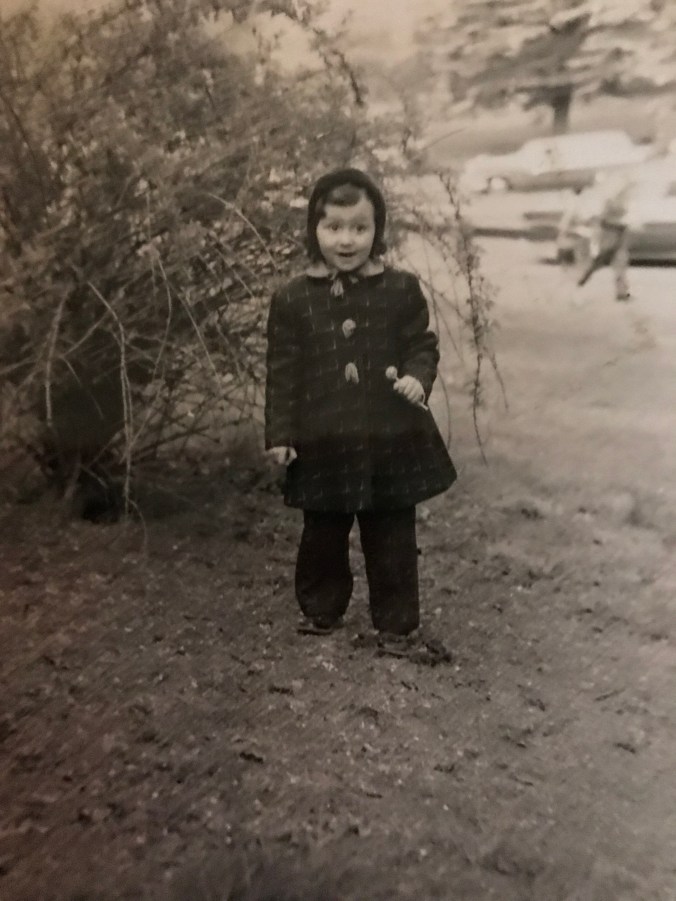
Suddenly Mad Three Years photo

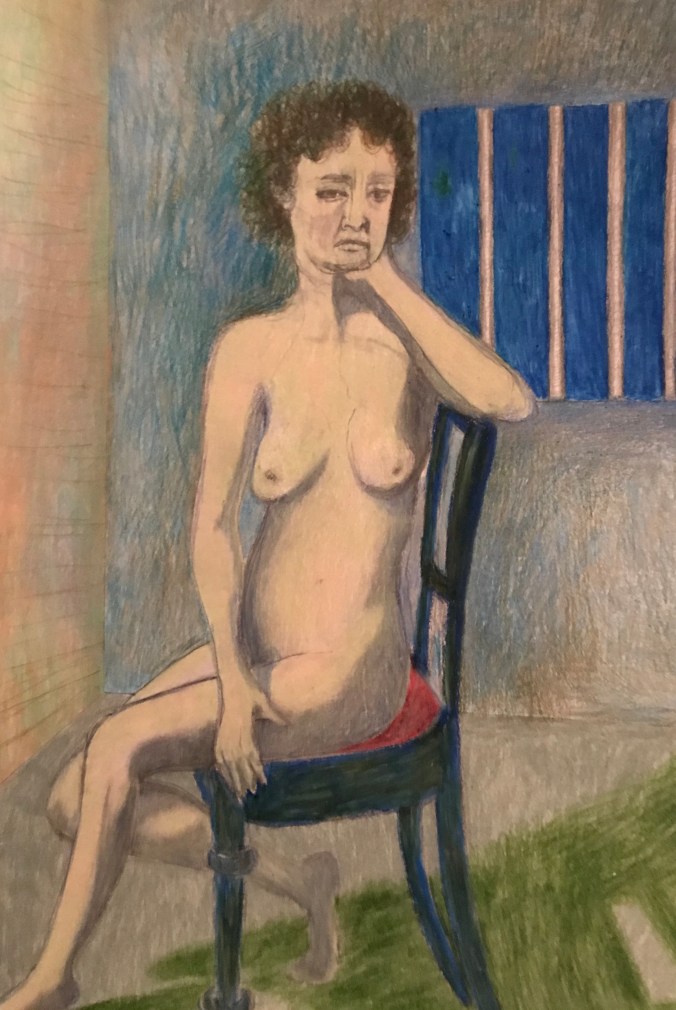
Suddenly Mad Self Portrait (Depression) 1:1:2018Two images. Past. Present.

One an old photograph 1957 or 1958.  I’m around 3 or 4 years old.

The other a self portrait. My last drawing.

Innocence.

Depression. Imprisonment.

“It is hopelessness even more than pain that crushes the soul.”
― William StyronDarkness Visible: A Memoir of Madness


Writing cohesively is getting harder to do. I go back and forth, deleting what I have just written. I started this post days ago.

Every day I have tried to continue, but get stuck and can’t go on.

When I return to write, I find I can’t complete the thought, and go off on tangents.

If I didn’t have Alzheimer’s I would call it writer’s block.

Enough, I say and close the computer, and tell myself I will come back and complete this the next day. The next day and the next day, the same thing happens.

_________________________________________________________________________________________

Here are the fragments from the last few days.

It’s likely too personal and without a filter.

Unresolved sagas about my mother, my father, my sister… It makes me think that those who have a contented dementia, must have been loved as a child, must have felt loved. I did not feel loved and was not nurtured by hands of gentleness. I defended against being honest with myself about these feelings for years. My parents were Holocaust survivors, I would tell myself. Forgive them. Their experiences made them crazy.  I am now confronting the emptiness that they left me with, and yet missing them because there is no way to resolve any of it.

Yes they were survivors of the Holocaust, and I do blame Hitler for the people they became, but I was their child, and did not deserve to be tormented in the wake of their nightmare.

My mother 

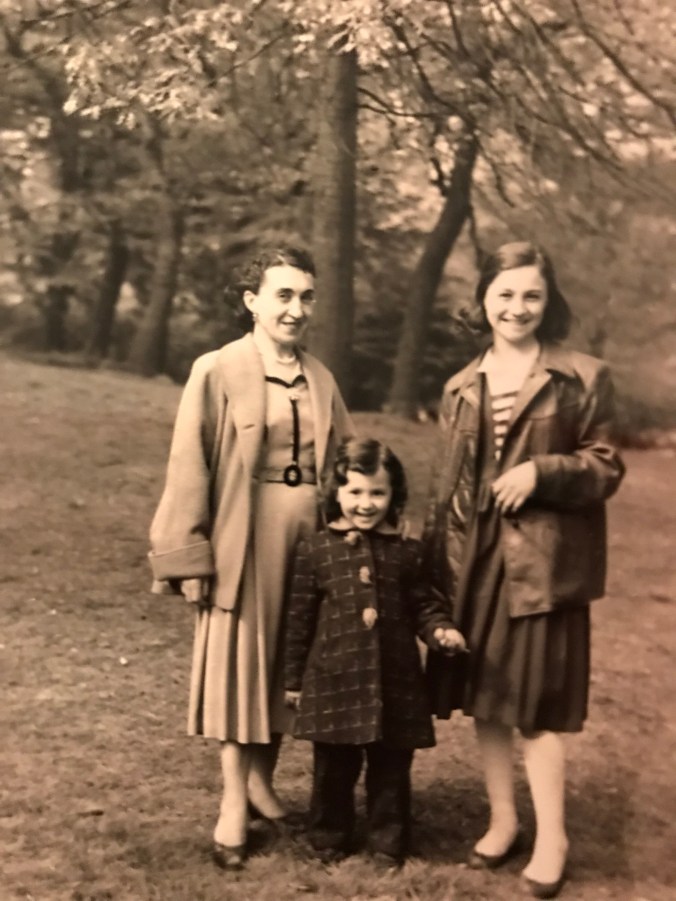
The photo of me as a 3 or 4 year old has my sister’s name on the back. It was obviously me, but my mother wrote my sister’s name on the back. I know it’s me because the photo below shows the three of us together in a park near our apartment in the Bronx. It was taken before everything fell apart. Years before her mind started to erode.

Suddenly Mad- photo with Lillian, me and Sonia

How can a photo contrast so sharply to what I remember, to what it felt like? The three of us look so happy.

By the time I was the age my sister was in this photo, around 12 years old, my late mother was severely depressed. My sister was seven years older than me. I realize now that my mother only had the capacity to love one child, and that was my sister. She was the beautiful one, and for my parents she represented life reborn after all the loss and insanity of losing their families in the Shoah. She was born in 1947 in Germany after the war. A premie, she had a rough start, but by the time she was two years old she was a ruddy cheeked strong toddler. My mother nurtured her. She was loved and adored by my parents, truly cherished. They made the journey to the US by ship when she was five years old, and settled in New York City, aided by HIAS an organization which resettled and aided the displaced Jews who were able to get here.

I was born in New York in 1954. My mother told me that when my father visited the hospital, he said, “Oh no, not another girl”.

My father adored my sister. She was the beautiful one. Instead of taking my mother to bar mitzvah’s and weddings, he brought my sister with him to show her off, and left my mother at home with me. Rather than bond with me, she withdrew into her own world.

Growing up, I knew to leave her alone. Depressed people can not give of themselves. Silence is what my mother craved. Silence and her bed. I was privy to her behavior the most, because my dad was at work, and my sister was already out of high school, taking college courses, working as a secretary and rarely home.

My mother would race around cleaning, prepare the evening meal, and then retire to her bed in broad daylight. She settled into a powerful silence. She actively ignored me. She didn’t respond to my attempts at conversation, my questions, my pathetic efforts to amuse her, to cheer her up. It was as if I didn’t exist, even when I was in the same room. I hated her neglect.

My father had a small manufacturing business. He ordered machine parts from Germany that knitted plastic and curled copper and brass pot cleaners. My mother worked in “the shop” that was my father’s side line. His “day” job as a machinist was supplemented by this manufacturing business. On weekdays my mother ran the machines.

It was a dirty noisy place. She probably didn’t think I should be there. But I didn’t know this then. So much of the time I didn’t know where she was.

At age five, I was often alone in the hall entry to our building on Walton Avenue eating Turkish Taffy. I became addicted to candy. My favorite thing to do was to go to the corner candy store.  I would buy taffy, gum, Jujubes, cherry slices, Bazooka gum (with Bazooka Joe  comics inside), hot tamales, watermelon slices, tootsie rolls. Candy cost a penny then, 2 cents, five cents and a dime. She doled out the change to me from her little change purse with little metal clasps. No wonder I had tons of cavities as a child. She would take me to Dr. Topperman, who filled the drilled cavities with mercury fillings.

Today there are conflicting reports that the mercury in amalgam fillings may contribute to developing Alzheimer’s. Mercury is toxic to the brain.

It’s sad to think that eating so much candy was my way of filling the emotional vacuum of feeling like an unwanted child.

_____________________________________________________________________________________

My parents moved to Florida when I was 17 and I went in the opposite direction to study art in Canada. I was ill prepared for life on my own, and college in another country, but my father who lived to the ripe old age of 90, had had a heart attack at 53, and he and my mother were intent on taking care of themselves. My sister, was by that time married and starting a family of her own. Armed with a student loan and $100 a month that my father sent me, I survived. This was 57 years ago.

___________________________________________________________________________________

By 1990, my parents had made a move from Miami Beach to Hallandale, Florida. She was disoriented. This new area, a block from a strip mall was isolating. She spent all day in her housecoat, shuffling around inside the apartment and clinging to my father. A few years later my father hired an older divorced woman, Dorothy, to be her companion. After Dorothy, who chain smoked Virginia Slims, suddenly died, my mother hardly got out of bed. My father sat in the living room, watching the stock market readings on the television as she lay in bed all day. At night, she would get up after he went to sleep, and would pace around the living room, railing about him. He snored through it. By that time, I flew to Florida every two months, took them to doctors, arranged for Jewish family services to provide social workers to visit them. She continued to decline, and became incontinent. A hospital bed replaced the matching twin bed.

She died at age 87, after doses of Haldol prescribed by a psychiatrist, purportedly to give her a better appetite, caused a stroke. It happened when she was in the hospital rehab, just released from the hospital where she had been admitted with dehydration. I was standing by her bedside. She had just taken a walk in the corridor, and was smiling and talking to a nurse. She got back into the bed and the nurse came over and administered a large dose of Haldol. Within seconds her mind was gone. I sat with her as the ambulance rushed her into the adjacent hospital and I frantically pushed the stretcher to the ER, where she was readmitted. For the next two years she had to be fed by spoon with pureed food mixed with Reglan to increase her appetite. She had to be turned in bed to avoid bed sores, which happened anyway, as her immune system broke down. She never walked, talked or moved her body by herself again. But she did utter one word when I brought my then 8 year old daughter to visit her. She opened her eyes, and called out my daughter’s name.

____________________________________________________________________________________

Depression has been shown to be toxic to the hippocampus, making it shrink, and today there are studies that link depression to the onset of Alzheimers.  Mine was an extremely depressed and highly anxious mother. I in turn suffered from depression, experiencing the first overt signs of it as a teenager. After I married I was happily free of it’s dark cloak for a long time. I was too busy to be depressed. I held jobs in the art world, then graduate school, gave birth to my son, ran a contemporary art gallery in New York, then gave birth of my daughter.

By the time I was forty three, I crashed. Deep unrelenting depression. The psychiatrist who I believed to be an expert in his field, a doctor and professor at Cornell Weill, prescribed large doses of SSRI’s and SNRI’s along with benzodiazepines. I believed that the psychiatric drugs would make me well and I  trusted him. But the drugs made me at turns much more anxious and ultimately more depressed. The side effects were atrocious. I could not stay on them, and went on and off of them for the next fifteen years. Now that I have Alzheimer’s I have learned that antidepressant drug usage is associated with AD/dementia and this is particularly evident if usage begins before age 65.

https://www.ncbi.nlm.nih.gov/pmc/articles/PMC5347943/

I was also prescribed thyroid medications when I was deemed sub-clinically hypothyroid by a Functional Medicine M.D. who said it could help with depression. I was never truly hypothyroid, and have now read the research which links medication for hypothyroidism with hypo-metabolism of the brain.  Results of studies suggest that taking thyroid medication at baseline may be associated with a faster rate of DAT diagnosis.

https://www.ncbi.nlm.nih.gov/pmc/articles/PMC2820146/

I had loads of therapy. Primal therapy in my twenties, where I screamed and cried, and released chunks of embedded emotion. I laid on the couches of numerous Freudian, transactional, cognitive and humanist therapists. I could have bought another piece of real estate for the money I spent on therapy and psychiatrists and doctors.

__________________________________________________________________________________


If I had one tenth of the knowledge I have now about the risks for developing Alzheimer’s early in my life, I might not have gotten this horrible disease. I know I can analyze it until my face turns blue,  it’s not going to change a darned thing.

__________________________________________________________________________________


Wish I had a better sense of humor

I read on http://www.alzconnected.com about my email friend who has been diagnosed with probable Alzheimer’s is moving on with her life, making changes. She says her husband who is not the father of her grown children, is miserable with her, and she with him. He is not cut out to be a caregiver, she says. She lives in the great lakes region and now plans to go live with her ex-husband who is in California, and be near her daughter, who is helping her with the move.

Even with probable Alzheimer’s, she is able to change her life and move in a direction that brings newness and possibility. She claims that CBD oil is what saves her and allows her to be functional. It’s legal in her state. My daughter had been getting it for me, and I was taking it for a while, but there is no more now. This woman swears by the stuff. She says that without her dose of Rick Simpson oil before bed, and Charlottes Web CBD oil in the daytime, she would be a “porch sitting drooler in 3 days”.

I think it’s actually her soul, spirit and spunk that saves her. She’s funny (porch sitting drooler!!!) and even in the throes of a co-morbid recent near death illness, she has a sense of humor.  She has been on the forum for years, I see that she’s been posting since 2013, which means she was diagnosed 5-6 years ago. So I know that she has progressed slowly. I’m a fast progresser. This began for me around two years and eight months ago, starkly and suddenly.

Taking a shower

Getting from my bed to the robe and slipper socks that I leave on the chair, putting these on and going down the spiral stairs, over to the list that tells me what to do, which sits on the kitchen island (that I have written the night before to guide me through the next day) is the first hurdle of the day.

I took a shower. It was a big deal. I pushed myself and managed the steps of washing my hair with shampoo, rinsing, putting in conditioner, rinsing, washing my body parts with a washcloth and soap, dealing with the many strands of my curly hair falling out in the process, and curling around my fingers. Then the thought struck me, how the hell did I deal with all this before I got sick? How did I cope with this hair and what were likely the simple steps of taking a shower and getting dressed? How long did it take then? Was I freezing as I am now when I am wet and slow? Getting out of the shower, and putting a big towel around my head turban like, drying my body with the other large towel is a transition. Transitions are hard now. Task switching is hard.

Then I sat on the toilet seat and wept.

Finally, I pulled myself together, brushed my teeth, and dried my hair. I took each article of clothing off the hanger one by one, making sure the labels were in the back, and got dressed. Slow process, but each time I am able to do it, is a small triumph. I do it every day, but nevertheless it is a small triumph that it gets done. It means I can participate in my life. I can show up and not look like a stringy haired demented woman in a robe. Being able to get dressed is something that people do every day. Alzheimer’s which I picture eating up my brain like a Packman on steroids, is making this important activity of daily living, harder to do.

Suddenly Mad - hoto of me blurry and close up 1958

Out of focus

I am attempting here to assemble memory, analyze my experience, and connect the dots in my fragmenting sense of self. The more I reach for legibility, as for the flicker of a memory, the more it slips from my grasp.


You Can’t Buy a Friend

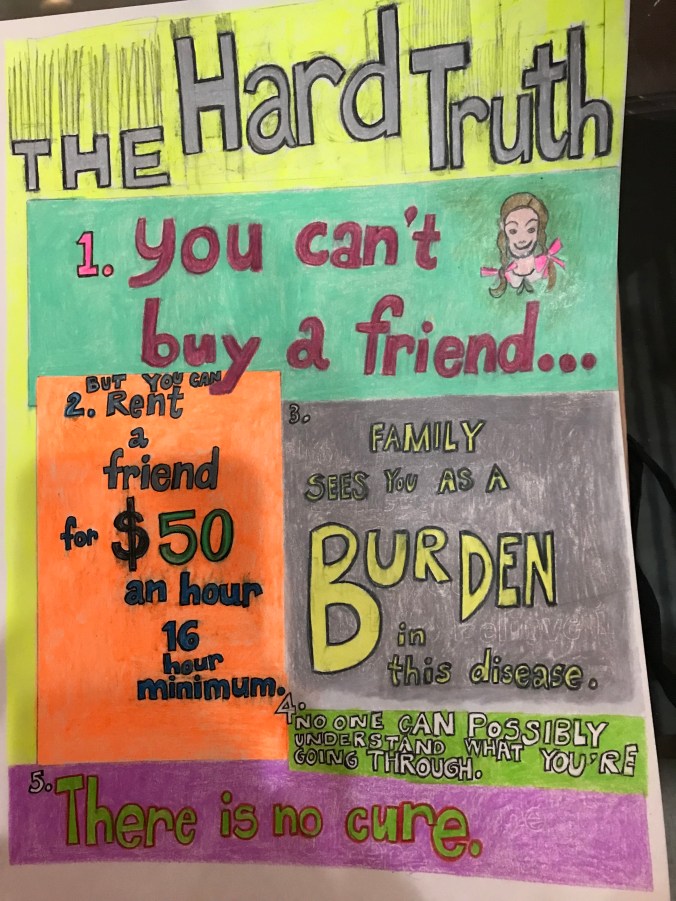
Suddenly Mad drawing The Hard Truth and You Can't Buy a FriendIt’s been a few weeks since I posted.

The drawing above illustrates the “hard truth” of what it feels like to lose the ability to fully take care of myself independently, the regression that comes with Alz, the ongoing need for companionship and assistance, the realization that no one can really understand what I’m going through, and that everything is economics.

I know I have progressed since the summer. My behaviors and speech are very peculiar. I hear myself speak and realize that I am dropping pronouns and sounding more aphasic. My sentences are clipped and I hear an alien voice come out when I speak. It’s like I have to push the words out to express myself. I often can’t find the words to describe things. I sound very nervous my husband tells me.  I often have terrible agitation, I pace, repeat, talk to myself and babble. It’s embarrassing, yet I can’t control this a lot of the time. My husband looks at me aghast. Yes, I am losing my mind, have lost my grip. Only when I sit here at the computer and am able to reflect and write about it, am I composed enough to see that these are the progressive symptoms of a disease of my brain. It’s not who I was. I never paced and babbled when I was well, for heavens sakes!

Anyway, I made this drawing after the young woman who was my companion quit, and the woman who was involved with my case, the cognitive remediation counselor, recommended I go on Caring Kind’s website and look for another home health aide/companion who has training with Alzheimer’s people and is trained in dementia care.

Here are some examples of what I found:

 I offer companion care services. I have a certificate with CPR, First Aid, and I recently took the 50 hours of Dementia  with CaringKind, I am very grateful with them. I have years of expirience also many recomendations.
I love to work with elders and I have many good memories with them. 

Fell free to contact me, I will be waiting.

Pardon me for finding fault, but this person can’t spell. Ever heard of spell check? I guess one can earn a certificate in CPR and First Aid, and not be able to spell or use spell check. It just makes me wonder who this person is and how they could be a suitable companion for the likes of me at this stage.

Here’s another-

 I have more than 1 years of job experience as Home Health aide. I would describe myself as Spiritually stable. I am responsible , i have received training for people with alzheimer and dementia…

Spiritually stable. That’s so interesting, but what does that mean? I’m actually very interested to meet someone who characterizes themselves as Spiritually stable. Clearly I am not that, and maybe she is a good navigator who can help me spiritually.

another…

My information is coming soon!

Well that’s not enough information, sorry, I will have to take a pass.

I DID FIND A WOMAN WHO SEEMED IDEAL-

Why I choose to work with people with Alzheimer’s. My mother in law was a brilliant and fun loving women who had Alzheimer’s. Helping my father-in-law to care for her led me to want to work with other’s who have Alzheimer’s and other forms of dementia. I started working full time as a companion in 2013. I don’t see a disease. I see a person. Perhaps their world is different than yours and mine. My job is to enrich their world by living with them in their world. One connection I found to be a powerful tool has been through photography. Through my years of being a companion I have found that it is the power of photography that remains a strong connection for a person with dementia and memory. My husband and I have a professional photography business. I use the power of personal photographs to create collages…

I thought- PERFECT- she will get me, I’m a creative person, an artist, or I was, and she will understand me and how devastating it is that I am suddenly unable to function as I did before. She’ll be able to accompany me to museums, and be a great companion. I wrote her an email and asked her to be in contact with my husband who now handles all the finances.

The next day he told me that she had emailed him and that she told him clearly she’s not a home health aide, but a companion, and that she charges $50 an hour. She said that  because I am not in Manhattan and she would have to travel to get here, she would require a 16 hour minimum for 2 days. I can still use the calculator on my iPhone and that shows it would cost $800 for her to spend 2 days with me per week.

I now collect Social Security Disability Insurance through the Compassionate Allowance Initiative for people who are under retirement age. On a monthly basis it’s not much more than this woman would make in two days. Yes, pitiful, but I was working as the chair of an art and art history department in a private school and these elite private schools are notorious for the lower salaries they pay for the privilege of working in a school with smaller classes and gifted students, so my SSDI is pretty low. This means my SSDI per month payment would pay for about 2 and 1/2 days of this woman’s fee.

So that companion is not going to happen for me, unfortunately, as perfect as she may be. It’s not affordable. She is deemed to be a companion for the ultra wealthy old folks who can afford her services.

Me – I’m going to have to be alone, or let my husband hire someone who may not be a suitable companion, culturally or cognitively. I don’t have any friends or relatives who are free to escort me to doctors appointments, museum programs for people with dementia, or even to go for walks. I am generally alone, except for one dear friend who visits every week, another woman from my synagogue who invites me to go with her to cultural programs there, or when my husband, who is exhausted and generally does not like to be in the same room with me, has the patience to take me out for a walk, or visit one of our children, which means he drives.

I’m cognitively impaired, but I’m not stupid. Without a hired companion, I won’t be able to go to museum programs for people with dementia, because there’s no one to take me, as I haven’t been able to travel by myself for the better part of two years.

Unless, I lower my standards. Maybe I can get someone who charges $20 and hour. Who will that be? Hopefully it will be someone who owns an iPhone and speaks English and can text.  I can text, and hopefully it can be someone who knows how to text. (I’m trying to be funny here, and point out the insane hilarity of where I am in this disease, able to text on an iPhone, able to type this post on my computer, but too cognitively challenged in terms of navigation, and confidence to be able to travel alone and get anywhere on time).

Why can’t I travel alone? Because I get agitated, disoriented, unable to gauge how long it takes to get to places on public transportation, and potentially I may get lost. I have a great deal of trouble being alone in crowds, noise is not filtered anymore and cars, voices and all sounds come at me simultaneously (I am imagining now my dementia mentor telling me to use noise reducing headphones. She is the expert at accommodations for people with dementia, but that would be dangerous to do in Manhattan when one has to cross very noisy and busy vehicular intersections, as well as deal with crowds safely- you have to be able to see and hear, and know where you’re going simultaneously to not get hit by cars). I may need to use a bathroom. Oy! People with Alzheimer’s don’t always have control over their you know what. I would hate to wet my pants in public because I couldn’t find a bathroom. Maybe I should get my husband to buy me Depends and bite the bullet. Maybe I should buy myself a memory bracelet with a navigational device so if I get lost, my husband can alert the authorities to find me and conduct a safe return. He will be in another state at work. I guess the authorities could hold me until he picks me up.

I am trying to funny, but it’s not funny.  I am not getting lost in my own home, yet, as you saw Julianne Moore as the character Alice got lost when she tried to find the bathroom in her beach house, if you saw the movie. But it happens to Alzheimer’s people. It’s part of forgetting, orientation and navigation.

I’m an educated woman in the early to moderate stages of a disease who is not just losing her mind, but is traumatized by all of the circumstances that began 2 and 1/2 years ago and have led to this point. How can I have changed so radically from being the confidant, friendly, globe trotting traveler I was, to someone who is fearful, anxious, socially awkward, and disoriented? Maybe I should use UBER or hire a dedicated driver to take me places. Driving Miss Daisy my husband calls it. Let’s see what would that cost (probably a hundred bucks or so round trip), and what happens when the Uber driver calls my phone as I wait for him at the museum entrance, and tells me to meet him at a distant corner because he can’t pull up in front of wherever I am located, where hopefully I was able to remember and tell him the correct address and street (?). I would need to find and identify his model of car and be able to identify myself. “I’m the woman with the gray coat and hood waving madly at the corner, do you see me?” If only it were that easy. It should be. It should be easy.

Perhaps you can’t comprehend the complexity of what I am describing and why it isn’t easy. Well picture this. I hadn’t been out of my house in 3 days, but did walk about 6 blocks today. That was something I could do.

It should be easy to do these things. Travel to Manhattan to a museum and back. It was so easy when I had friends, knew how to navigate, had tons of energy, and could be alone easily, or go anywhere myself.

It was all so easy.


Beginnings and endings, but life goes on…

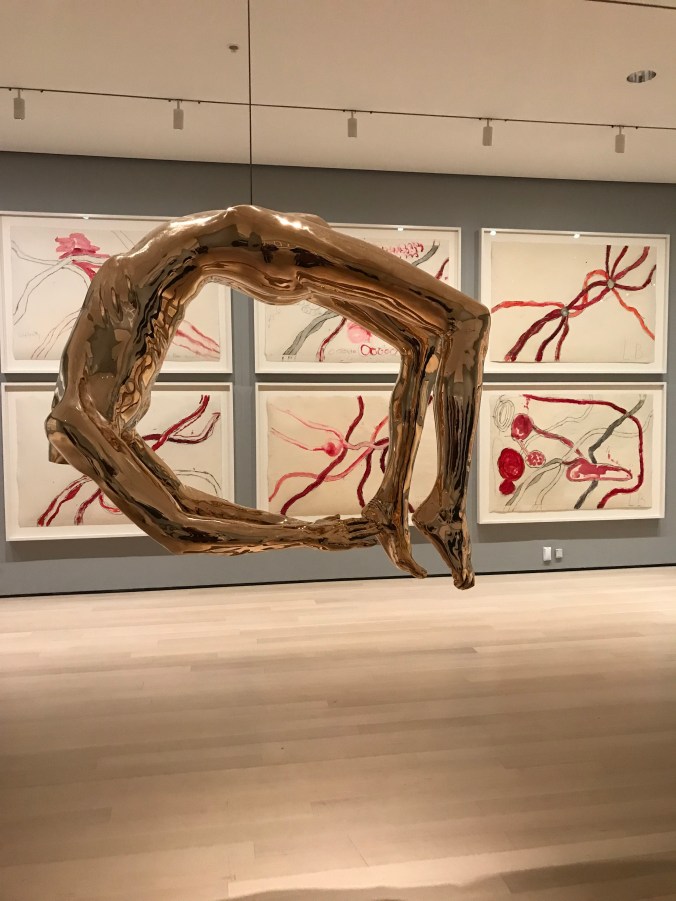
Suddenly Mad - Louise Bourgeois : Arch of Hysteria 1993Arch of Hysteria                                               1993                                      Louise Bourgeois

___________________________________________________________________________________________

Memory is so much a part of who we are. Without it we are always in the now, without an anchor for our existence.

Before too much time elapses, and I forget, I want to describe the things I have experienced over the course of the last days. A lot has happened, and today marked an ending to a source of support.

But first this will be about art….

I visited the Museum of Modern Art and The Rubin Museum of Art, attending programs for people with memory loss and dementia.

Last Friday, I attended the Mindfulness Connections program at The Rubin Museum, which is offered once a month. I traveled there in bitterly cold weather, with the young woman who was my part time companion (who told me today she doesn’t want to do this anymore). We met with others in the cafe on the ground floor of the museum. I spotted a woman sitting at the long table where we gather, who I had not seen before. She has early onset Alzheimer’s. She is 65, quite lovely, well groomed, and young looking for her age. She seemed cheerful, and I thought I had finally found someone like me that has Alzheimer’s early stage, that I could communicate with. Maybe this can become a friend, I thought. An email buddy, or someone I can speak with on the phone. How wrong I was. She was accompanied by her aide, who had a lilt to her Jamaican accent. I approached this woman and introduced myself. I read the name on her name tag. “Hello Marianne (not her real name)”, I said, and shook her hand. I asked her questions about herself, such as where she lived and does she use email, and does she use a computer. She said yes, she does. Her aide quickly interjected, shaking her head, that she was in middle stage Alzheimer’s, and said that she plays with things and looks at things, but that NO, she is not able to use a computer and has no access to email. I wondered if she could read. I asked her where she lives, and she mumbled an M sound, Mmmm…. I  asked “Manhattan?”, and she nodded and smiled. During the discussion about the artworks, she was not able to articulate very much at all about what she was looking at. We looked at a painting of a wrathful deity and I remembered seeing this same work during previous visits. I addressed the docent, saying something about how the prescribed methods of Buddhist art is so unlike contemporary art, where the artist determines the content of the work, displays a personal iconography and ideas, and how this, like all religious art, dictates a prescribed system of belief. I said I think that this is the same as in Christian art, and all art that is based on religious doctrine. I still know enough about art to know that sacred art involves the ritual and cultic practices and practical and operative aspects of the path of the spiritual realization within the artist’s religious tradition. There was a group of visiting advisors along for the tour. Junior dementia experts, I’ll call them. I sensed their surprise that someone diagnosed with this disease was able to comment perceptively about the artwork. I exceeded their expectations. How lonely this made me feel. Here I am terribly aware of how changed I am, articulate enough to find the words to describe my experience, but dependent on a companion to cart me around. Afraid to travel alone, aware that I have lapses and can end up stranded. I’m unable to gauge when to leave my home and be there on time myself, not able to simply be independent in the outside world. Regressed, angry, petulant, but  still able to think critically, and see the connections between disciplines. Suddenly Mad - Warthful DeityWrathful Deity – Yama

The questions posed by the docents included some one would ask a child in an art class, “what colors do you see” “How is the color of the figure in the center different from the others in the painting”? Marianne responded to the red in the image, agreeing that she was indeed seeing the color red. My frustration was mounting, as I saw once again, that I am at a stage where I’m aware of what’s happening to me, and grouped here with others who are further progressed. Who will I be in a year, two years? Will I be able to speak about my ideas, voice my thoughts, respond intelligently to questions. Will I be like this woman, not know where I live, unable to write this diary about my experiences?

I asked Marianne’s aide, what she is like during the day, and she told me that she walks a great deal, is surrounded by her family, sees her grown children, and is quite happy. Wow! She is happy! How can this be? She must have had a nurturing mother, I think. She must have been a happy person before this happened to her.

A goofy old fellow in his 80’s, who I met at Rubin before, kept repeating that he had been to the Temple of the Tooth during WWll. He had repeated this same thing when we viewed the Tibetan artworks before.  Over and over he repeated this. He’s just an old man who repeats himself, right? But this time I became annoyed, my tolerance strained. Irritated. The slogan, “When you’ve met one person with Alzheimer’s, you’ve met one person with Alzheimer’s”, comes to mind. I am so unlike him at this point. I’m about twenty years younger, and there is no point of reference for us to be together in this place, except for the art. Ok, I must practice acceptance. OM………………..

The previous day, Thursday, my husband took me to The Museum of Modern Art in NYC for a program for people with memory loss offered through the hospital where my neurologist practices. He took the day off from work to take me. We entered the museum at the education resources entrance, where I had taken students to visit the museum for tours many times, when I was still working. I used to go there all the time with friends and alone. The last time I’d been there was 3 years ago, when I was teaching and an active working adult with a very full life. The people attending the program were not Alzheimer’s patients, except for one. One optimistic man with a sunny disposition, accompanied by his wife, was a patient who has some memory loss, but clearly is normal, high functioning. This couple were both in their 70’s but looked much younger. Then there was another fellow, who looked like he was in his late sixties. He was in his own world, non communicative, in a daze, accompanied by what appeared to be his son. It looked like Alzheimer’s or FTD, middle to later stage. I was distressed at witnessing the disparity between those who attended,  those who appeared normal and this fellow who was so far away cognitively and emotionally blank.  Me in the – in between, spatially disoriented, anxious, needing assistance, communicative and aware. I would be disoriented making my way around this museum that I had visited so many times by myself and with others.

I remembered so many of the artworks, remembered the names of the artists, and recognized their signature styles, and eagerly participated, voicing my wealth of knowledge about contemporary art, when the docent who led us through the galleries referred to specific works.

MEMORIES, ART AND ME:

There was a major installation by the late sculptor and artist, Louise Bourgeois, who wrote my recommendation for graduate school, back in the day. I met her in 1978, when she invited me to her Chelsea townhouse. Her studio was in the basement, with sculpture in various states of completion. She was by that time a widow, exhibiting her sculpture at Xavier Fourcade gallery on the upper East side, which I went to when I visited the galleries every week or so. She was around 70 at the time, and I admired her singularly personal work immensely. She persevered in making art and building her art career at an older age, and was just beginning to be recognized publicly. This was at a time when women were having a rough time getting their art work shown in New York galleries. Bourgeois was tiny woman, but I could see that she had a strong body. Her eyes were light blue and piercing. She offered me some jellied pigs feet to eat, which I declined. Two young women were romping around her home happily, and she said, she never would have been able to have young people in her home like this when her husband was alive. Her late husband was a historian, and she described him as very rigid. They had had 3 grown sons. I understood that for her art, making art, was about freedom, self expression, choice. She chose a  lifestyle that enabled her to be extremely prolific. She was disciplined and worked every day. She hated to travel. She created thousands of artworks during her career and is now considered one of the most influential artists of the twentieth century. Working with a wide range of materials and forms, she created a body of work that extended over seven decades.

I sat in her parlor, as she nibbled on pigs feet, as she looked at my drawings and projected slides of my sculptures. I was 24 at that time. She examined my drawings, stopping to look for a long time at my graphite drawing, that I called “Cups”. It is an image of towering teacups, that teeter precariously, with an insert of a woman covering her face with her hands.  She blurted out, “I think you like to torture yourself”. I can’t forget that. I thought it was a great drawing. She saw masochism. She was wrong. The drawing was about fear. Lack of protection. Vulnerability.

Bourgeois was able to discern something about masochism that she saw in this drawing, and I understand that when we are young, we try to connect with our parents.  Some of us are  lucky to have emotionally available parents who are capable of providing  us with a secure attachment.  Some of us are not so lucky.  This is a  huge problem because we associate love with what the relationship with our parents or caregivers feels like.  We associate love with what our  childhood home felt like. In other words, our subconscious definition of love becomes what home felt like for us as a child. The drawing embodied this lack of a secure attachment. I did not feel safe.

Here are some of Bourgeois’ exhaustively prolific works from the MOMA exhibition. She said the use of the spiral is an attempt at controlling chaos. She would often combine forms with parts of the figure.
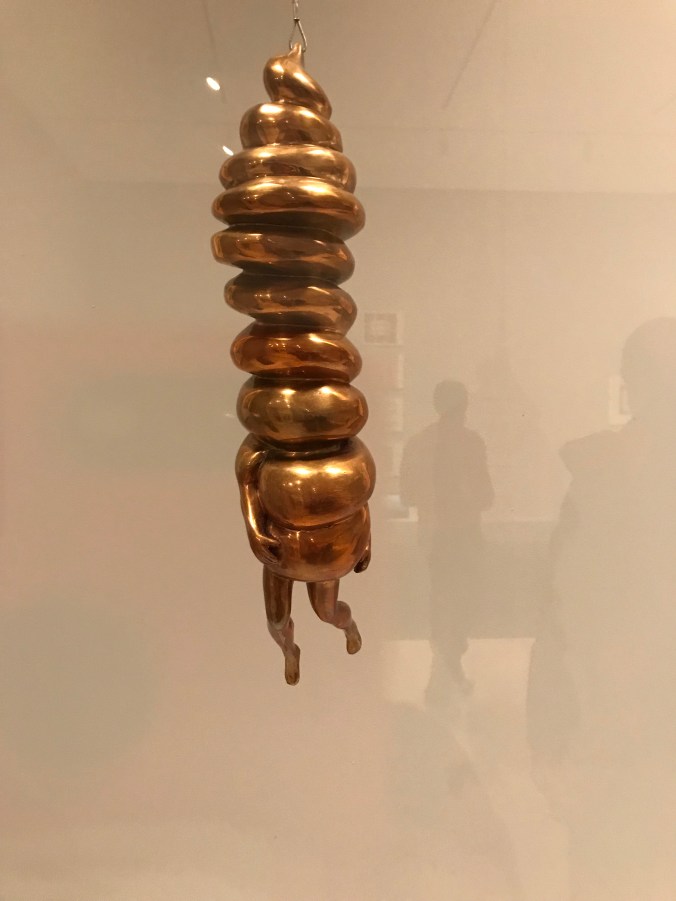
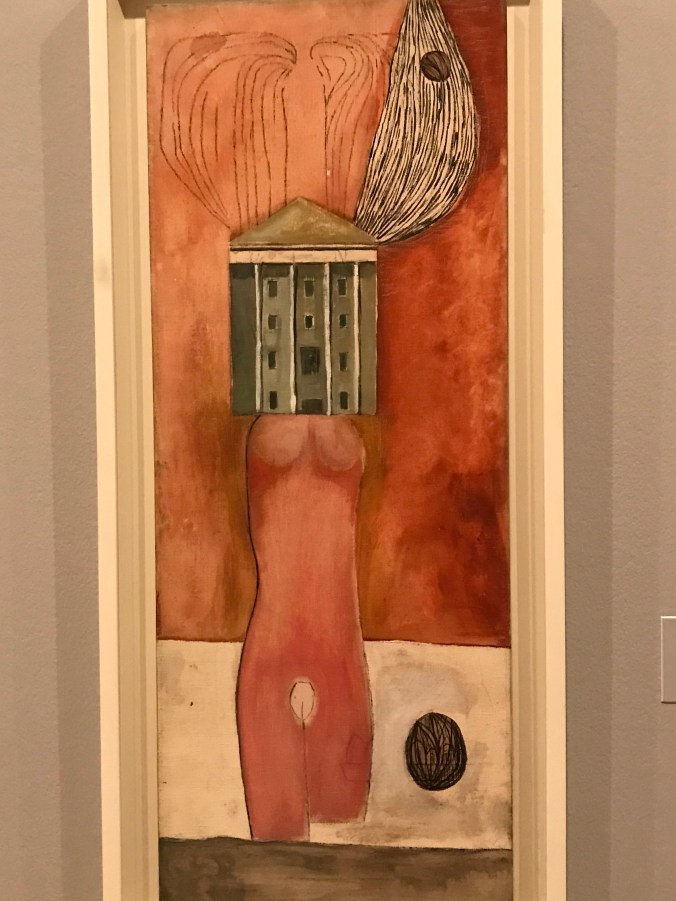
Suddenly Mad - MOMA Louise Bourgeois - SpiralsSuddenly Mad - Femme Maison Louise BourgeoisFemme Maison (1946-47) is a painting and drawing in linen, that speaks to the work she made about architecture embodied. For Bourgeois, architectural structures and room like chambers represented safety, and refuge, and conversely, entrapment. Suddenly Mad : Louise Bourgeois - cell VlCell VI, 1991, painted wood and metal
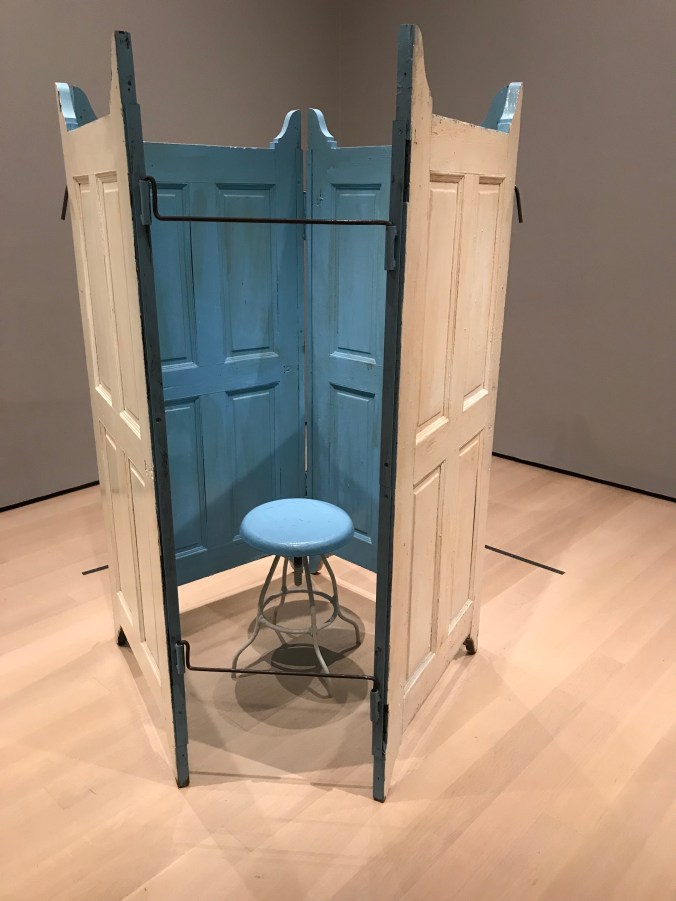
She began a series of room-like sculptures called Cells in 1991, eventually creating sixty examples in varying sizes and complexity. Some are filled with a haunting mix of her personal belongings. This is among the simplest. She often chose the color blue for it’s serene and calming effect.
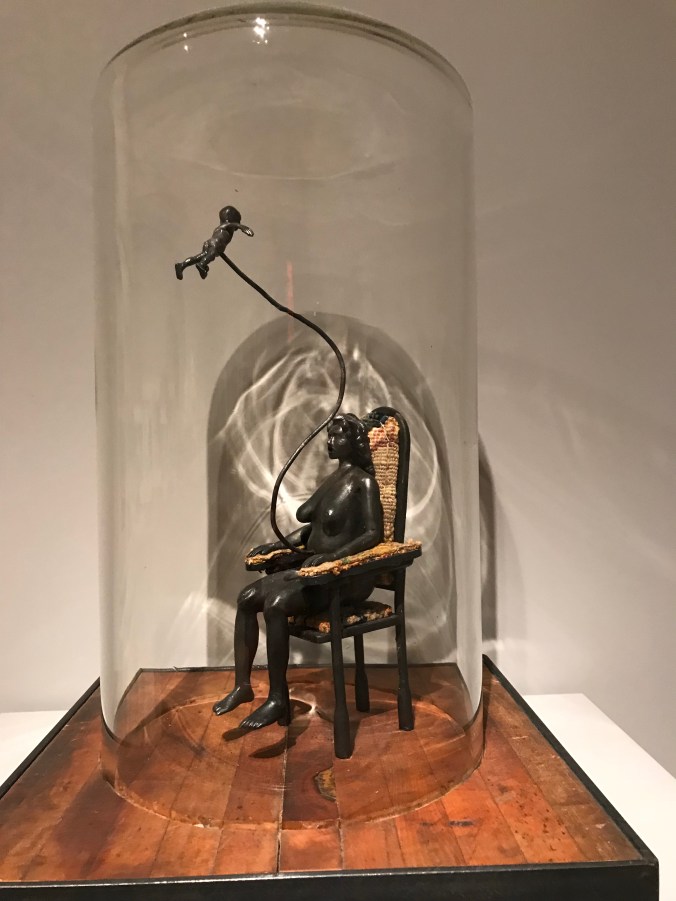
Suddenly Mad - Louise Bourgeois alone and togetherI Redo (from the installation I Do, I Undo, I Redo) 1999-2000, steel, glass, wood and tapestry

Throughout her career, Bourgeois turned to the figure as a means for self portraiture and for examining her relationship with others. They often contain elements of the real and surreal. She treated the human figure as a vehicle for comprehending her fears, desires and vulnerabilities.

She was raised in France in a family of tapestry restorers, and introduced fabric into her art when she was in her eighties. She decided she no longer needed all the clothes or household fabrics she had saved for years. She would hang dresses, slips and coats in her cell sculptures, and cut up cloth for stuffed figures and patterned collages. Stains, scorches, testify to the the old garments history.
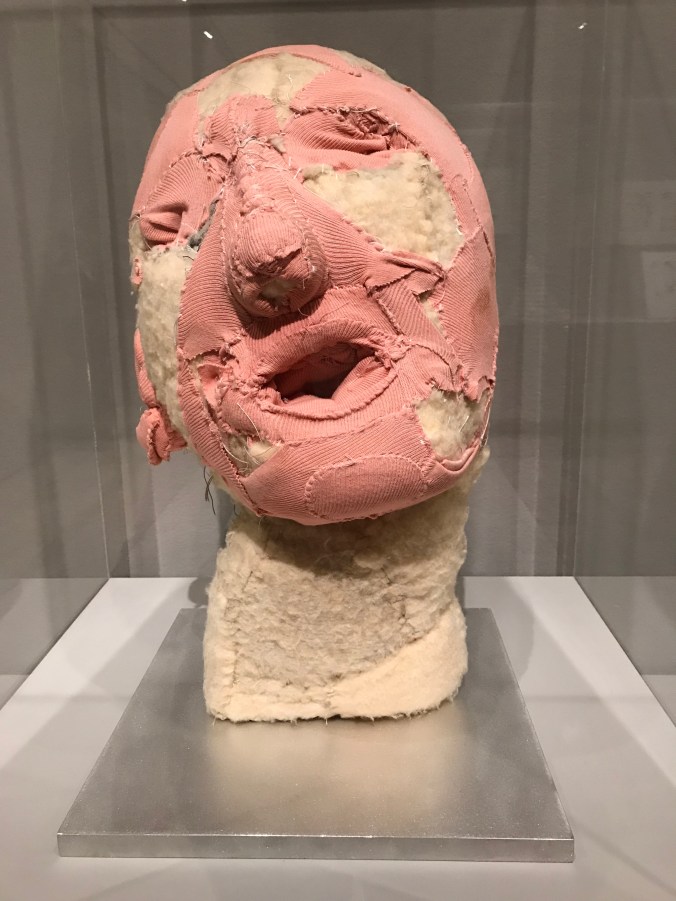
Suddenly Mad - Louise Bourgeois fabric head

Below is a painting by Brice Marden, titled Vine, from 1992/1993. To the left is an opening in the wall, and through it a sculpture of one of Louise Bourgeois’ “Spider” sculptures hangs in midair. They are grouped to play off of each other. Marden’s abstraction in Vine, playfully embodying a web design, against the sinister Bourgeois Spider.

Marden is another artist I knew back in the day. His daughter attended The Little Red Schoolhouse, the same school my then very young son attended. We would greet each other in the morning as we dropped off our kids at school. I would go to the gallery I owned then in SoHo, and he would be off to his studio. This was thirty years ago. Normal life, a busy life, an active life. Then. He was already famous for his spare and minimalist paintings. At almost eighty he is still a working artist, and owns a huge chunk of SoHo property, making him one of the wealthiest American artists around. His works sell for around 10 million for a painting. Maybe I should write him a note and tell him my story. I wonder what he would think and if he would read my blog.
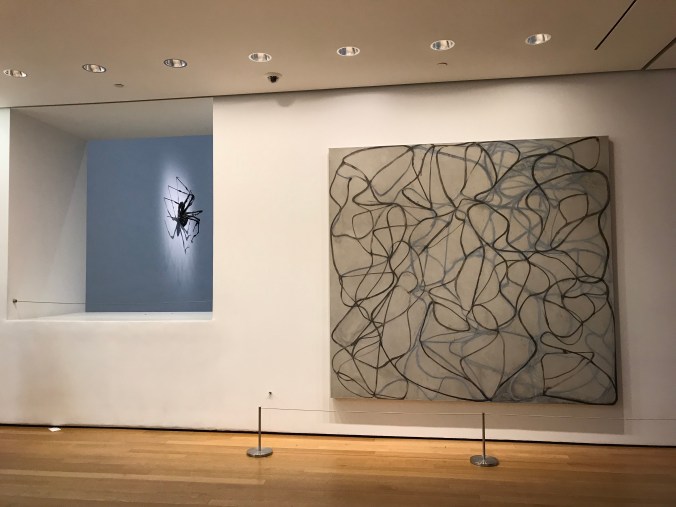
Suddenly Mad Louise Borgois Through Opening in the walk and BRICE Madden Inbox x

I have to include one painting by Pablo Picasso that I loved as a child, and saw this again at MOMA. Three Musicians is an oil and collage painting from 1921. The painting features three musicians, dressed as a monk, a pierrot, and a harlequin. It’s a perfect example of Picasso’s Cubist style. In Cubism, the subject of the artwork is transformed into a sequence of planes, lines, and arcs. Cubism has been described as an intellectual style because the artists analyzed the shapes of their subjects and reinvented them on the canvas. The viewer must reconstruct the subject and space of the work by comparing the different shapes and forms to determine what each one represents.

As a child I had no understanding of Cubism, yet I found this painting unforgettable, and looking at it made me happy. As an adult, I learned that Picasso was a misogynist and that many of his children and grandchildren suffered great psychological trauma. Among creators of genius, Picasso was not alone in carving a path of emotional destruction through the lives of those closest to him, but his record is nevertheless chilling. In the years following his death in 1973 his second wife, a longtime mistress and a grandson committed suicide; his oldest son was killed by drink; and almost everyone else related to him was scarred by the experience. His granddaughter, Marina Picasso, wrote in her book, Picasso: My Grandfather,  “He needed blood to sign each of his paintings: my father’s blood, my brother’s, my mother’s, my grandmother’s and mine. He needed the blood of those who loved him — people who thought they loved a human being, whereas they really loved Picasso.”
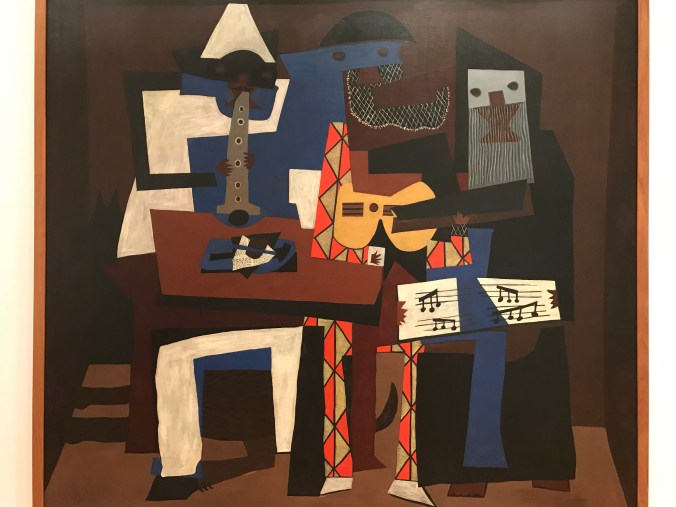
Suddenly Mad MOMA Picasso Three Musicians

(Below) The End from 1991, by Edward Ruscha, evokes a split second of film projection on the big screen. The effect of instantaneity is enhanced by the imperfections and vertical lines in the gray field, which are intended to resemble the tiny scratches, scrapes, and particles of dust that can mar film and projector lenses. The fuzzy contours of the airbrushed letters, split between the top and bottom of the canvas, suggest that something is amiss in the projection of this particular movie frame. The illusion of continuity is not being created. This “illustration of an out-of-sync mode,” as the artist has described it, refers to the past  and the future — once the technology of celluloid film is obsolete, if not totally forgotten, will the painting be recognizable? The title and subject of the work remind us that the continuum of time is composed of the momentary; a flash of ending differentiates past from present and present from future. Suddenly Mad - MOMA - Edward Ruscha - The End 1991
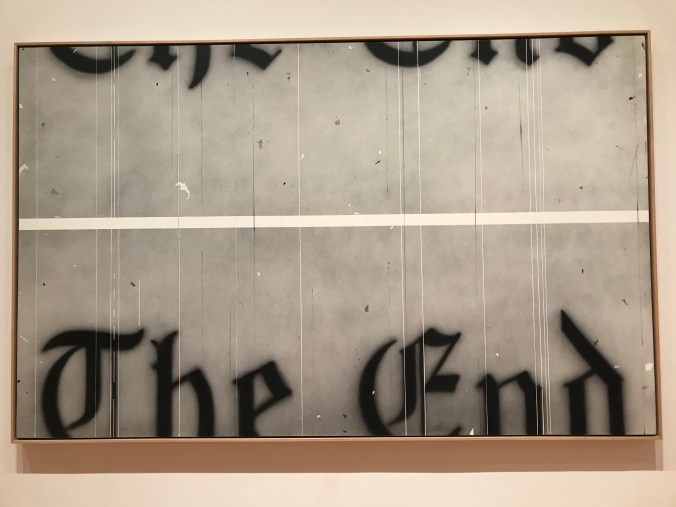
Endings. Continuity. Endings that lead to new beginnings. Endings that are a goodbye.

Another ending. Today. There have been many during the course of this disease. Too many. A sea of strangers paid to care for me. It is an abrupt ending.  I am so worn down from abandonment. The young woman who has been my paid companion since early October, has resigned. Why? She didn’t want to do this anymore, she said. She wasn’t designed to be a home health aide for a woman with early Alzheimer’s. She’s a young woman who has had many issues, health issues, both psychological and physical, and is fragile. If I had known better, I would not have allowed myself to get so close to her. I became accustomed to her helping me. I became dependent on her. That’s a danger for people with this disease. We can give up too early what we can still do for ourselves. But her presence brightened my day, and I would look forward to her presence. My husband hired her after she visited me as a mitzvah (good deed), prompted by my rabbi sending her a text that there was a woman in the community who would benefit from her visiting. I really liked her, trusted her, appreciated her help enormously. Now she won’t do this anymore. She told me she wants to live her life, pursue her design career. I can understand this. My own daughter is doing exactly that, working as a TV producer and living with her boyfriend. She wants to live her life. I thought having this companion would free my daughter to do just that, and afford me the opportunity to still have a companion who would make sure I ate (I forget, don’t have an appetite), make sure I did not get lost when traveling, would help me exercise, and help me remain functional, conversant, have structure in my life. I thought this would help keep me in the early stages, as long as possible.

Who wants to be saddled with the job of being a companion to someone who is losing their mind? Last year I interviewed a home health aide who arrived 2 and 1/2 hours late, had a bouffant of dyed blue hair and weighed around 300 lbs. My husband told her that I become anxious and when stressed, argumentative and strident. She told him, I know how to handle Alzheimer’s people who get like that. I pictured this huge woman holding me down. Pinning me to wall.  Clearly it was not a good fit.

But the symptoms are not getting better. I am scared of the person I was this past summer, sitting all day in the house alone. It was only when I came “out” to my religious community, the rabbi, a friend who had worked on my films, an acquaintance who had experience with people with Alzheimer’s, that I have this disease, that visitors started taking an interest in helping me out and keeping me active.

I’ve been through many aides since the insidious onset of this disease. I know that the personality changes that are currently happening are a result of my dementia. Persons with dementia have a change in personality. Aggression, anxiety, depression, agitation, and paranoia are all aspects of dementia. Psychiatrists prescribe anti-psychotic medication to help reduce aggression or an anti –depressant for anxiety or depression. Anti-psychotics are black box warned against for people with dementia, yet psychiatrists still prescribe them. Many anti-depressants are anti-cholinergic and kill brain cells. It was a cocktail of antidepressant medications and benzodiazapines that hurt my brain, disrupted synapses. I wish I had never taken psychiatric drugs, ever, but I did and began in my forties because I believed they would help with depression. This young woman, my former companion, sustained neurological damage from the same drug, Klonopin, that hurt my brain, and contributed to pushing Alzheimer’s disease in my brain http://www.psychiatryadvisor.com/alzheimers-disease-and-dementia/benzodiazepines-alzheimers-dementia-death/article/443262/. We shared this, and she sympathized with my condition. She has vertigo, and says she couldn’t walk or talk for four years as a result of the damage the drug caused.

I need assistance with many activities of daily living. But you can’t buy a friend. Here was an employee that my husband hired to be my companion. I made a mistake thinking this perfect stranger would be my friend. I am still strong and have to stand tall for myself, and battle this disease. I’m doing that by writing about it. My husband, though embittered and exhausted from being a worker and a caregiver, is here for me. He may not be a great conversationalist, but he is my dear care partner. Anyone he hires to help clean our home, or serve as a travel companion for me, is not invested. He is.

I have a beautiful granddaughter who turned two at the end of October. She is the daughter of my son and his lovely wife. She will not know me as the normal grandma I would have wanted to be for her, but I try my best to engage happily with her when I see her every few weeks. She is the beginning, the joy taking flight, and I am waning at an age when this should not be happening. Her great grandma, my husbands mother, lived to be 94. She had Alzheimer’s in the final years of her life, but when she was my age she was the greatest grandma imaginable for my son, spending time with him with gusto and exuberance. My son traveled with her to Disneyland after her husband (my husband’s father) died of a sudden heart attack at the age of 70. She rode the rollercoaster at Disneyland with my son, her little grandson, spent so much time with him and adored him. I married young, and in a sense she mothered me too. I feel her presence now fortifying me to be stronger. To accept the love that’s offered. To not depend on strangers to take over what I can still do for myself. I adore my little granddaughter.  I doubt I will be able to be like the grandma, my son’s mother was for my son. Logistically it’s unlikely, which makes me sad. She has another grandma, the mother of my daughter in law, who she will likely do these things with. Before I was diagnosed, I imagined I would be the kind of grandma who would take my grandchildren to museums, the theater, introduce them to great New York restaurants, the theater, be the one to be sure to introduce them to high culture. But I can still play with her, sing to her, and watch her as she grows smarter and stronger every day, bless her.

I was born into the Baby Boom generation. My granddaughter was born at the tale end of Generation Z. She will be a part of a generation of self-starters, self-learners, and self-motivators who will stop at nothing to make their mark on the world. Being born at the tale end of this generation, she will likely be a maverick. I see it in her now at only 2 years old. She’s a brilliant ball of energy. I pray I will get to know her, and be cognizant of her as long as I am alive, never forgetting to be able to still give her the best of myself.
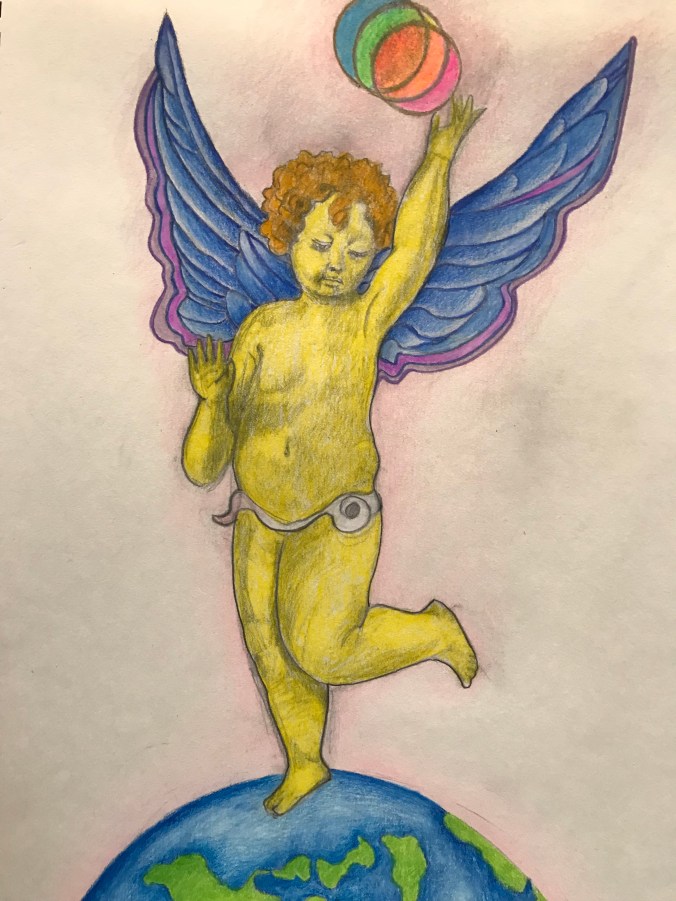
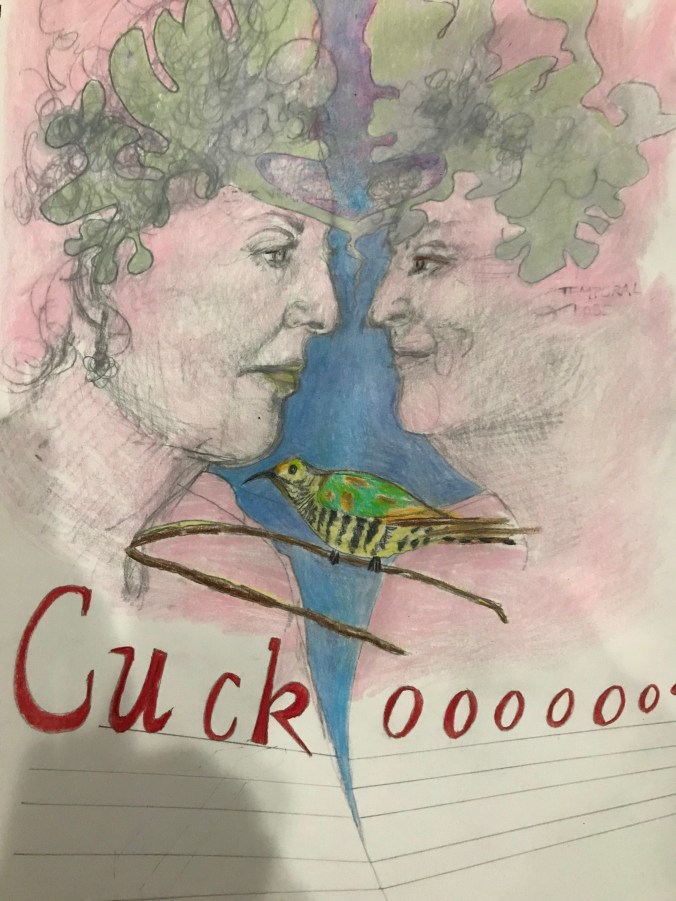
Cuckoo with pluck

Suddenly Mad - Self Portraits with CuckooDouble self portrait with Cuckoo                     Dec. 2017                                     Minna Packer
The weekend:  I was snowed in at home in my East coast abode. I spent my time drawing the double self portrait with a cuckoo bird, the phone silent, my husband weary and resting, and me reading the The New York Times news feed, eating, playing Lumosity and Brain HQ games and trying my hand at the Times crossword puzzle.

It doesn’t sound out of the ordinary for anyone’s weekend activities. That’s why it’s called the weekend. For me though the comfort of familiarity and routines in my life are changed. Instead of a job teaching students about art, I am home alone so much of the time. Having this disease has cut me off from the world I knew. A normal routine, punctuated by time with friends, going to films, traveling, community involvement– a life. A normal life which is something it seems I will never experience again. I didn’t choose retirement. I thought I would never retire. A life at home with a list I write the night before, telling me to eat, get dressed, take my medication, take a walk, is not what normal person imagines will be their construct in late middle age. It’s absolutely bizarre, yet without my list, I don’t remember what I should do. I get confused. I have to enforce a routine and I do it with a list. This is my new normal.

The people in my life who were present every day are gone, colleagues, friends, extended family are replaced now by social workers, psychologists, a cognitive remediation counselor, visits to the neurologist, doctors, and a hired companion who helps me to complete household tasks. The occasional visits from and to see my adult children are “events”. My beleaguered husband who works full time and takes care of my nutrition, doctors appointments, and manages our household is my mainstay who keeps me going. He cues me to get out of bed and helps me when things like walking down the stairs are hard to do. I’m alone with my husband four days a week. He works remotely on his computer two of these days. He is a loner and doesn’t bring social contact into our lives. I was a sociable person, and as much as Zoom chats with my dementia mentor are awesome and I adore her, it’s once a week for an hour. Dementia Alliance International is great source of support, but again Zoom chats once a week, often at a time when I’ve had appointments, are not enough to cut through the isolation I am experiencing. Sometimes these Zoom chats make me feel like I’m a dementia patient on the Starship Enterprise using communicator panels to connect with those who are light years away.  I think anyone would become stir crazy if forced into this sort of isolation.

I read the news and see that I am one of the fortunate ones with a roof over over my head and food in the fridge. Global warming is affecting everyone and everything, but for the moment, I am safe. The fires are continuing to burn after those in Sonoma and Napa counties have destroyed 14,000 homes with losses topping $3 billion. Now fires continue to rage from Ventura to San Diego. More than 100,000 people ordered to flee their homes! One human death reported yesterday, two the day before, dozens of horses killed. This at the heels of 42 dead in Sonoma County. Valiant firefighters battle to contain the flames that has destroyed over 245,000 acres.

Reading the news makes human tragedy just that, readable. Isolated in a world where we are exposed to news events every minute of every day, it becomes more challenging to give a single story the attention it deserves. The sheer number of environmental disasters, competing with social events happening at one time, alters our ability to feel fully compassionate towards a single event. We’re so drowned in data that we’ve become numb.

On the same electronic page with the report about the fires, are advertisements for a child’s luxurious colored crochet blanket in the shape of a mermaid. This makes me better able to understand how the artist Andy Warhol visually depicted how everything in our culture is reduced to banality. The same page that delivers the news of tragedy and devastation, delivers a luxury item for kids. Life and death trivialized in a barrage of data.

Another news feed: Trump’s incendiary move to announce that he recognizes Jerusalem as the capital of Israel, and will move the U.S. embassy there, is expected to inflame tensions in the region and unsettle the prospects for peace. Jerusalem is braced for it’s it’s most serious flare-ups of violence in years.

Jerusalem: I was there in March 2014, asked to speak at Jerusalem University, about the film I was making, “The Lilliput”,  about a dwarf who hid in garbage cans during the Holocaust and survived https://vimeo.com/91234297.  I was with Ada Holtzman, a prominent genealogist, a few years older than me, who compiled the records of those who perished from our late father’s shtetl (town) in Poland. This is the plenary website she created to honor the memories of those who lived to tell their stories and about those who perished http://www.zchor.org/indexgom.htm.  We walked through the old city, and had a such a lovely time, enjoying a mid afternoon lunch. We hadn’t seen each other in six years, but had communicated regularly by email. Two years later this woman who was so full of energy, and passionate about her work, is dead from lung cancer that spread to her brain. Here I am alive with a head full of Alzheimers pathology and a changed brain that makes daily life a challenge. I miss her. I miss myself, the self I was that afternoon.

A text pops up on my phone. It’s a daily text from a Christian woman who urges me daily to pray and have faith. She quotes from Psalm 17:6 telling me that G-d can quickly change things in my life and my situation. I consider the brightness of her urging. There are blessings in my life. There are many things I am thankful for. I am not being sarcastic when I say that my iPhone which brings me her message to hang in and have faith, and my Mac computer to write my blog on, and connect with my dementia buddies on Zoom chat, is a blessing. Thank you G-d for creating Steve Jobs, who lived to make this happen. Six degrees of separation.

I turn back to the newsfeed.

The sex scandals continue to spark with allegations made against the most powerful men in the land, in various industries. The list keeps growing. Republican Alabama Senate nominee, Roy S. Moore, is alleged to have molested teenage girls. From the most prominent liberal minded Democrats to ultra conservative Republicans, former American presidents, members of the U.S. Senate and U.S. House of Representatives, celebrity actors, celebrity chefs, billionaire movie executives, directors and producers, US judges, political journalists, chief news editors, musical directors, lauded talk show hosts, famed fashion photographers, world famous comedians, playwrights, CEO’s, pop stars, NFL quarterbacks, soccer stars, venture capitalists, hotelier’s, rappers, and even a famed magician. The most influential and wealthiest men are toppled because they believed themselves to be more powerful than others, perversely pleasuring themselves by degrading women under the radar of the public eye. Will this be a clarion call for women to replace men in positions of power and influence in every facet of public life?


___________________________________________________________________________________________

I know that we plan and imagine our lives going one way, and things go another way.

Loss as muse.

Loss as character.

Loss as life.

And yet…I remember that without dreams and hope life is dismal. I give myself permission to mourn my losses, but I also encourage myself to remain an active participant, a part of the world. I am hoping to meet my dementia buddies in Chicago next year for a dementia convention. I want to be able to be able to start a support group for those with early onset in my own community.  Told by the co-director of the local Alzheimer’s organization that she hoped to start such a group at the local hospital, I see now that this will not happen unless someone with the disease makes the effort to reach out directly and find ways to facilitate these connections. She told me the only two people she knew who were close to my age and were diagnosed, were so afraid of the prevailing stigma, that they would not reveal themselves. Her organization has 3 support groups for caregivers, and nothing for those who have been diagnosed. That needs to change. I want to be able to speak to people about living with the disease while I can. These are dreams I’m holding onto.

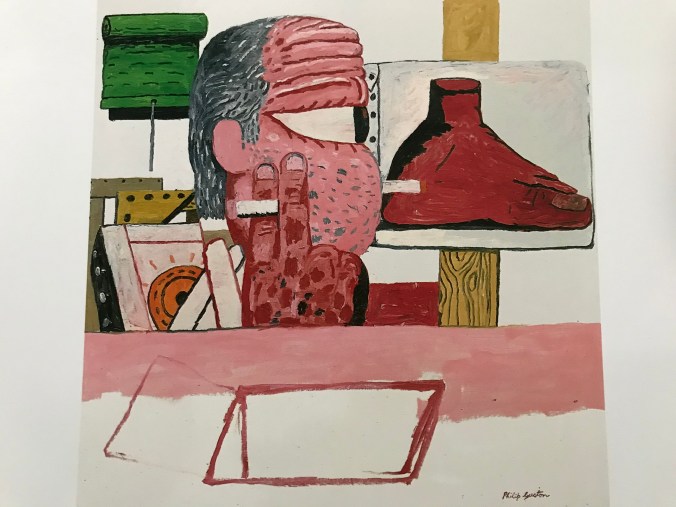
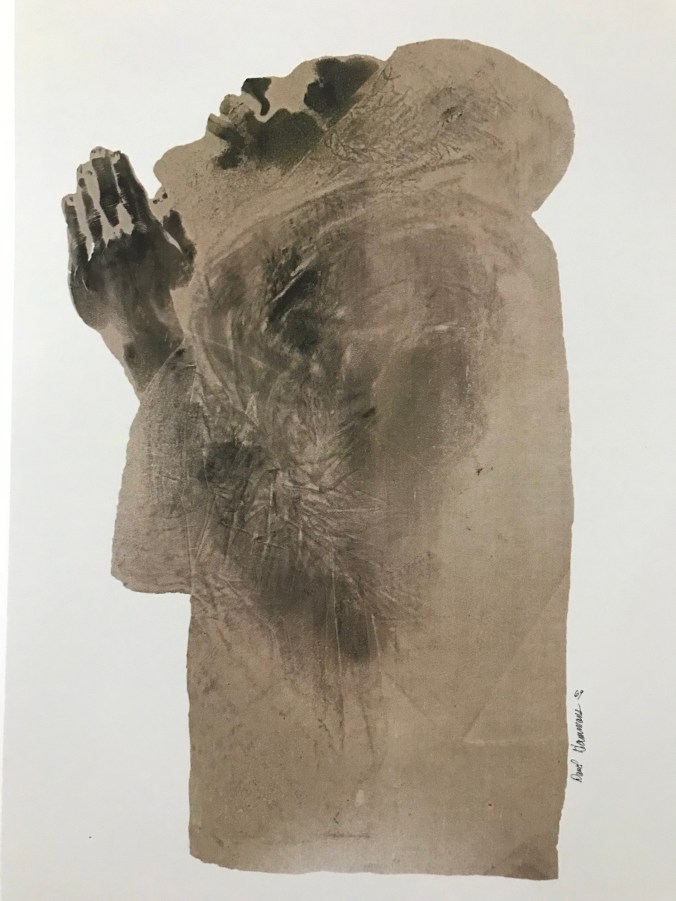
In the meantime, social activity for me now involves organized trips to museums with programs for people with dementia. Programs tailored to those with cognitive disabilities is where I am able to bring forth my best self now. I engage with the caregivers if the person with dementia can’t speak. I stand at a juncture between them, and it’s my point of reference. Last Thursday I attended a program hosted by The Museum of Modern Art in New York at the hospital where my neurologist practices. The presenter was a young woman who showed us images by Andy Warhol, Phillip Guston- one of my favorite painters, images of hanging works in wire that are called drawings in space by a woman artist whose name I don’t remember, a painting by Cy Twombley from an installation now at MOMA, called the “The Four Seasons”, and a body print from the sixties by David Hammons, an African American artist now in mid late career. She wasn’t surprised that I knew so much about the artists and their work when I told her that I had taught art history and grew up in the art world, had owned a gallery in SoHo, and that this was the world I used to swim in.

People often say, you can’t possibly have Alzheimer’s, because you speak so well. “You’re so articulate”. “You write so eloquently”. The ideas people have about those with dementia is misconstrued. Some of us have more depression, some more anxiety, some lose abilities (activities of daily living) faster than others, some have hallucinations, some progress and plateau for a while, some progress quickly, some become incontinent and have to wear Depends (as is the case for a prominent writer who just published the second edition of his book about living with early Alzheimer’s!), some get locked up in psychiatric hospitals and are drugged and stumble around muttering to themselves. The bizarre combinations of symptoms in some people with the disease is startling and alarming. Here I can write a blog, but have a lot of trouble following a recipe, getting dressed and traveling alone, because I become disoriented and have a lot of fear about getting lost. The early stages are deceiving to those who do not understand that we process things differently, can’t think as fast as we used to, thus our reactions are slower, we need to plan and prepare well for everything we do.

Suddenly Mad - Phillip Guston In the Studio, 1975

Art is my respite. Here are 2 images from the discussion about contemporary art I attended on Thursday. This is a painting by the late Phillip Guston, titled “In the Studio”, 1975.

In a career of constant struggle and evolution, he emerged first in the 1930s as a social realist painter of murals in the 1930s. Much later he also evolved a unique and highly influential style of cartoon realism.

One of the things I love about Guston,’ says Philip Dodd, head of London’s Institute of Contemporary Art, ‘is that he was not afraid of vulgarity. Once he leaves abstraction behind, he ceases to be a tasteful painter, in fact in his late work he is willfully tasteless, but this was not a man who would do anything as obvious as setting out to shock. He understood that he had to make a new kind of art that was about flesh as meat and meat as flesh. I can’t think of any other artist who is so cerebral and so cartoonish.’

Suddenly Mad David Hammons 1969

Body print by David Hammons, 1969

Although Hammons is known for his ephemeral objects and short-term installations, often on themes related to African-American life, his early work took the more concrete form of one-of-a-kind prints based on impressions he made of his own body. To make this image, one side of his body was covered with oil and sprinkled with pigment, then he laid down on a huge piece of paper and left his imprint.

Looks like he’s praying.

Finally, a quote from Steve Jobs, who enabled me to communicate with you on this device.

“Almost everything–all external expectations, all pride, all fear of embarrassment or failure–these things just fall away in the face of death, leaving only what is truly important.”


How I found a simple recipe for being happier and more grateful

My friend Jeanne, who is vegan sent me this and it changed my attitude…a lot! Making this simple dish changed me in profound ways…

Wrap veggie with hummus

*Tortilla (Food for Life brown rice or sprouted grain)

https://www.foodforlife.com/product/tortillas/ezekiel-49- taco-size- whole-grain- tortillas

*Oasis hummus

Nuke tortilla for 30 seconds to soften.

Preheat oven to 425 degrees.

Layer on tortilla as follows:

Hummus – Essential

These are the ingredients that I use if I have them on hand. You may want to use others.

Frozen corn kernels. Stick these into hummus to anchor.

Chopped sweet onion, e.g. Vidalia or white. Or sliced scallions

Sweet red pepper chopped or julienne or roasted red pepper, sliced

Carrot chopped or julienne

Sliced kale (I prefer lacinato)

Sliced or chopped fresh tomato

Roll up filled tortilla as best you can – it may be quite full depending on the ingredients you use.

Bake 7 minutes until edges are brown and crispy.

Yumm!

So why did this recipe bring joy into my life?

I haven’t been able to prepare anything but scrambled eggs, and I relearned how to make a cheese omelet a few weeks ago. Now I can add this to my repertoire of easy meals I can make!

People take the little things in life for granted. How to prepare a meal for oneself is not something a person normally thinks about as something extraordinarily special. But for someone with Alzheimer’s who hasn’t done it in a very long time, it can be a very big deal. It was for me today, and it led to remembering a video that a brave woman named Laurie shared with me months ago.

My dear friend and dementia mentor, Laurie Scherrer, who I meet with on Zoom chat every Tuesday morning, wondered why I said I can’t prepare meals. Now I have to have to wonder too. Every day is different and today I was able to dust and clean my furniture in the living room, and make my bed and my husband’s bed (with a little assistance from him). I cleaned all the cabinets in my kitchen.

APATHY BE DAMNED!

The truth is that apathy is common among people with dementia. It is different from depression. Apathy is much more common among people with dementia than in older people without dementia. About 2–5% of older people without dementia have apathy at any one time, but about 50–70% of people with dementia have apathy. A person with any type of dementia can have apathy but it is particularly common in frontotemporal dementia. Apathy can start at any stage of dementia but often develops early on. Many studies suggest that apathy becomes more common as dementia progresses. Once present, apathy tends to persist rather than come and go.

One of the reasons that people with dementia are thought to develop apathy is damage to the brain’s frontal lobes. These control motivation, planning and sequencing of tasks.The first neurologist I saw suspected I had FTD, until the results of the Spect scan showed the pattern of Alzheimer’s. He said my frontal lobes are likely being affected, despite not showing up on the scan. When someone withdraws, stops doing things and loses their confidence and abilities, their apathy can get worse and so they become even less motivated.

It is important for anyone supporting the person with dementia to help them avoid apathy.

This is a video of a man that Laurie introduced me to months ago, that finally got through to me, and got me thinking about how I am seeing the cup as half empty.

When my cognitive remediation counselor was here observing me making an omelet, I was so bummed that the plate I needed for putting the omelet on was not there when it was ready in the pan. It was sitting on the surface at the other end of the island. To me, the fact that I didn’t remember to get the plate, represented a failure in my planning. The woe is me attitude struck. She pointed out that I only forgot one thing.

What I need to remind myself is to see the cup half full, rather than half empty. I have lost a lot of confidence because of the losses I’ve experienced. Although things are harder for me now, and there have been losses and sometimes I get scared when I turn into the wrong door when I’m headed to a different location, or I can’t remember the name of someone whose face is very familiar, or I find myself telling someone something, and completely forget my train of thought, I need to remember that I am still okay. Yes, I’ve lost a ton of confidence. But today I was reminded, that following the steps of a simple recipe can help me regain confidence by showing me what I am still able to do. For those of you who read this and have no problems with the simple activities of daily living- dressing yourself, making breakfast, this must read as pretty dismal. “Change the channel”, you think, or “I don’t want to read about this, as it has nothing to do with me”. But things happen to people! Some like Nick Vujicic are born without arms or legs.  I developed Alzheimer’s. It can happen to anyone.

But look at what a person with disabilities can do. Nick Vujicic does more than people who have arms and legs do. He inspires.

I have to keep working on my attitude.

I have had a pretty bad attitude and yesterday was an example of this. I had to go with my husband to the Social Security office to provide a signature for the final approval for my Social Security Disability Insurance payment for the Compassionate Allowance that the Social Security Administration (SSA) has added for early onset/younger-onsetAlzheimer’s, giving me expedited access to Social Security Disability Insurance (SSDI) and Supplemental Security Income (SSI). My sleep is often impaired, I sometimes don’t get to sleep until 3 or 4 am. (Sleep disorders happen in people with Alzheimer’s disease and other dementia’s. We often have nocturnally disturbed sleep, with an absence of a circadian sleep/wake cycle). I had had about 3 hours of sleep, and was bitchy and grumpy, forcing myself to get ready for an appointment that for me was too early in the day.

Rather than being happy SSDI had gone through, I was extremely sad. I looked around the Social Security office and saw people I’d seen in my community that I formerly considered the losers. That was when I was an active normal person, but now I saw myself sitting with them waiting for my number to be called. I felt so glum that my life had come to this point. I never associated with these people, and used to feel high and mighty compared to them. I would offer them money if I passed them in the street, but never imagined myself in similar financial circumstances. Now I was sitting with them at the social security office. Mine was a special appointment with a man in the back office, to sign the paperwork for SSDI disability due to early Alzheimer’s. I found out that I will be receiving a third of what I was making when I was well and employed as the chair of my department. I walked home with my husband, and passed a few people I knew for many many years, who did not acknowledge me. I suspect it’s because word is out about me having Alzheimer’s in my small city, where I’ve lived for 40 years, and that stigma is raising it’s ugly face. It saddens me that people think I don’t have feelings, and treat me differently, and that these folks rushed past me and didn’t say hello. My internal pity party was raging.

Yet, for today, I am glad that I made dinner for my husband and myself. My new friend who knows I have this disease, sent me this recipe, after she invited me for lunch, where she served this in exquisite china, in her beautiful home.

I am not alone. I was proactive and found a social network through Dementia Alliance International and I Zoom chat with others diagnosed with varying early stage dementias, every week.

I found my friend and dementia mentor in Laurie Scherrer, who I also Zoom chat and text with (special thanks to Gary LeBlanc who created Dementia Mentors to connect people with dementia and help motivate us in an online community).  I’m able to Zoom chat, write my blog, and communicate. There are those with this disease, I have been told, some who are in the early stages, some who are younger than me, who can’t use a computer, who can’t write or read any longer. That day may come for me, but it is not here yet. My life has changed and every day has it’s challenges. What I do need to be thankful for, when I fall deep into the abyss, which I have done often and fallen hard, again and again, is to be grateful for what I still can do and for the care and understanding that is present in my life now.

Laurie Scherrer is adamant about maintaining her independence, despite having early Alzheimer’s and Fronto Temperol dementia. She hasn’t lost the ability to do many things that have felt impossible for me. She has created accommodations for herself to make it possible to still lead as normal a life as she possibly can. She still drives a little, shops and cooks (although her husband puts the casseroles etc. in the oven for her as she has burned herself badly trying to cook). She has created systems for cleaning her lovely furniture, and for making beds, and dressing, and even knowing how to pack her suitcase for traveling so it is easier for her to get dressed. She and her husband still do quite a bit of traveling together because of the accommodations she has put in place for herself. She has confided in me that many of the startling losses I have experienced, have been challenges for her too. I had just assumed that because she can do these things, she isn’t as progressed as me. She might not be as progressed, but she has certainly experienced losses. It might be that I am progressing faster, or was diagnosed later in the process. But one thing I do know. She is my inspiration to tackle things that I am still be able to do, and she helps to keep me on track and believing that my will can be stronger than my woe.

https://dementiadaze.com/

What works for you? Tell me how anything here is relatable. It might be running or exercise, watching butterflies or drinking bullet proof coffee, or riding your motorcycle, or doing yoga and then sitting quietly in meditative pose. What is your routine and how do you keep yourself motivated?

Leave a comment.

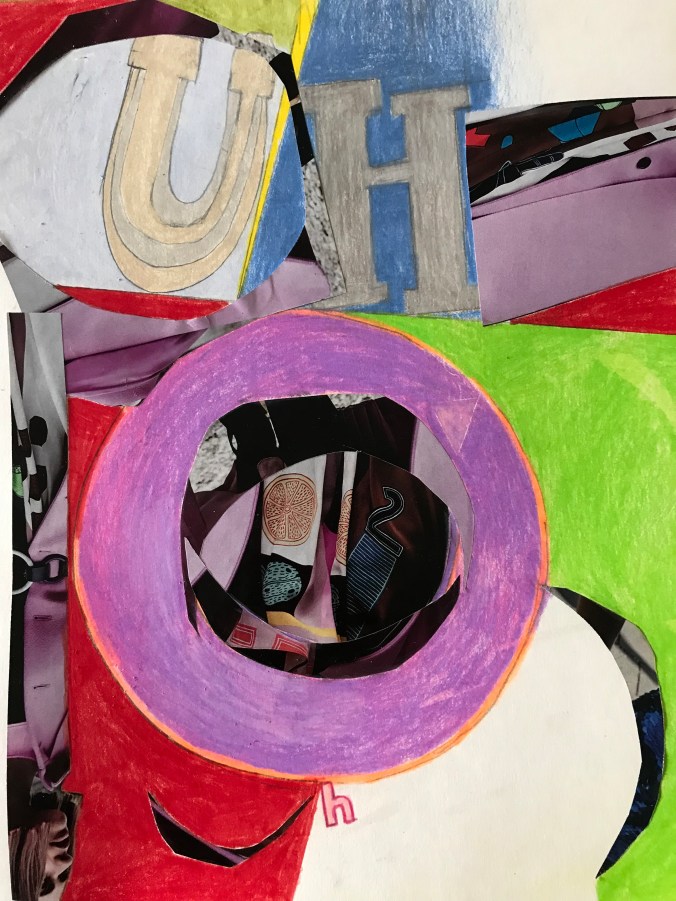
UH OH

Uh Oh suddenly mad blog IMG_2839“Uh Oh”, is the name I’ve given to this drawing collage, pictured here. In the English urban vernacular, it’s a term used to express alarm, dismay, or realization of a difficulty.
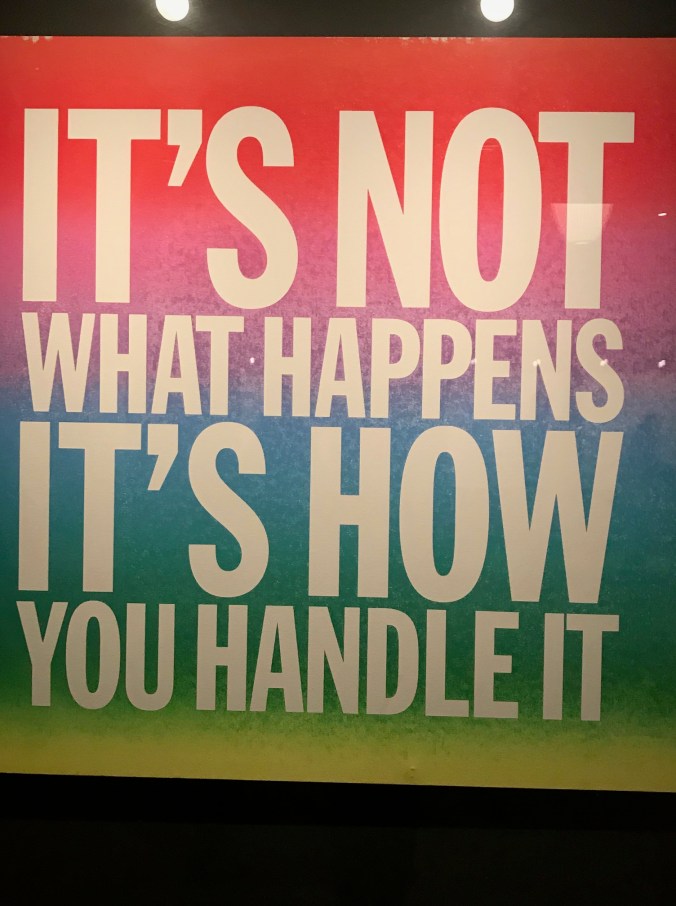
I am still creating images, and hope to increase my output. Though my current art work will never be seen in a major museum like that of de Kooning, whose late works from the period in which he was declining with Alzheimer’s were highly valued, (although some of my more sophisticated art works from the past, are in public collections, including the Chicago Art Institute, and The Canada Council and a number of private collections), my simple drawings and artworks are mine and offer a visual illustration of my current state, my sense of humor and a glimmer of who I was. A woman who was an artist, writer and filmmaker.

I have fallen off the cliff, and am progressing I know, but I am not yet so far gone that I am not aware of what is going on. I’m painfully aware of precisely what is happening to me at this point. I am using my drawings and writing as a graph to illustrate what I am still able to do, and to show me how far I have descended from my previous baseline.

“Uh oh”, I stop at the mid point between holding onto to myself, and slipping into the abyss.

When did my decline begin and can it be charted in my previous work? I wonder.

I offer this interesting analysis of the several major figures in modern art who developed Alzheimer’s and Parkinson’s disease, as compared to masters who did not.

In a study published in Neuropsychology, a psychologist at the University of Liverpool argued that early signs of neurodegenerative disease can be unmasked in the works of master artists through mathematical analysis of the artists’ brushstrokes. Alex Forsythe, the lead author, discovered that mathematical patterns—called fractals— that underlie a piece of art changed in the work of major artists who eventually developed Alzheimer’s or Parkinson’s.

Fractals, often referred to as nature’s fingerprints, are never-ending patterns that repeat in similar or identical ways at different scales. Branching fractals, for example, are visible in trees, and in aerial views of rivers and mountain ranges. Spiraling fractals are seen in ferns, seashells, and the textured spikes of Romanesco broccoli, while other fractal types appear in individual snowflakes.

To uncover fractal patterns in a painting, scientists subject images to specialized computer programs that place a virtual grid over the work, then measure the brushstroke patterns repeating within the grid’s smaller squares. Using this method, a British physicist famously detected that Jackson Pollock’s seemingly chaotic paintings actually contain fractals that are pleasing to the eye, even if the viewer is not conscious of why. Although its accuracy is debated, the fractal analysis method has been used to authenticate art works of unknown provenance.

For the study, Forsythe, working with colleagues at the UK’s National Health Service and Maynooth University, analyzed more than 2,000 paintings collected from museums and galleries. All were produced by one of only seven legendary painters: Willem de Kooning or James Brooks, who were both eventually diagnosed with Alzheimer’s; Salvador Dalí or Norval Morrisseau, who both developed Parkinson’s disease; and Marc Chagall, Claude Monet, or Pablo Picasso, three masters who did not suffer from any neurodegenerative diseases. The last three artists served as the control group.

Fractal testing revealed that the artists whose gray matter was eventually compromised began to work outside of their normal range of fractal dimension—defined as a measure of how completely a pattern fills a space—long before their diagnoses. Typically artists will work within the same fractal dimension, whether low or high—for their entire life. This doesn’t necessarily mean they won’t work in different styles, just that their fractal range remains the same, much as a writer will create works in fiction, mystery or other genres in the same voice.

All of the control group artists—Chagall, Monet, and Picasso—were found to have stayed within a relatively steady fractal dimension range throughout their lives. De Kooning and Brooks began to show a wide variance in range in their 40s, while Dali and Morriseau launched their careers working in a low fractal dimension, which increased in during mid-life, before dropping once again.

______________________________________________________________________

For me now the act of drawing is therapeutic, but that too comes with the recognition of how my fine motor skills are altered. I must focus intently to sharpen the prisma-color pencils, and cut and paste the elements of a collage.

I wonder if de Kooning who had Alzheimer’s, experienced a consciousness of his declining ability to manipulate material and utilize his tools, brushes, paints, pencils and other materials.

_______________________________________________________________________

Here is a painting by artist Mary Wyant, an artist who has Alzheimer’s and stopped painting. This is a clip of her daughter describing one of her mother’s last paintings-

_____________________________________________________________________________

Finally, I leave you with the works of a U.K.-based artist William Utermohlen, who in 1995 was diagnosed with Alzheimer’s disease. For the subsequent 5 years he drew self portraits, documenting the his journey and ability or inability to draw his own face.

https://www.boredpanda.com/alzheimers-disease-self-portrait-paintings-william-utermohlen/

It’s not what happens it’s how you handle it

Going places and remaining engaged is so important when one is losing their mind (what an odd sentence that is, and yet it is precisely my situation). But that too can get dicey. Recently I’ve had lapses when I’m outside, almost walking into places that are not where I’m intending to go (on route to the gym I almost walked into the bank which is next door to it; on my way back from a walk and trying to get to my therapists office, I turned to enter into the wrong door of a building on that street). I wish I would not sweat this stuff when it happens, because I do catch myself, but I become fraught with anxiety.  It’s not the full out not knowing where I am,or getting lost, as evidenced in the scene from “Still Alice”, when Julianne Moore stops while running a familiar route through Central Park and doesn’t know where she is, as she stands in front of what should be the familiar buildings near Columbia University where she worked as a professor for decades. I do not want to allow this to stop me. I do have a new companion who makes sure I don’t get lost, but she’s only with me a few days a week. There are times I am alone on the street, and I very much want to maintain some level of independence and be able to go out by myself. In my daydreams I am normal and active and navigating my way everywhere. This has been curtailed to almost zilch, and that is extremely depressing. So I push myself to get out and go, even if I need to be accompanied, as I do on trips to New York City.

Yesterday I had to push myself hard to get to the Rubin Museum for their wonderful program for people with dementia called Mindful Connections, which I’ve attended twice, and occurs on the 3rd Thursday of every month.  http://rubinmuseum.org/events/series/mindful-connections

This was my third visit and this time I went with Jill, who helps me several days a week to keep active, helps me complete tasks and recently to travel to the city. I was scared she might lose me, which turned out to be foolish. She sticks by my side. Her sensitivity and enthusiasm are a gift at a time when things are getting harder. Below are some highlights from the exhibits at Rubin that resonated with me. I was an artist, art historian and filmmaker, and I am still able to respond and understand and speak about art,  so I’m grateful for this program. It's Not What Happens It's How You Handle It - Mindful Connections for blog IMG_2802This is a large piece by John Giorno, a New York poet and artist, who draws largely from his poetry. The work indexes his commitment to Tibetan Buddhist practice. Each painting can be read as a mantra, which, when repeated, has the potential to transform the reader’s mind and loosen the ego’s hold.
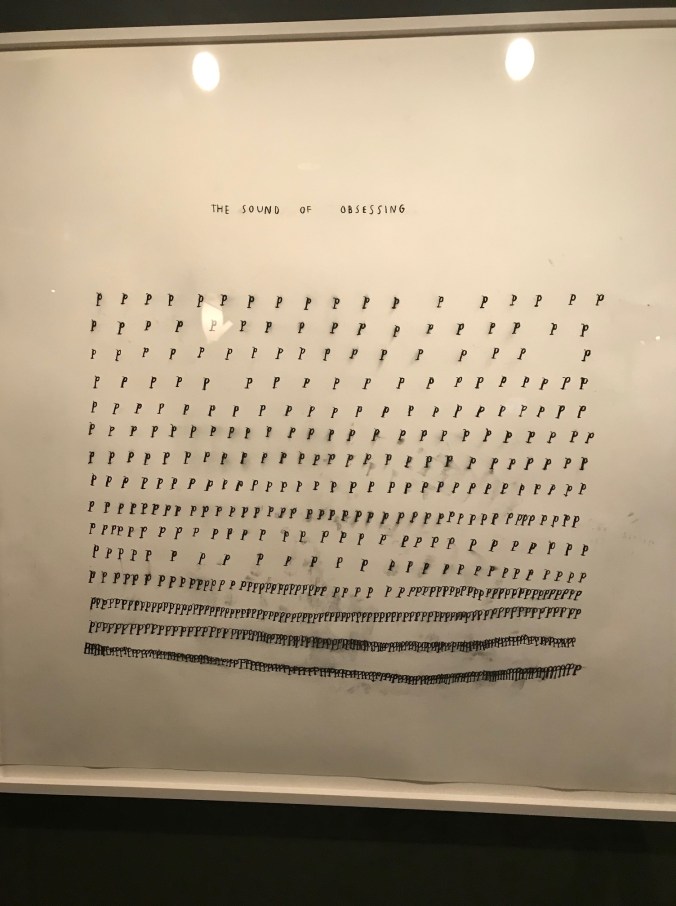
IMG_2800Christine Sun King is a deaf artist who uses musical notations, known as dynamics, which typically indicate the loudness of a note or phrase, as a metaphor for the behavioral dimension of sound. This allows the viewer to participate in the same mediated experience of sound that she does by de-familiarizing the process of hearing.
I’m impressed by this artists’ ability to take what is her sensory impairment, and make use of sound (probably through vibration), musical notation and translate this into drawing, to impart the experience of each note, and how she perceives sound visually. Here in “The Sound of Obsessing”, the notational P’s end up ganging up on themselves, the experience of obsessing conveyed in how it looks and sounds to her.

Cartier Bresson photo of dancers and their teacher Rubin Museum Nov 17, 2017 IMG_2815


This is a photograph from the exhibit by Henri Cartier Bresson: India In Full Frame, which I’d explored in depth with my daughter when I came to the museum with her in August. This time the docents led us to this particular photo for a discussion on what we perceived. While many of the works focus on Bresson’s decisive moments of political unrest and change (for example, Mahatma Gandhi in Bombay (Mumbai) the day before his assassination, followed by witnesses to the ritual mourning), here our group was simply asked what this image of dancers conveyed to us personally. We were told the dancers were in the presence of their teacher. I noted the resemblance of the hand gestures to the iconography we had seen the previous months in paintings and sculptures of Himalayan art. These hand gestures called mudras convey meaning. I do not know how to decipher each of the mudras as the dancers gesture in front of their teacher. Instead I was struck by these animated gestures as reverence embodied by their hands and swaying bodies, in contrast to their teacher who sits erect but stiffly in the chair, his arms sagging onto the armrests, his fingers drooping downward. The contrast spoke to me of the vitality of youth and the stiffening and fading of old age.

*********************************************************

I was quite verbal and engaged in discussion. The docents were stunned that I have this disease, as to them it was in no way evident. I can walk and talk and engage with others. I can type and write sentences and attempt to convey meaning, as I am doing here. What is not apparent to others who meet me, is that I am not able to take care of myself. I have not been able to food shop, or prepare meals. I am not able to dress myself without preplanning the clothes I will wear the next day, and putting these on a hanger, which my husband now helps me bring downstairs to the bathroom, where I dress. It is not evident that getting out of bed and starting my day is incredibly hard, and fraught with confusion and anxiety. My legs are stiff and navigating the spiral stairs is getting harder. I have to create a written list list for each of the tasks I wish to accomplish each day. This includes taking medications and eating meals, which I forget to do unless I prompt myself to by referring to my list. Time is something I experience as passing only insofar as the day turns to night. I have found myself straining to write something meaningful, as the hours turn from day to night and day again. I am lonely and worried. My friends have disappeared, replaced by an assortment of folks I know as virtual buddies who also have neurological brain diseases and dysfunctions that range from mild to moderate. My professional life is gone. My husband, who is my caregiver, is not doing well at all. His health and energy are crushed under the burden of my care, and his need to continue to work and drive and take care of his wife, who can no longer take care of herself, is impacting heavily on him. I understand that this disease destroys others and I am doing my utmost to give him space and allow him to rest.

I wonder about the folks who showed up for yesterday’s tour and discussion, which included some who had attended previously. What are their lives really like on a daily basis. Once again, I saw Michael, the man who is close to my age in the wheelchair, who is not able to speak or walk, along with his amiable companion, Jaime. I went over to Michael and greeted him. He communicated with his eyes and alertness, simply glad I was saying hello directly to him. Like the last time he attempted to speak, but what came out was inaudible. He is completely dependent on Jaime who I imagine dresses, diapers, and feeds him with great care. There was a new guy, Steven, an older well dressed gentleman who was clearly well off. He had great clothes on, and was fully mobile and well mannered. Likely he is in his late seventies or eighties. His attractive caregiver/ home health aide sat slumped in a chair with earbuds in her ears, bored and unstimulated. Clearly he has some form of decline, as he isn’t able to care for himself and is escorted. But whatever he has, it does not appear to me to be dementia. Elaine arrived sitting in her wheelchair with the Elsa, her Polish caregiver, who attends to her needs. Well cared for, Elaine has a lot of anxiety and Elsa has a great deal of patience and fortitude. I wondered about Elaine, and how she manages the anxiety and how she sleeps. She appears well nourished, and I’m certain this is a result of Elsa’s abiding care.

I am worried about the daily decline I am witnessing in myself. I wonder if the cognitive meds I take are making me more confused and possibly making me worse. I;m on a low dose. It appears to me because I am relatively young to have this disease and my body is managing to withstand the stress, I will simply fade away and not know when it happens.

Yet for now….for the moment, I can appreciate the poet artist who counsels in his painting- IT’S NOT WHAT HAPPENS IT’S HOW YOU HANDLE IT.


Could it be caused by bacteria in the brain?

A new friend I met after I came down with the insidious symptoms is Ryan Carty. He’s a young fellow who is very much onto something. Here is his comment on my blog yesterday, “I believe the sudden increase in people losing their mind is due to a bacteria that’s called t. whipplei that our great country is in the dark about. Better known as whipple’s disease it also causes severe dementia. This is what I have and has been spread to me and my family members and kids and no one cares or is doing anything about it. It’s commonly found in our saliva and stool and virtually goes undetected and can and will kill you if not diagnosed or treated in a timely manner. So you can only imagine if it’s found in saliva how many people and dentist offices this stuff is spreading to. It’s caused by an actinomycete bacteria. It would only be detected if the person is specifically tested for it. It’s a systemic infection that will not show up in any imaging studies or lab work. I don’t even think New York has testing for it because it’s such a polluted state. You should really look into this. It causes organic decomposition of the entire body and brain over time. “
I researched and found there is a marked increase in bacteria found in the brains post autopsy, of course, in people who have Alzheimer’s. Ryan may indeed be correct that this bacteria which is everywhere is infecting people with a variety of dementia’s.
See this report from 2017-
The research team set out to discover if there were any differences in the types of bacteria present in brains from Alzheimer's disease patients and healthy brains.

Researchers in the UK have used DNA sequencing to examine bacteria in post-mortem brains from patients with Alzheimer’s disease. Their findings suggest increased bacterial populations and different proportions of specific bacteria in Alzheimer’s, compared with healthy brains. The findings may support evidence that bacterial infection and inflammation in the brain could contribute to Alzheimer’s disease.

Alzheimer’s disease is a neurodegenerative disease that results in cognitive decline, and eventually death. In the brain, the disease causes neurons to die and break down, and involves high levels of a peptide called amyloid and aggregations of a protein called tau. However, scientists are coming to appreciate that inflammation may also play a role.

“Alzheimer’s brains usually contain evidence of neuroinflammation, and researchers increasingly think that this could be a possible driver of the disease, by causing neurons in the brain to degenerate,” says David Emery, a researcher from the University of Bristol, and an author on the study, which was recently published in Frontiers in Aging Neuroscience.

So, what’s causing this inflammation? Some genetic risk-factors for Alzheimer’s disease can have effects on the inflammatory response, but infection may also play a role. “Neuroinflammation in the brain may be a reaction to the presence of bacteria,” says Emery. The brain is normally sealed behind specialized blood vessels that make it very difficult for things like bacteria in the blood to enter. However, at least one of the genetic risk-factors for Alzheimer’s disease may cause these blood vessels to lose some of their integrity, which could allow bacteria to enter and colonize the brain.

The research team set out to discover if there were any differences in the types of bacteria present in brains from Alzheimer’s disease patients and healthy brains. “Previous studies looking at bacteria in the Alzheimer’s brain have primarily investigated specific bacterial species,” explains Shelley Allen, another researcher involved in the study. “We wanted to use an unbiased method to obtain the fullest overview possible of the entire bacterial population in the Alzheimer’s brain, and compare these results with those from a healthy aged brain.”

The researchers analyzed eight Alzheimer’s and six healthy brain samples from a brain bank, where people donate their brains after death for medical research. They used a technique called next generation sequencing (NGS) to detect specific bacterial genes. “NGS technology allows millions of these DNA molecules to be sequenced at the same time, providing an unbiased overview of a complex bacterial population,” explains Allen.

They found that the Alzheimer’s brains contained different proportions of specific bacteria compared with the healthy brains. “Comparing the bacterial populations showed at least a tenfold higher ratio overall of Actinobacteria (mostly P. acnes) to Proteobacteria in the Alzheimer’s brain compared with the healthy brain,” says Emery. (I NOTE THAT THIS IS THE SAME BACTERIA THAT RYAN CARTY WROTE ABOUT. IT CAUSED THE WHIPPLES DISEASE HE IS FIGHTING, AND IT CAN CAUSE OR CONTRIBUTE TO SEVERE DEMENTIA).

However, the researchers were surprised to find that there also appeared to be more bacteria in the Alzheimer’s brains. “Unexpectedly, Alzheimer’s brains gave on average an apparent 7-fold increase in bacterial sequences above that seen in the healthy brain,” says Allen. “The healthy brains yielded only low levels of bacterial sequences, consistent with either a background signal or normal levels present in the blood stream in brain tissue.”

The team caution that the NGS method does not directly indicate actual bacterial numbers, and further work will be required to confirm that bacteria play an active role in Alzheimer’s disease. “We need quantitative studies on the bacterial presence in the brain,” says Allen. “Larger numbers of brain samples are required, and future studies should also investigate if bacteria are involved in other neurodegenerative diseases involving neuroinflammation.”

I’m always trying to figure out why I got this disease at a relatively younger age. Now I ponder the role of bacteria crossing my leaky brain barrier. My neurologist says I reached a threshold.

The greatest researchers and neurologists still have only clues. They know that Alzheimer’s brains show disproportionate amounts of Amyloid. They measure the amount of Amyloid and Tau in cerebral fluid. But bacteria colonizing the brain? Oddly, the insidious symptoms of progression began in me around mid 2015 a few months after beginning an invasive dental procedure for a dental implant. After a long period of great happiness and delightful high functioning, I suddenly could not handle my work load and the many demanding facets of my career.

With me the deterioration was sudden and has been quite rapid. It wasn’t only a matter of losing things and forgetting my keys. I did not find myself putting my shoes in the freezer. It was a full fledged breakdown in the ability to process my thoughts. My thinking became fragmented.  At this point, I’ve lost many of my Instrumental Abilities of Daily Life (ex. I recently relearned how to make an omelet, and I was a gourmet cook. I have to put my clothing on a hanger for the next day, because when I get up I can’t figure out where anything is and dressing myself is a nightmare if I am not prepared. Glad I still can dress myself though!). That’s a rapid precipitous decline from my previous level of functioning, in which I was a world traveler and lecturer, professor, teacher and chair of my department.

Two and one half years is half the time in which the late great Pat Summit lived between diagnosis of EOAD and her death. It’s very scary and I admit I am scared as I witness the daily changes in my functioning, my physical body, my emotions and mood, my procedural, episodic, declarative and working memory. I’m a wife and mom, and a grandma of a 2 year old bundle of joy. True, I’ve had a “good run” as they say, I got to be past 60! My dear friend Moshe says, we are all here in the living room together, but there comes a time when we will have to say good night. But early onset AD  is truly a horrible disease with no real treatment and as you all know, no cure. It destroys the life of a family as roles reverse, and children become parents, and spouses become caregivers. It decimates the family’s finances as I can attest to the stack of bills my poor husband is struggling to pay.

Something is causing the rapidly increasing numbers in people getting this disease, and it’s not just old age.

Bacteria in the brain causing the amyloid to grow and kill neurons, and as a result causing a cascade of neuro inflammation?


Born under a Bad Sign

It’s pouring rain here all day and night, and I am cooped up inside. I did have a visitor today, bless her heart, a lovely women named Jeanne, who stayed and chatted for a few hours. She’s gone now and I’m listening to the music of my generation. Yes, I was born under a bad sign. My mama told me it was a beautiful spring day when I was born, but I now know better. I always loved the blues and it’s no wonder why.

Born Under a Bad Sign was recorded by some of the greats, Cream (Eric Clapton, Jack Bruce, Ginger Baker), the phenomenal late Jimi Hendrix, Eric Clapton, Johnny Winter, Albert King, among others. I just discovered a most awesome version by the high priestess of soul, Nina Simone. I’ll offer three versions here, Nina Simone (you shouldn’t miss this if you know her voice and her music), a rare cut with the late great Stevie Ray Vaughn playing with Albert King, and the one by Cream, the British band from the 1960’s and 70’s, whose influence was far and wide.

This is how I’ve been feeling today. It’s still raining, cold and it’s dark outside, and I am trying to feel some heat. 


Born under a bad sign.
I’ve been down since I began to crawl.
If it wasn’t for bad luck,
I wouldn’t have no luck at all.

Bad luck and trouble’s my only friend,
I’ve been down ever since I was ten.

Born under a bad sign.
I’ve been down since I began to crawl.
If it wasn’t for bad luck,
I wouldn’t have no luck at all.

You know, wine and women is all I crave.
A big bad woman’s gonna carry me to my grave.

Born under a bad sign.
I’ve been down since I began to crawl.
If it wasn’t for bad luck,
I wouldn’t have no luck at all.

Bad luck and trouble’s been my only friend,
I’ve been down ever since I was ten.

Born under a bad sign.
I’ve been down since I began to crawl.
If it wasn’t for bad luck,
I wouldn’t have no luck.
If it wasn’t for real bad luck,
I wouldn’t have no luck at all.

Born under a bad sign.