A revision.
Experiencing anger that nothing I do will change the fact that this disease progresses and I have no control over the “stages”. What am I looking forward to? Not being able to speak? Having 15 words left in my vocabulary, then 5 then 3? Stumbling along between my bedroom, living room, kitchen and bathroom? Then what? Forgetting where these rooms are located? Seriously, my world keeps getting smaller. I know where this leads, but I also don’t know. Because I’m not at that point yet. I have observed others who have this diagnosis. Some stay in the early stages for a long time. Some progress within months or a few short years. Each person is different.
Sure we’re all on a trajectory. Alzheimer’s or not. No one knows where their lives will lead. People who went to work at New York City’s World Trade Center twin towers on September 11, 2001, had no idea that two commercial passenger jets would crash into them making the towers collapse. They just went to work one day and this is what happened. 2,763 people died that day. The only ones who knew they would die were the 10 hijackers. The 2,192 civilians, 343 firefighters and 71 law enforcement officers, woke up that day, had their cups of coffee, or whatever they used to do when they arose. Most of them probably took showers and the women looked fashionable and the men looked spiffy in their suits and ties (it is New York City and people dress this way for work). Maybe they kissed their wives or husbands before they left for work. Maybe they told a joke and laughed and hugged their kids, after rinsing out their cereal bowls. And then shit happened. Shit happens! This is an extreme case, but I for one know that we plan our lives, and then our lives plan us.
It’s been many weeks since I’ve written. Often when I write, the letters get scrambled with misspellings, letters missing, and I stop. I have trouble reading more than an article in The New York Times, or a short story. I don’t retain much information. I forget. But I still want to write. Will there come a time when I get on my computer and the words look like this xjeho9odyxnbdk,disjms,djYTTRYUKmnheuyiodpuxyyhjsllpeo0iysghdkeo873t53555%^?
I don’t remember most of the posts I’ve written. I reread them to see how I’ve changed. A year ago there were no problems walking, chewing, or swallowing. My speech did not sound different. A year ago I was having trouble getting dressed. A year ago I did have trouble getting out bed and getting the day started. I wasn’t able to sleep much at all. That has improved somewhat, but I do go to bed very very late and do fall asleep as soon as I climb into bed.
I never wake up and jump out of bed and get dressed and ready and out the door. That is a thing of the past. The pattern is now to fall asleep after I write my list, make my tea, brush my teeth and wash my face, and take the tea and robe upstairs along with my iPhone. I set down the tea on my night table, plug in the phone, and put the clothes on the hanger for the next day. I put on my pajamas, and take the hanger with the clothes on it downstairs along with my shoes. I hang the clothes on a hook inside the bathroom door, and go upstairs to bed. Lights out and I’m asleep quickly. Sometimes I still wake an hour after falling asleep, but can close my eyes and fall asleep again. Lately I wake up five hours after I fall asleep.
I remember the lyrics of a song by Donovan I used to listen to as a teenager.
It’s called Sleep.
Sweet gentle sleep
Sooth and refresh me
Weary am I of this life
And my fortune
Black velvet night
Do envelope me
Falling am I, like a star
In a dark swoon
Winter peeps
And silent creeps
Under hill, over dale
Autumn leaves
Like crimson wreaths
Sadly down the wind sail
The wind sail
Little Linda
Glowing cinder
Sparkle like a star
Sun and roses
Merely shows us
Exactly where we are
A jaguar, a hollow car
Far in the winter, lane-o
Lacework trees, the Jack Frost breeze
Pheasant birds are slain-o
They’re slain-o
They’re slain-o
*****
I know that there are people who read my sad musings and some have said they look forward to receiving my words. So I write for you so that you’ll know I am still here. I’m reporting from the outer reaches of my Alzheimer’s mind.
I understand that you are trying to relate and it’s hard to understand my lack of motivation, the difficulty starting, the start stops, and the great big nothing in between. All I can do is try to explain what it feels like.
I think of the movie I watched with my son when he was little called The NeverEnding Story. It’s about a boy, Bastian, who misses his mother, who has died, and he is bullied at school. One day, he is running away from the bullies and hides in a bookstore, where the owner shows him a book that he has never read called “The NeverEnding Story”. He takes the book, leaving a note saying that he will return it after he reads it. He goes to the attic and reads the book that tells the story of the magic kingdom of Fantasia that is doomed to destruction, unless a boy, Atreyu, can go save it. But he needs the help of an Earthling boy to avoid that The Nothing destroys his world.
What I keep remembering about the movie is the visual force of The Nothing. The way it destroys everything. The boy succeeds in battling The Nothing. The Nothing is a good metaphor for Alzheimer’s. The Nothing is entropy. Chaos. Death. The wind that blows away the world. Unlike the boy in the story, I can’t stop The Nothing.
*****
The days have turned into weeks. The blur of sameness. That’s the part of all this that is depression. I am able to parse that out. My late mother who had late age Alzheimer’s, I believe beginning in her late seventies and lasting until her death at age 87, used to say in Yiddish, “Alles is allamool der zelbe, der zelbe, der zelbe”.
The translation is “Everything is always the same, the same, the same”. I did not understand then. I understand perfectly now. She was by then mostly bed bound and fully housebound. I had no idea that what she suffered from might be Alzheimer’s. I was uneducated and naive. She would spend the day in bed and get up late at night when my father and I were trying to fall asleep. She would pace around the living room and rant and rave for hours about how horrible my father was. It seems to me now that she was experiencing sundowning. I would hold my hands over my ears trying to silence her intrusive wailing. A few years later, frail and in steep decline, she fell on the tile floor of the living room of their Florida condo, and broke her arm. That spurred a much faster decline. When I called her on the phone (which was in their kitchen), she told me she could not stay on the phone (a wall phone) because it was too hard for her to stand. A year later I sat next to her on her bed, and my father walked into the bedroom. She looked at him and instead of Michael, his name, she called him Moshe (the name of her deceased cousin). By that time she was incontinent and a hired caregiver would come and change her diaper. Then she was hospitalized for dehydration. In the rehab, a nurse gave her a prescribed dose of Haldol, which caused a stroke within minutes. She never spoke again and never walked again, and never fed herself again. She went from late stage to beyond late stage. She lived like that, incontinent, hand fed, moved by caregivers from the hospital bed to a chair, then back into bed, and mainly slept the rest of the time, for almost two years. She died of aspiration pneumonia, but it was Alzheimer’s or a combination of this and Vascular dementia, that took her down that miserable path.
So here I am twenty two years younger than she was when she died. I do not want to decline like that. I do not want this disease, but I have it, and know what it’s called and know that it’s neurodegeneration. I do not sleep all day in my bed as she did, but find it very hard to get out of bed and function. I have a form of what my mother had and the onset came for me almost two decades earlier than it did for her. She suffered from depression. Depression and anxiety can lead to dementia. I took medications for this in 2003, 2005, 2008, 2012 and then in 2015 when I was put on Wellbutrin, SAMe, Lorazepan and Klonopin the medications pushed me over the edge. The neurologist said they disrupted synapses. My broken brain could not recover. When this started and I thought it was a terrible relapse of depression and anxiety. Then a few weeks after starting the medications, I had a paradoxical reaction, and woke into a psychotic state in which I was dreaming fragments of a dream while awake. The medications to treat the depression and anxiety broke off whatever remaining synapses there were that were holding things together. I do not have the Presenilin gene, and was tested for that, but I obviously had the same tendency, or genetic makeup as my mother, and succumbed to whatever brought her down. But so much damned earlier and so much faster.
*****
The other day my brain physically shifted in my head. It felt like that. Like a seismic shift in the topography inside my head. It’s possible that my brain which is shrinking, moved inside my skull. The word I would use to describe what it felt like is “Doink!”. Something shifted.
*****
Now that the friend who promised to be my friend until the end, has severed all ties, there is essentially no where to go by myself. I experience this as loss of independence. Being able to go to her apartment and visit her kept me going. Kept me from sitting so much. Kept me walking. Gave me courage. Gave me hope. Put a smile on my face. Lately I have to force the smile and my lips crack.
*****
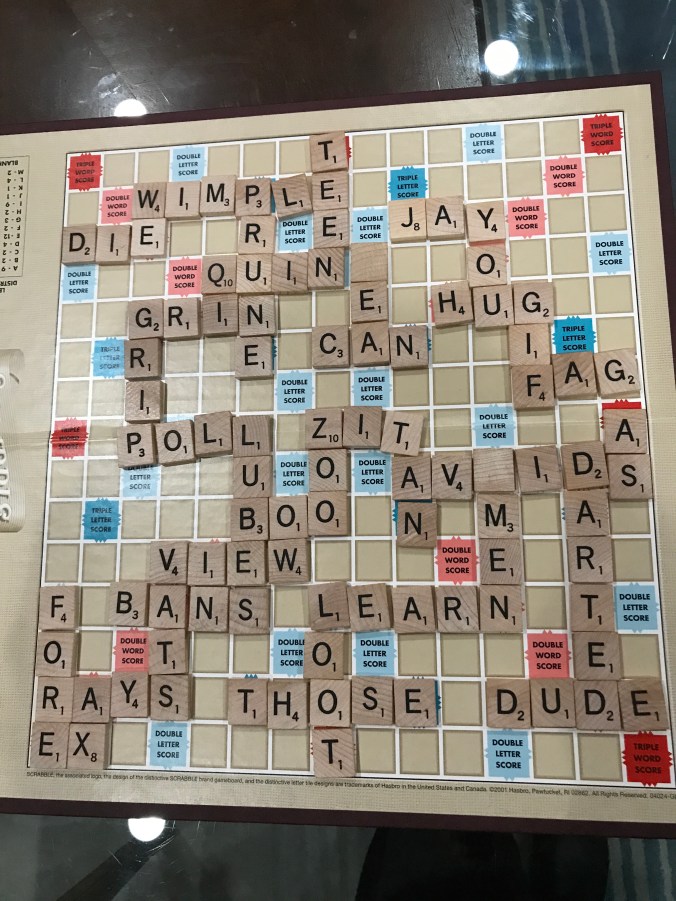
Once a week, on Wednesdays, Jeanne visits and brings good food and we pay Scrabble. When I played with her last Wednesday, I noticed the words I came up with related to my condition. Scrabble poetry. I spelled MINDS and then spelled ENDURES. I then added an S to ENDURE and then spelled WEEPS by connecting ENDURES to it. This gave me 41 triple word points. I beat Jeanne by around 100 points. Emotional Scrabble. My mind weeps and endures.

My husband hired a woman, Teresa, to be my companion two days a week. She takes care of a 94 year old woman in the evening, who is blind and has Alzheimer’s, so being with me a few afternoons a week, is more stimulating for her than that job. She said when this woman speaks, she talks to and about her dead husband as if he is there. Last week we walked a mile and half. She came last Tuesday (as she did again today), and it was freezing cold outside, and we stayed inside. We stayed inside again today. My yoga teacher, Krishna came, and while I was doing yoga, Teresa made the bed and did some light housekeeping. Last week I asked her to put together one of my Ravensberger puzzles, and I timed her on my iPhone timer. It took her longer to do it than it took me. She is 58 and has five adult children and grandchildren. Her husband died 8 years ago at the age of 62 from a blood cancer. She said he lasted 8 months. She’s told me a little about him. He was a New Yorker, and it sounds like he was inspiring to her. I showed her the documentary, The Forgetting. I showed her a video of Laurie Sachs (Looks Like Laurie, sounds Like Laurie) who had rapidly degenerating Fronto Temperal disease that began when she was 46 and killed her by age 52. Always the educator, I want her to know what she’s dealing with. I am still a teacher in a way. She asked if I like to listen to Dolly Parton. Has she heard the music of Lou Reed, David Bowie, or Patti Smith? Chopin or Debussey? This is the music I listened to and can relate to.
She is open to learning and is patient…and let’s face it, I’m stuck. I do need a reason to get up and push myself to get through some semblance of a routine, live through each day…somehow. I haven’t been drawing much at all, and though I still read, I am not retaining much. I am at the point that I need a companion to go out and take walks. I need someone to talk to. Everyday. My friends have abandoned me, except for Jeanne who visits on Wednesdays. So Teresa is for now my part time companion. To chase away the loneliness and keep me going.
She’s a petite woman, and I doubt she will be able to move me around, and shower me, if and when it gets to that point. My late mom during those last two years of horrible decline was sponge bathed in the hospital bed by the nurses and caregivers my sister and I hired. Awful. So if you wanna pray for me, pray for my passing before it gets to that point, because I will not be a docile creature that is easy to wash and feed if I can’t do it myself. And I can’t imagine my husband will give me sponge baths. So pray for me to not get to that point, because I hate this disease and do not consider that a life worth living.
On Thursday, Teresa texted and canceled and said she didn’t feel well. I texted her later and asked if she went to work with the 94 old woman. She said no because she didn’t feel well enough. What happens if an aide doesn’t show up when a person is truly bed bound and doesn’t have any family member supervising? I guess they just lay there and wait.
I stayed in bed until 12:30pm that day, until my husband texted me and urged me to push myself to get up. Without a destination or a friend to visit, or a friend visiting me, I am not motivated to push against the confusion and gravity that confronts me as soon as I get out of bed. The enormity of dealing with this when I’m alone is daunting. The chasm between my bed and going downstairs to dress and go through the rigors of the routine – dress, groom, brush my teeth, put on makeup, eat breakfast, is likened to crossing the ocean on a broken raft. For what? To sit alone in my house? But there was a Dementia Alliance International zoom chat support group at 4pm to attend on my computer, and those good friends who welcome me, would not have been happy to see me disheveled in my robe, and unkempt. So I pushed myself to go through the routine and ended up looking presentable. Glad I did as I got to see Paula, Christine, Dallas, Jerry, Deb, Paul, Roger, Bob and Kate. Actually laughed a bit and I had some fun online with my dementia buddies.
*****
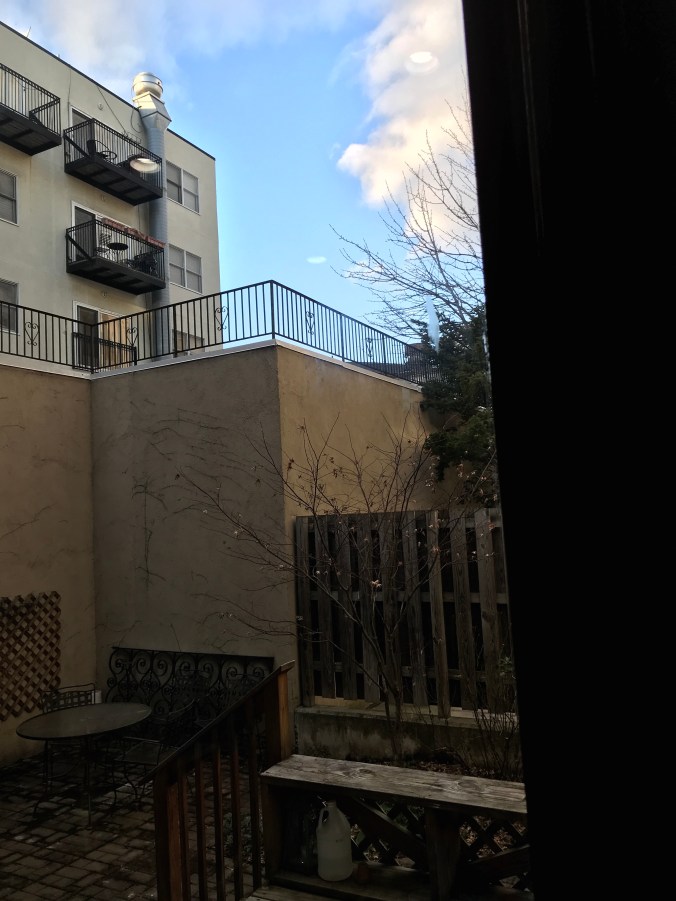
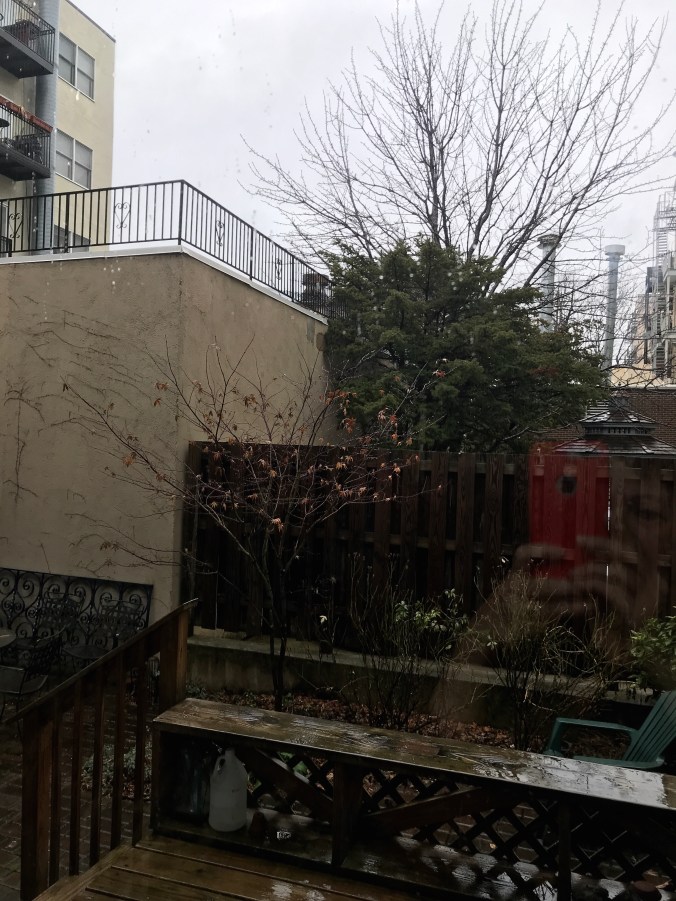
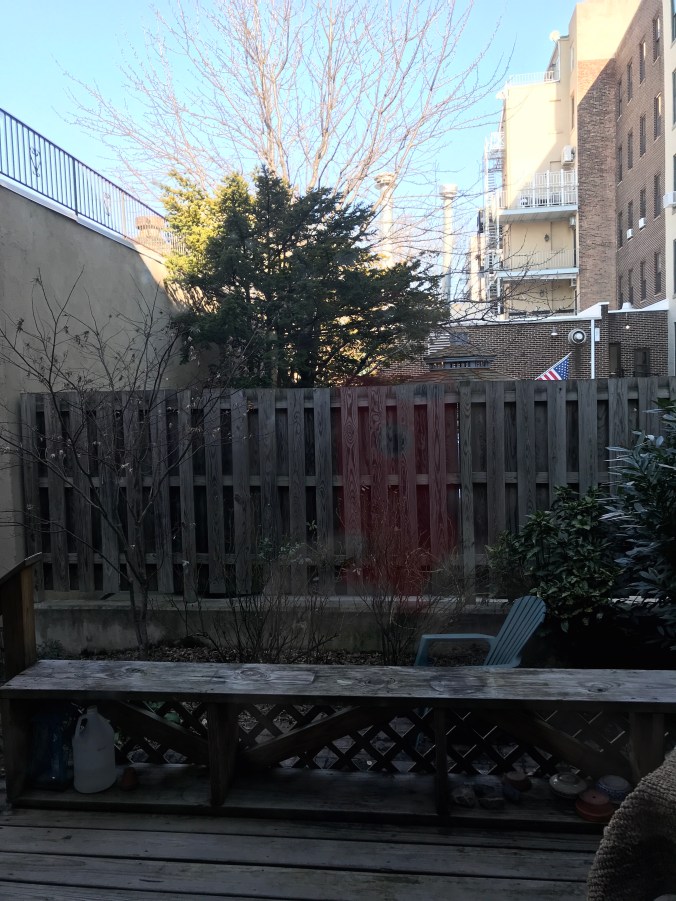
I still use the photographs on my iPhone to remember what I did do on certain days. But when there is nothing to do taking photos outside the patio door of the same view is more of the same and that’s when I know I have crossed the line.
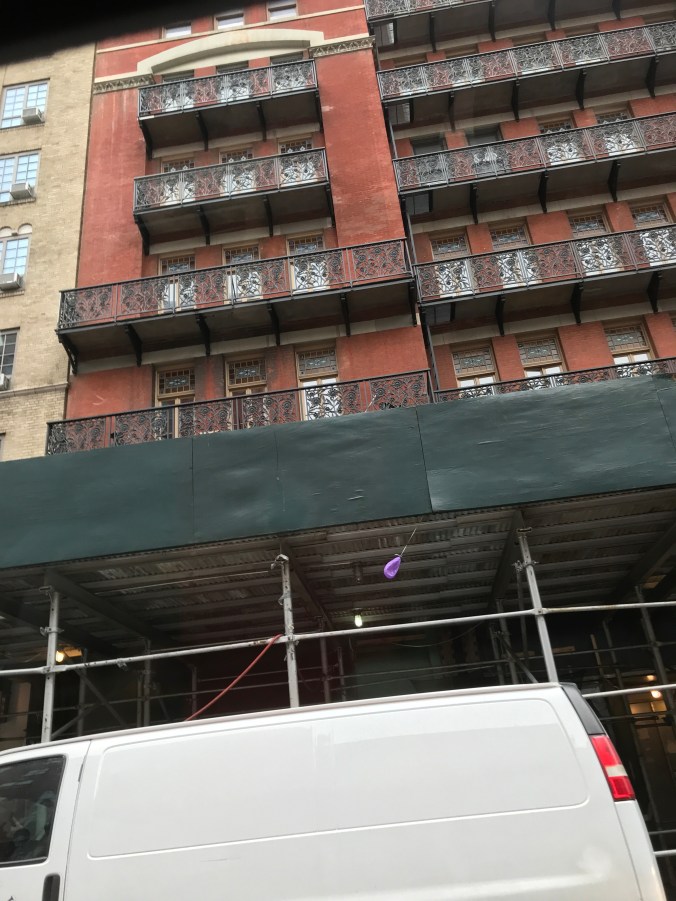
Once a month my husband takes me to The Rubin museum’s Mindfulness Connections program for people who have dementia. That is the highlight of the month, but also a stark reminder that I am not at all who I was. The photos below are from that day, Friday Jan 17. Entering the Lincoln tunnel, my husband at the wheel of his red VW. Passing the famous Chelsea Hotel on 23rd Street, which is being renovated. Introduced by the docents to a painting in the collection at Rubin called Ushnisavijaya and Celebration of Old Age. Kaumari, a repousse (hammered copper) sculpture of the Hindu goddess.
Maureen was there with her husband. Friendly and docile in her Alzheimer’s haze, she doesn’t speak much, certainly doesn’t participate, although her husband does. Scott showed up and I said hello. I would have liked to speak with him, but there was no opportunity. He also doesn’t participate, but I guess as a former plastic surgeon in the earlier stages of Alzheimer’s, he doesn’t have or retain much insight into the artworks. Still I wonder about this because he is able to speak and does have insight and clarity about life in general. He told me he is not afraid to die. said he has no kids, and his wife is dead from cancer. He has no remorse and is ready whenever it happens. Then an older woman, probably late seventies, was wheeled in by her caregiver. She was smiling and friendly, but when she spoke, what she said had nothing to do with anything we were looking at and it was obvious she was in an entirely different world of her own. It disturbed me to see her, pleasant as she was, she was in the museum, in this world, but not in it. I deflected and drew the attention back to the artwork we were looking at, and noted how the way the painting was organized reminded me of the registers used in ancient Greek and Egyptian art. Yes, I was freaked out by this woman who was no longer experiencing a reality that made any sense to me. Yes, it frightened me, because I never want to be like that.



*****
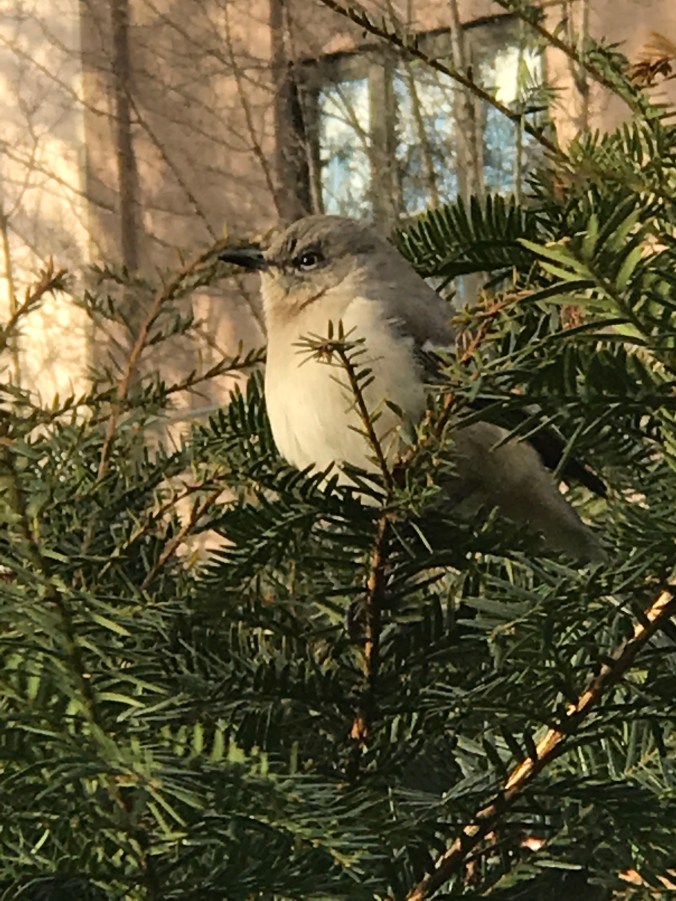
I have become much more housebound, and when Jeanne comes by on Wednesdays, at 2:30, I like going for walks with her. Since she only stays until around 6:30 and we like to play Scrabble, our walks are brief. The last time we went to the park, I spotted this bird sitting on top of a big bush. Jeanne is something of a “birder” and said she thought it was a Warbler. She asked me to send her the photograph I took, and she sent it to a woman at The Audubon Society. Turns out it’s a Mockingbird. A Northern Mockingbird.
I started to draw the bird from the photograph, trying to channel it’s composure, nobility and strength. It was coming out badly. I was unhappy to see that my drawing resulted in such a stiff semblance of this powerful feathered creature. My ability to capture it’s spirit was nil. I cut out an image of a piece of sky from a magazine, and pasted it over the top half of the bird. Not one of my better images but an image I made nonetheless, so I’m compelled to include it here with a little figure of a wolf howling up at it. The mockingbird is so-called because of its ability to mimic the songs of other birds. In fact, they have no call of their own. This way, they symbolize the power of the voice, its ability to draw or repel others, to make or break situations and relationships. I read that when you encounter a mockingbird, it’s time to stop for a bit and look into your heart for something that’s being left unsaid.

*****
So I looked into my heart and it took many weeks to figure out what was unsaid. I could see it on the list I write everyday. I wasn’t following my heart. Write to Raphael in my handwriting on my list, repeated day after day.
Raphael was my student. The one I gave my all to before I became ill. In fact, I remember telling him that when he graduated I would go into a kind of mourning period. ittle did I know then what would happen to me after he graduated. I would sink into depression and be diagnosed with Alzheimer’s. He studied drawing with me and art history. I introduced him to so many artists, took him to all the major New York museums, and mentored him. A brilliant young man, he is a master of languages. He speaks and writes Japanese, and taught himself Arabic and Hebrew. As my student I encouraged him, but he was also my friend. The last time I saw him was October 2016. He had already graduated and had started his college freshman year at The New School. This was at the same time that I was undergoing neurological tests at Columbia Presbyterian hospital. I had just undergone the Spect scan, and neuropsychological testing, and was told by James Noble M.D. that the pattern in the image of my brain was that of Alzheimer’s., diminished blood flow to my temporal and parietal lobes. When Raphael visited me in the fall of 2016, I was distracted and nervous. I didn’t want him to know what I was going through. I left him sitting at the kitchen island and took a call from my cousin Sandra who was calling me from England. I was on the phone a long time, speaking to her on the 2nd floor of our home, and left Raphael sitting there for the better part of an hour. When I finally got off the phone, Raphael was ready to leave. He tried several times over the course of that year and the next to get in touch with me and to stop by. I always made excuses for why I couldn’t see him, and then I stopped answering the phone when he called. A few months ago he called again, and left a message. I texted him that I would write him an email explaining what was going on with me. Months went by. I didn’t write him. Last Thursday, my husband took me to the hairdresser. As I was sitting getting my hair done, my phone rang, and his name came up on the screen. I didn’t answer it. Days went by and it bothered me. I didn’t want Raphael to think I was ignoring him purposely. I wanted to tell him what had happened to me. I wrote him an email and told him that I had been diagnosed with younger onset Alzheimer’s, and that in 2 and 1/2 years the disease had progressed rapidly, and that I had to resign from my position as the chair of the department in June 2017. A few days later he wrote me back and sent me some of his drawings. This is what I received.
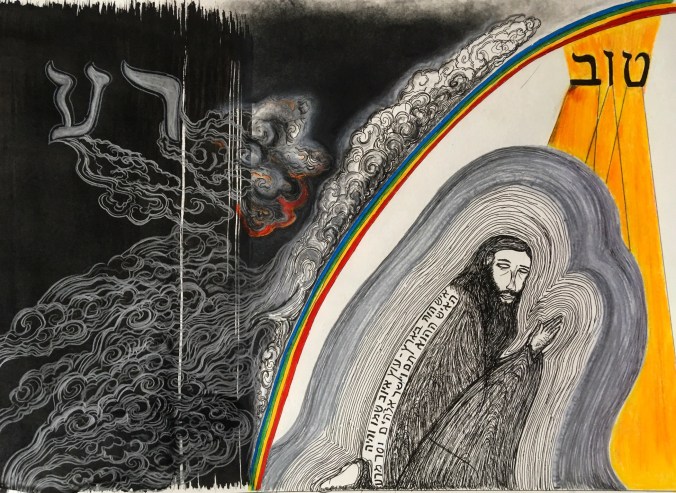
The Book of Job, Part I: “There was a man in the land of Uz named Job. That man was blameless and upright, he feared God and shunned evil” (Job 1:1)


The Book of Job, Part III: God’s fire fell from heaven” (Job 1:16)

The Book of Job, Part IV: “Naked came I out of my mother womb, and naked shall I return there” (Job 1:22)


 Portrait of Minna and granddaughter Ellie – January 2019
 I was resilient until this disease took over. I could shrug off difficult things and recreate myself. If something didn’t work out, I would plan my way out of the quagmire. This was possible while I was still working. I had goals and was always very busy. Before I progressed. Once I had to retire from work and could no longer do the things I did independently, the feeling of futility and emptiness generated by a childhood that had me always looking for love, came back to haunt me. I became dependent, helpless and with an endless need for attention. Maturity guards against these feelings, and while I was living a worthwhile productive life and succeeding in my career, I thrived. If a relationship didn’t work out, there were other relationships. If a goal could not be attained, there were equally satisfying goals to go after. There were self help books, therapy, interesting new people to meet, ways to thrive. Now all of that is gone. Now there is Scrabble, drawing, crossword puzzles, television. The simplest things are hard to do. Dressing, going to the bathroom, getting out of bed and brushing my teeth. I am regressing to a state of infantilism, and I have been fighting this as much as possible. I am still fighting this unbeatable foe, but I’ve needed support. Ruth was my support. My encouragement. I needed that and now it is gone. I warned myself that I was becoming too dependent on her. Prescient.

 And here is my husband preparing food for me for the next days, assembly style. He’s always pragmatic.
 Finally these three tomatoes caught my eye, and I told my husband that I would like to draw them. I told him I thought they were beautiful.
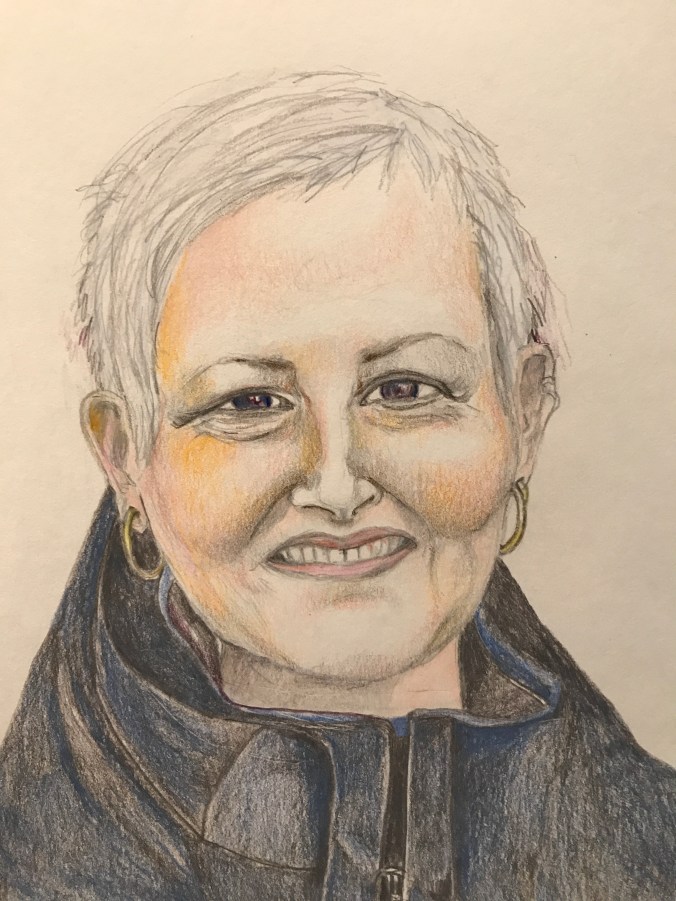 This is a drawing of Dina who is a lovely woman who I wish I would have known while I was well. She’s a sociologist and her daughter was my art and art history student, but I never knew her well. In fact, I did not know her at all. She was just someone I would see dropping off her daughter at school, and occasionally greet her and say hello when we were both at the synagogue. Dina came to my aid through the synagogue. She read about this woman who has younger onset Alzheimer’s on a posting that the rabbi and secretary sent to members. She didn’t know I had been her daughter’s teacher. She did know that I could no longer prepare meals for myself, as that’s what the anonymous posting said, and started bringing lunches and dinners. She started visiting in September and has come about twice a month. At first I had a lot of trepidation about this. But once she started coming over, she confided in me that her brother-in-law had a stroke and is in a wheelchair and can’t speak. Obviously it was a serious stroke, and she has experience, empathy and a good deal of understanding that a person can suddenly lose physical and cognitive ability, and that the brain, this mysterious master of our lives – can be damaged irreparably. She had never met anyone with younger onset Alzheimer’s before, but she’s a sociologist, a good soul, and she is interested in people. Sociology is the study of the development, structure and functioning of human society, and the study of social problems. I think Dina knows that people with Alzheimer’s are still quite human and need to be treated as such, and it is a social problem that people who have Alzheimer’s are ostracized.

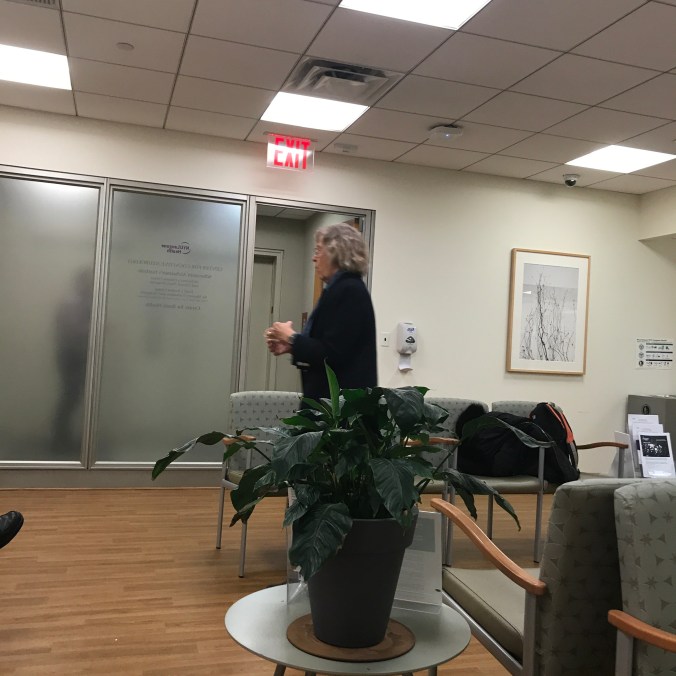
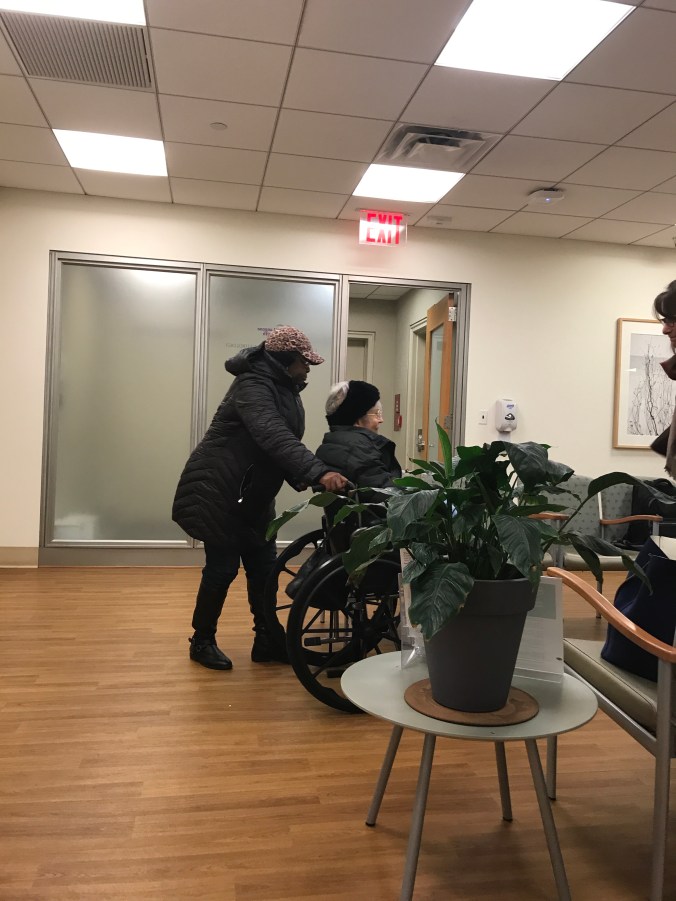 The woman being wheeled into the waiting room is an Alzheimer’s patient in her early 80’s. I watched as her 2 caregivers tended to her, removing her hat, adjusting her hair, crossing one leg over another for her. She looked like she was smiling. Later, after my appointment, I spoke to her aide. The woman had already gone into her appointment. I asked her about the woman and she told me that she speaks very little and does very little for herself. She said that 2 years ago she was able to dress herself, and spoke a lot. She said she naps a lot during the day, and lays awake in her bed at night. She said her demeanor is calm and content, and she was glad that she took care of an Alzheimer’s patient with this kind of nature, as she’d heard that some Alzheimer’s people are angry and violent. Again I was confronted with the misconceptions about this disease. Are people either calm and content, or angry and violent? This woman is in her 80’s and I guess she is taking the disease in stride. But I’m 64 almost 65, and I am not able to take this disease in stride. There is nothing worse than younger onset Alzheimer’s. It cuts a person down and destroys them when they are still strong and functioning, and little by little makes functioning, processing, living – impossible. It kills a person bit by bit, and since younger onset usually goes faster, it does this in a few years. I hate this disease.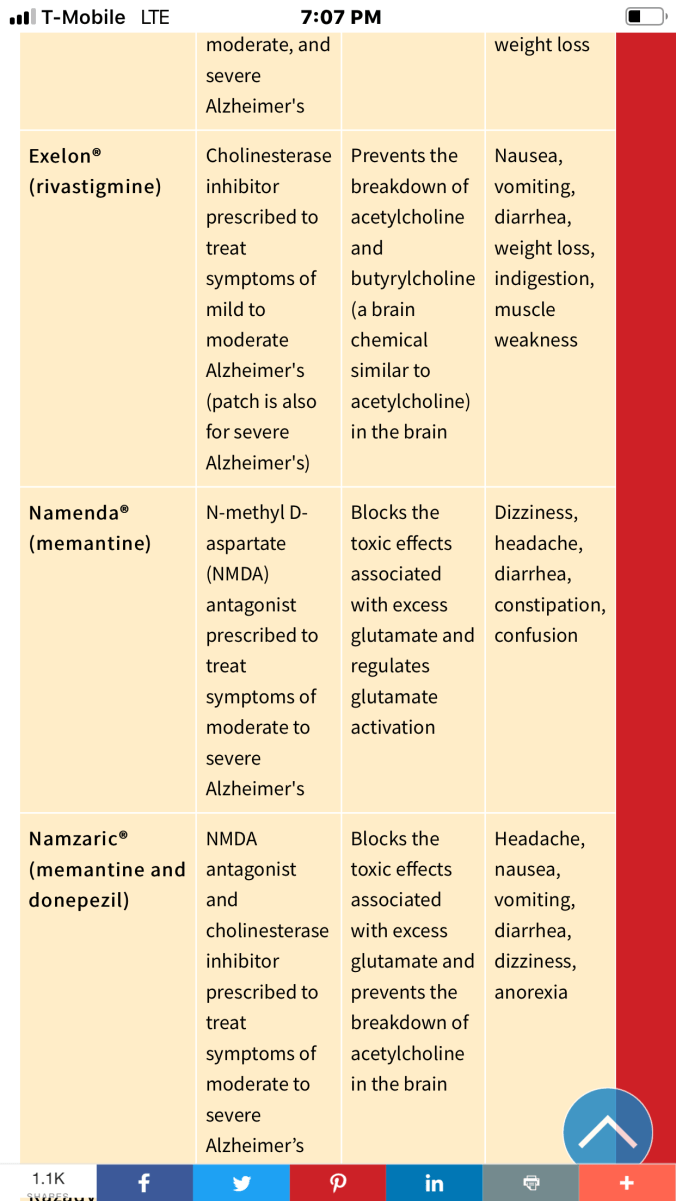
 On the ride back from the neurologist, we passed Macy’s Herald Square. There was a huge sign made up of little lights that said “Believe”. I asked Ruth what she thought this meant. She thought it meant they were telling us to believe in the birth of Christ. I looked it up on my iPhone and it showed that it was there to promote writing letters to Santa for the Make a Wish Foundation. For every letter received Macy’s will donate $1 up to $1 million to grant the wishes of children with critical illnesses. Nice sign. Believe. Believe that wishes can come true?


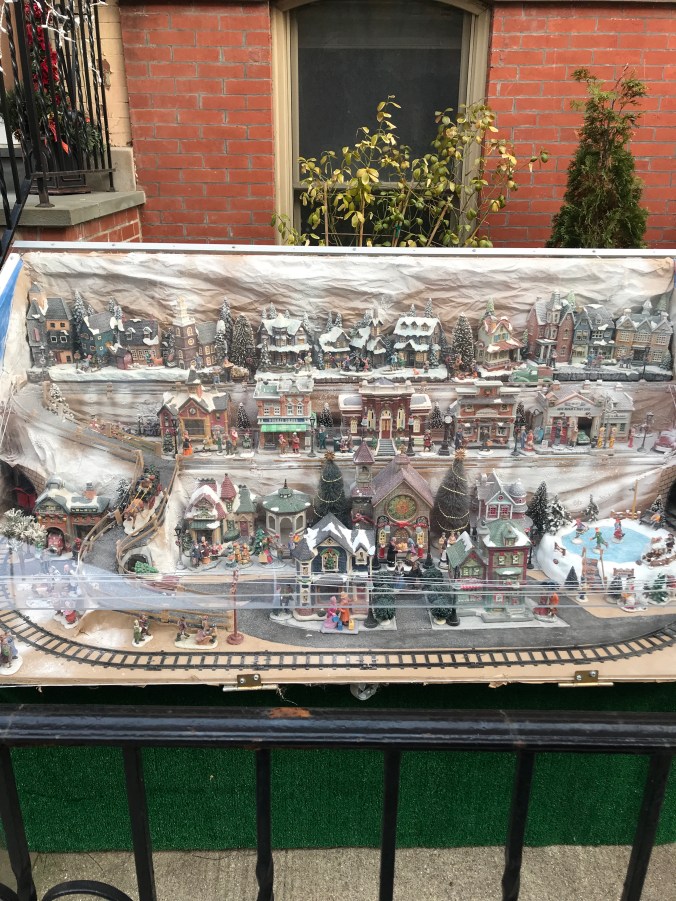 This was taken on Saturday, Dec. 8. I snapped it when my husband was walking me to Ruth’s. It’s a Christmas display outside of a house a block away. I used to think it was odd that some people who live in this city, would never go to New York and would hardly ever leave this town. I used to think how small their lives were. Now my life resembles theirs, but not because I have no reason to go and see and do. It’s mainly because I can’t. So I look at things in my environment, and photograph them to remember.
 On Thursday, Dec 6. I had an appointment at the hair salon. I go every six weeks, but getting there has been increasingly harder and functioning while I’m there creates anxiety. It’s only a half mile away. Ruth was going to come over and walk with me and we were going to come back here together. While I was stark naked in the bathroom trying to get dressed and ready, she called and said she couldn’t come with me, and had to go the eye doctor. Something was happening to her right eye, which turned out to be macular degeneration. She told me to cancel the appointment and postpone it for a week. This was the beginning of Ruth not being able to spend as much time with me. She has her own degeneration to deal with. I got dressed and ready and pushed myself to eat and set my alarm for the time I would have to leave my house to get there on time. I was concerned about how I would remove my coat and sweater, and how to hang them up so I could put them back on myself when it was time to leave. I didn’t know if i should put my sweater under the coat when I hung it up, and how I would put my sweater on, while I held my coat. I was concerned about dealing with my wallet and paying, and all the details of coordinating my things. I was concerned about what to talk about to the hairdresser, who does not know I have Alzheimers. I am very quiet when I’m there. I’ve become much more withdrawn since I noticed nonsensical babbling coming out of my mouth, and aphasia and word finding with stammering, has happened. I used to ask a lot of questions and engage with others while I was there. I don’t do this so much anymore. I asked my daughter to be available to text and my husband too. This is the anxiety of Alzheimer’s. Just going out and functioning in public places is getting harder. The triumph in this was that I was able to go there myself and get my hair trimmed and roots colored, pay for it and get my wallet back into my purse with the credit card and receipt inside, and get home by myself. Every action I take requires procedural thought and action, and my physical motions, actions, and thinking are really out of sync.

 On Wednesday’s, Ruth’s sister Jeanne, usually brings me a meal and stays to play Scrabble. Ruth is almost 73 and Jeanne is 77. I’m 64 almost 65. I would not have been friends with either of them if not for Alzheimer’s. They never knew anyone with younger onset, and their empathic natures brought them into my life. They are both rare in that they’re wise and compassionate, and willing to learn. But they’re both dealing with the setbacks of their own aging and their ability to be engaged with me is limited. Before playing Scrabble with Jeanne last Wednesday, I wanted to see if I could still do this Ravenberger puzzle that says it’s for kids 4+ years of age. It’s been on my table since the summer of 2017 and it used to take me 9 minutes to do it. This time it took 17 minutes. Different parts of the brain are used for different actions, and it seems that the visual, perceptual and physical are more affected in me. I say this because language and words when I play Scrabble with Jeanne are not so impaired. Our Scrabble scores that day were me- 324 points, and Jeanne 202 points. I usually beat her at Scrabble, but she has beaten me once. I can see how to add a letter to words and build a new word. After Scrabble, I set up a plate of the food Jeanne brought. That’s when the confusion really begins. The actions I need to take transferring food to a bowl and a plate, pouring the drink into my cup, heating the food in microwave, bringing it to the place where I sit at the kitchen island, and then chewing and swallowing are tasks that I have trouble with but still can do. I used to love food. Now the procedures of eating and cleaning up after myself, are tasks that I have to concentrate hard on to complete. There are many steps to it, and I get anxious when Jeanne wants to leave before I am done. For me time is endless now, and people have lives and need to leave. It’s that moment when they go that is hard for me. Being alone is hard for me. Which is why I write so as to be heard. Makes me feel less alone to describe my experience.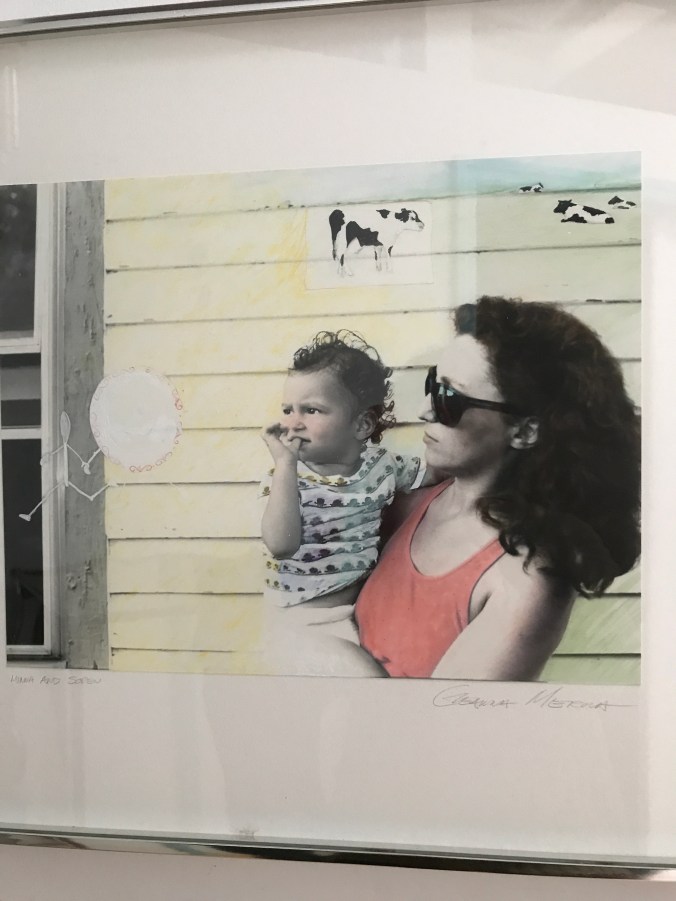
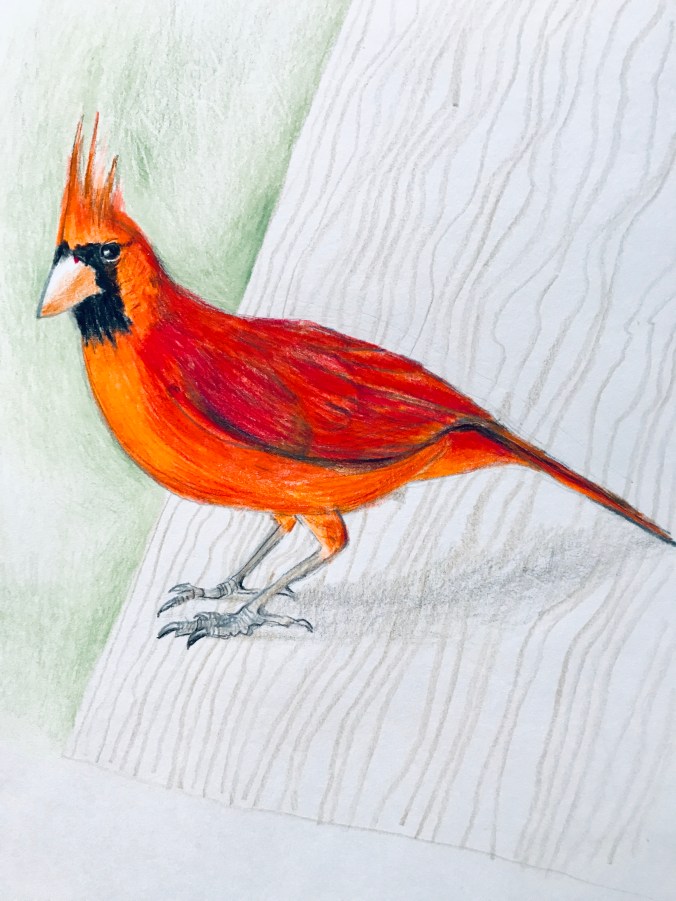 I am making this phrase, The Cardinal Truth, my own. I do not mean the cardinal truth as a symbol of the four virtues – which were recognized in classical antiquity and traditional Christian antiquity – temperance, courage, prudence and justice. I mean to refer to the idea that we must walk in spirit in all things, and listen with our spirit to all things.

 The library is on 5th Street. Make a left and cross Willow Ave, go past the building where my friend Zehava lives, and it’s there.
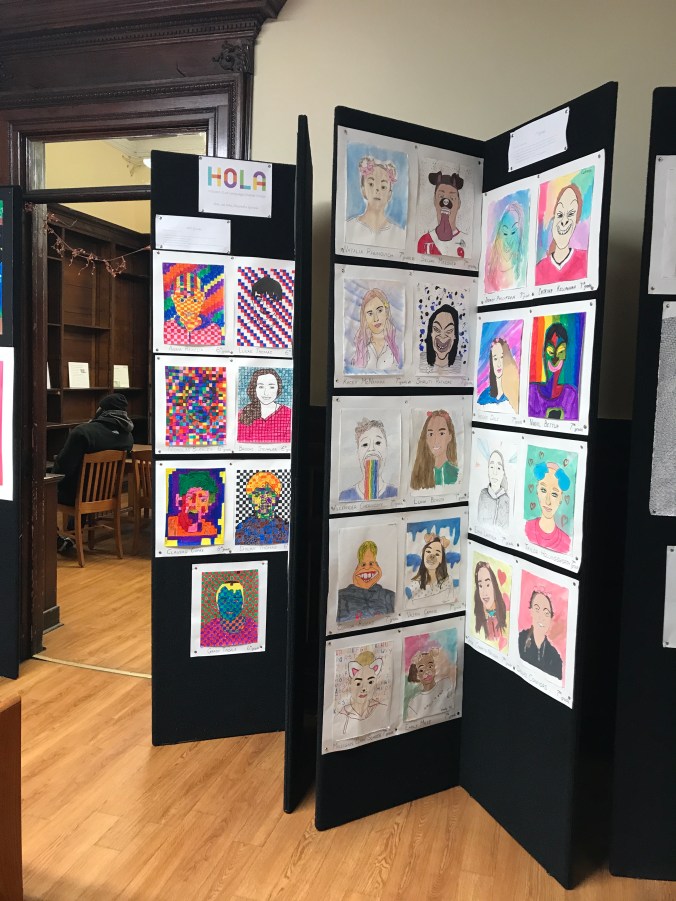 First thing we saw on the second floor was a student art exhibit from a local charter school. Looked sort of like the kind of installation I would prepare when I set up local exhibits of student work. Sadly it reminds me of what I can no longer do. I had to retire in June 2017, after pushing myself to keep going that term. I didn’t want to, but I could no longer do the work with the students, for so many reasons. I caught a glimpse of an artwork by the brother of a student I worked with privately around the time my mind started to scatter. Not a big surprise that Leo is talented and imaginative, as his sister Grace was. His detailed and funny illustration of freaks and geeks in some kind of extraterrestrial room, goes beyond the rudimentary examples around him made by other students. I recognized his last name and the grade he is in and realized it has been 3 and 1/2 years since I recognized the symptoms of this disease. Grace was studying privately with me in July 2015, and my mind was starting to jumble then. I remember.
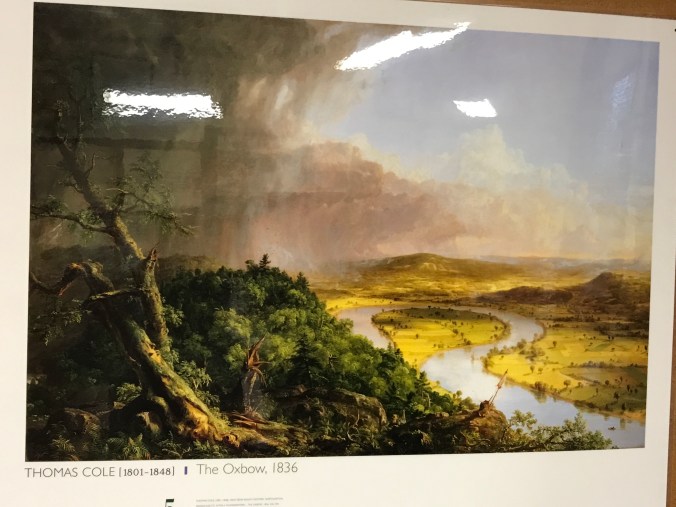
 Then we into a large room with historical memorabilia. I saw an image by the American painter, Thomas Hart Benton, whose work I would show my students, and The Oxbow, by Thomas Cole, who was the founder of the Hudson River School of painters. I used to use The Oxbow as an example of painting landscape in deep perspective.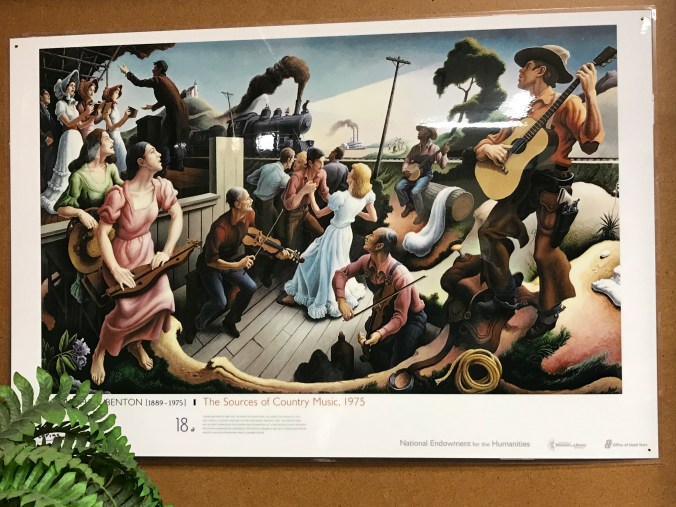
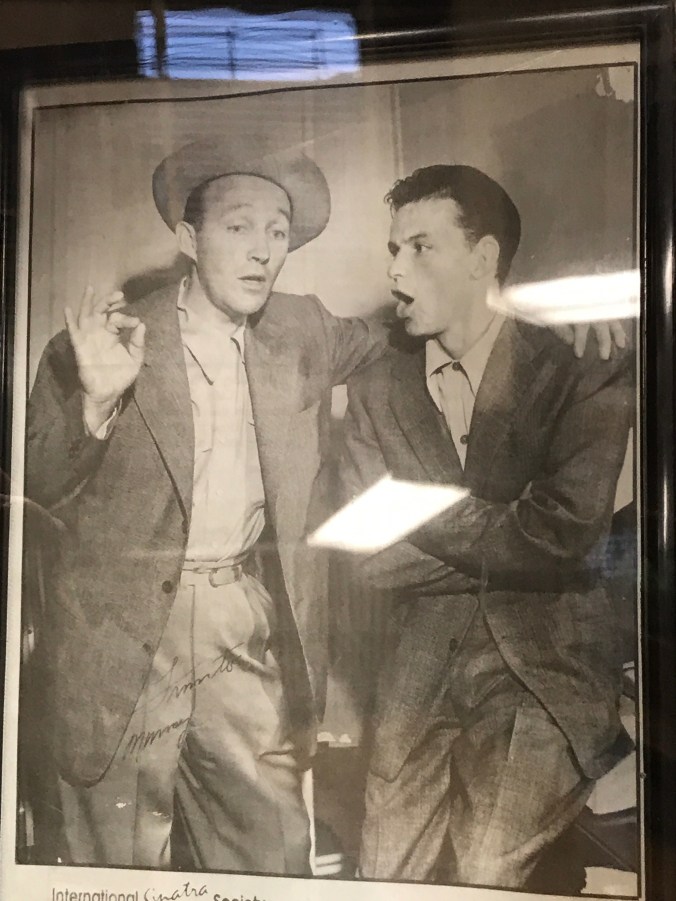
 Anyone who knows about Hoboken history, knows that Frank Sinatra was born here and grew up here. The rest of the room is dedicated to Sinatra. Photographs of his early years line the walls, and a life size cardboard Sinatra stands in a corner. I immediately recognized Bing Crosby in the photo with Frank. The street along the Hudson River is named Sinatra Drive.

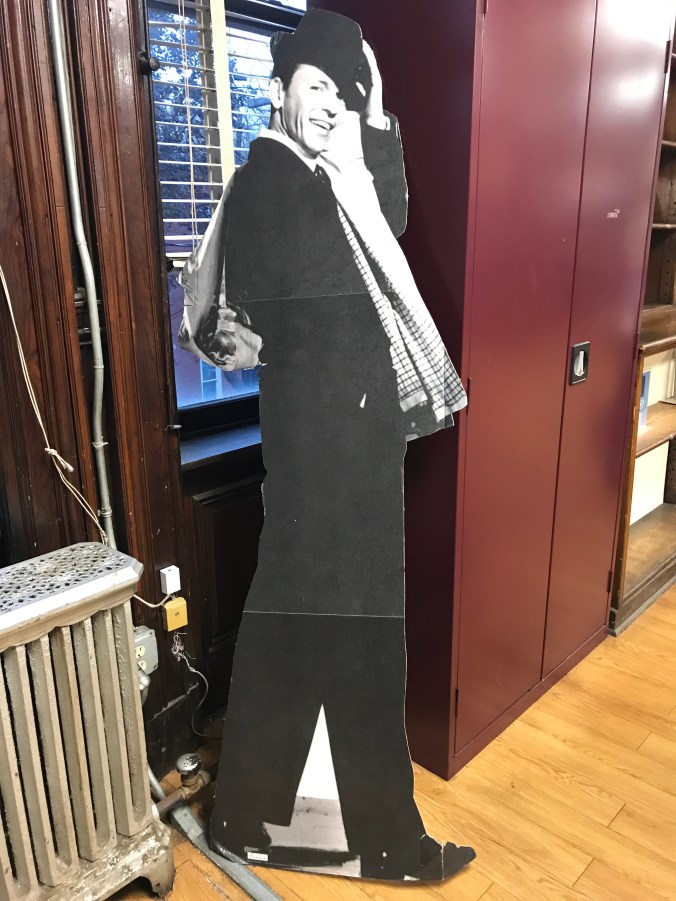 I’m realizing that my writing and photographs are becoming like a show and tell. I wonder what cognitive age this resembles. Am I like a 12 year old adult, maybe a 10 year old, by todays standards, maybe 8. I understand that this is intellectual regression. I still want to share and communicate, but I am now more limited, and it’s using the skills I still retain to show and tell. I hope it isn’t tediously boring. I’d much rather be writing imaginative stories, but my reach into the world of imagination is pretty spotty at best. I can still follow a storyline, and choose great movies and series to watch on TV. My ability to delve into a place that is imaginative where I could express something original and creative is limited to the few dreams I still have. A recent one I remember- I was in my daughters apartment, and her boyfriend was going to take me to the subway so I could get home from Brooklyn. I told him that I didn’t think I should take the subway, and to call an Uber. As we were walking to the door, I looked into the bedroom where my daughter was sitting on the bed. Her boyfriend dressed differently was walking into the bedroom. He was both walking me to the door, and also walking into the bedroom. There was TWO of him. I have read that in Lewy bodies dementia, people sometimes see two of the same person– but in a dream!!!? Maybe I have Lewy bodies too.

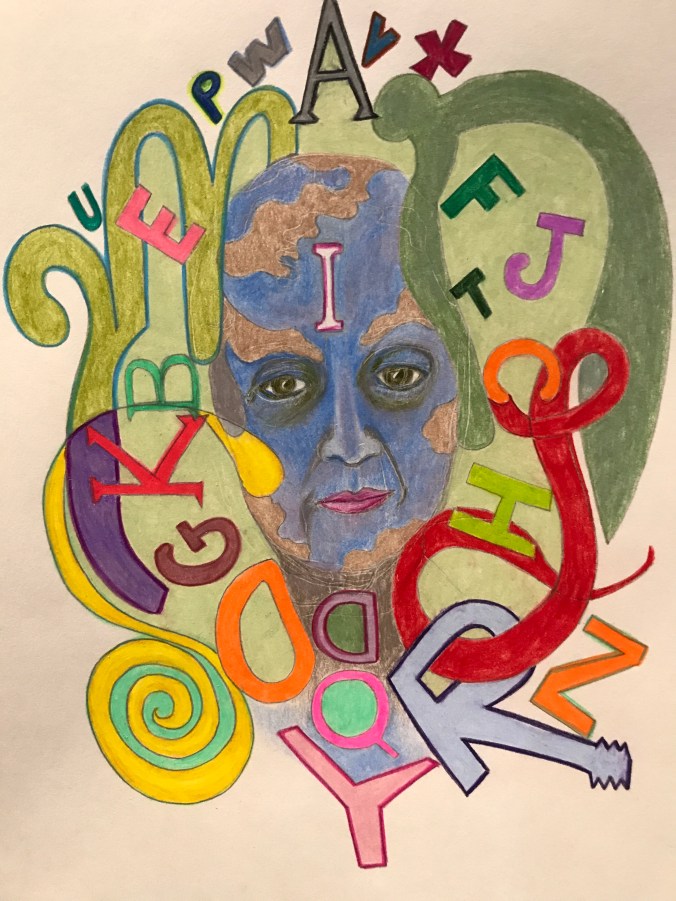 Word Salad is what I call the drawing. Not one of my studied and pretty drawings, but rather an illustration of what things have been like for me. I’ve been finding myself coming out with sentences that have no reference to reality now. I notice that it happens when I am very stressed. I wrote down that I heard myself say, “for self of it”. What the hell does that mean? It is obviously meaningless. Lots of what I am saying now is meaningless babble. I even find myself looking in the mirror and saying things I don’t understand. Things like, ” goings of it, when there is some places to do”, is something I wrote down when I heard myself say it, and “that’s how it is, when it happens it gets there” is another one I wrote down today. These are word jumbles and I don’t understand why this happens, except to see that it means I am progressing. I looked up Wiernicke’s aphasia.


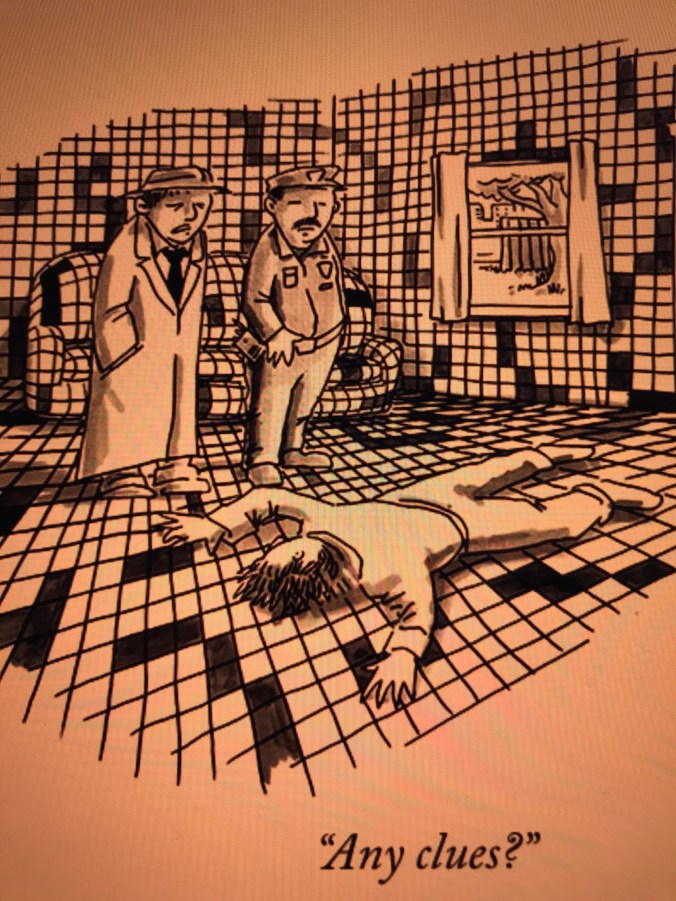


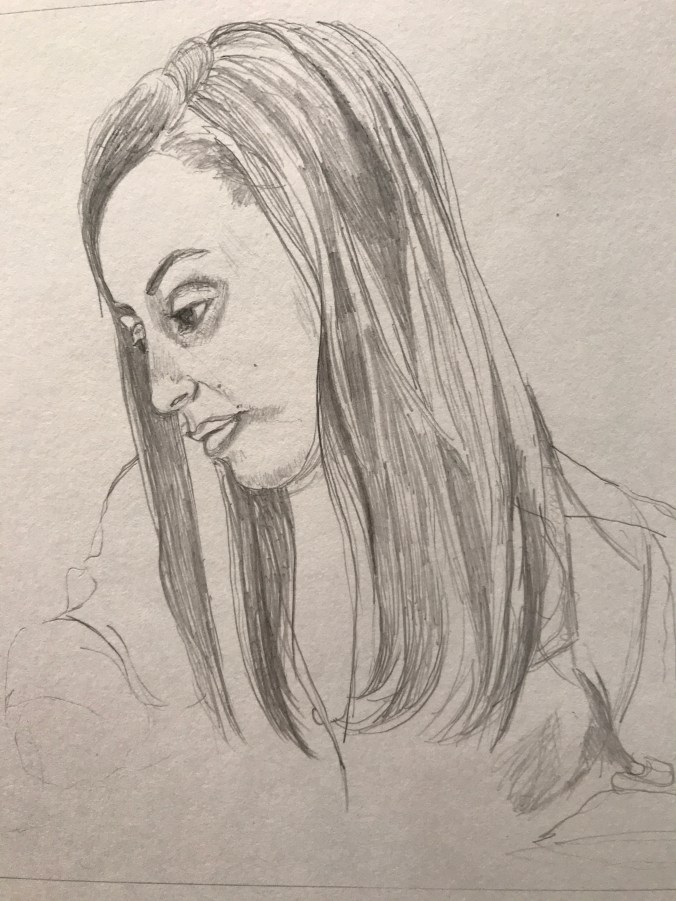
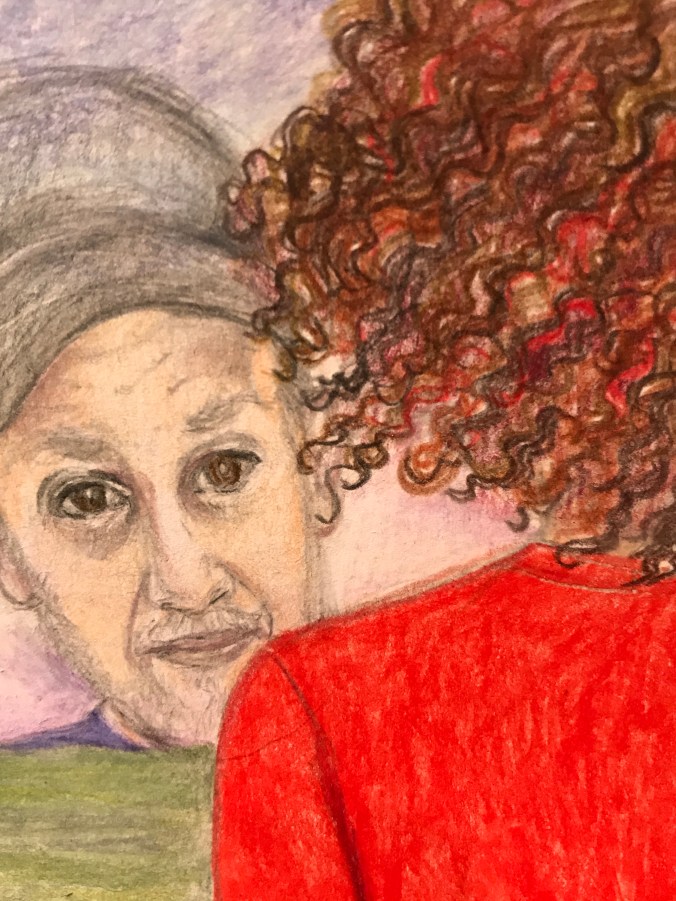
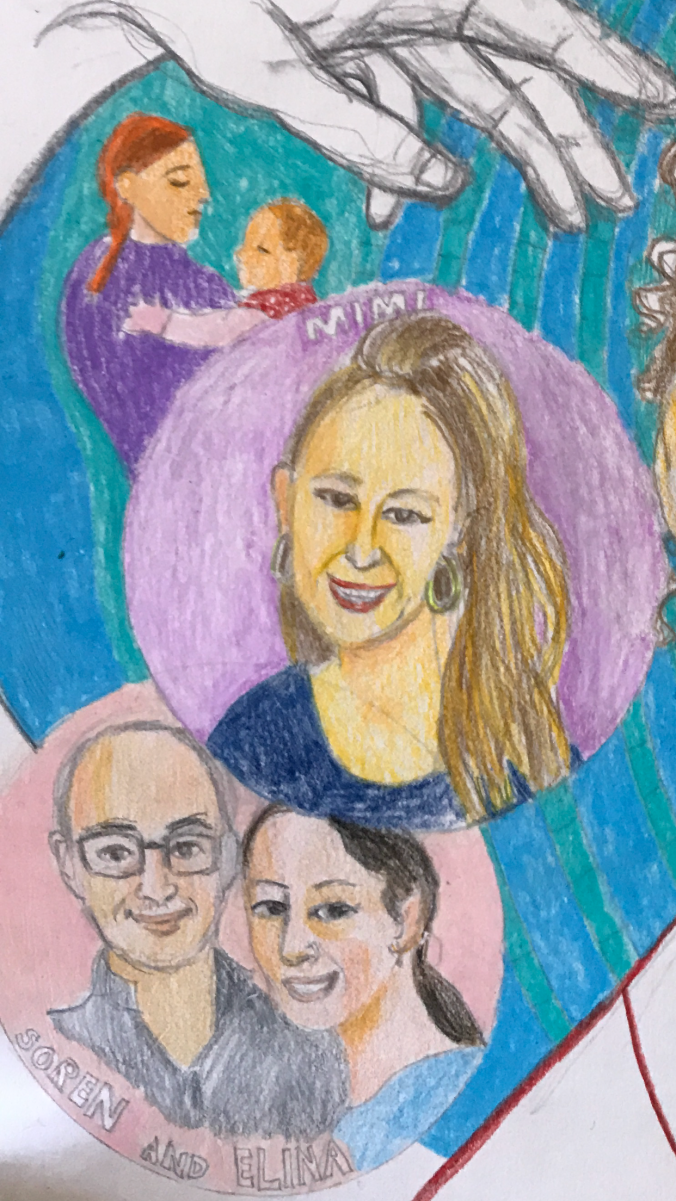 A few more memories before I sign off. Today I took a walk on Clinton Street. I passed a demolished house in a beginner construction site where a low building stood. It will obviously be another condo building. The cookie cutter buildings are all over the city, crammed in, side to side. My daughter had a friend who lived in this little building many years ago, whose name was Jordan who had a little brother whose name I don’t remember. Her parents were Susan and Stuart. I remember that Susan loved flowers, and always had fresh flowers in vases. I would go over there frequently with my daughter and the kids had a lot of fun together. They moved to the New Jersey suburbs and the friendships didn’t last.
 Michelle Araujo Untitled Oil, oil stick and tape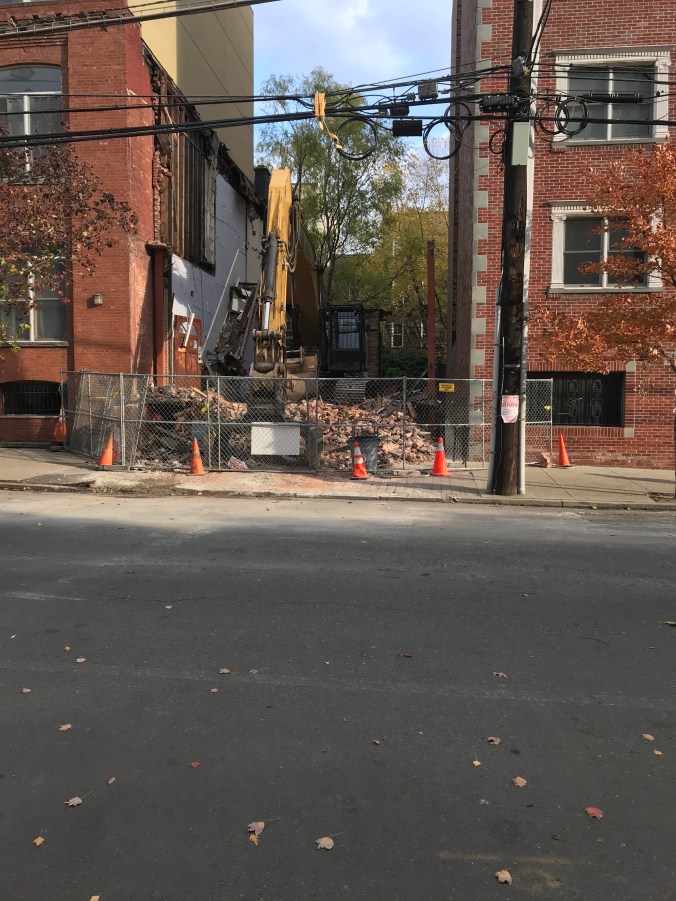
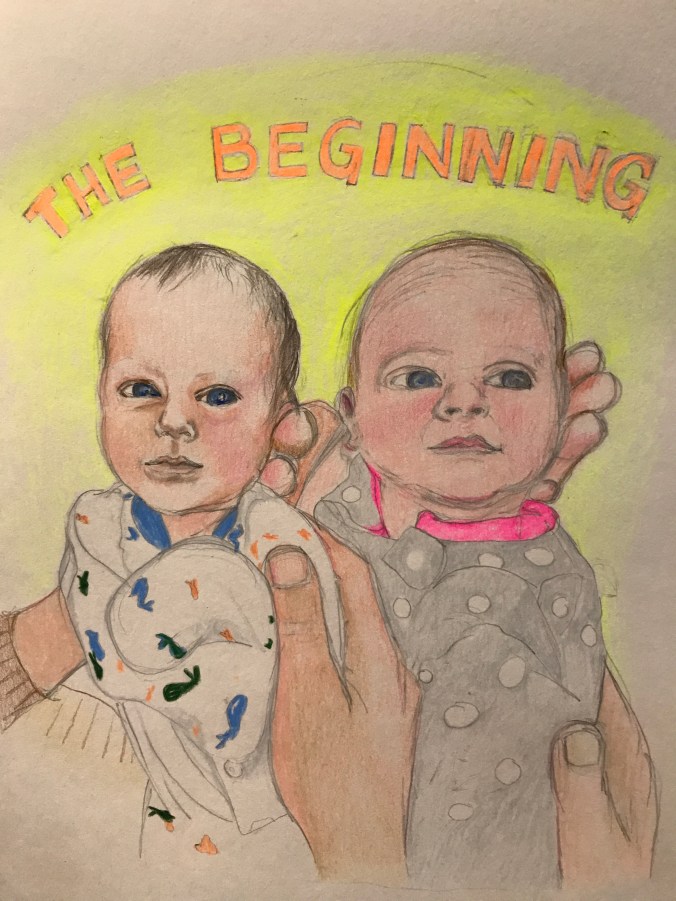 This is my drawing of Michael and Sara, my twin grand babies, born on October 11.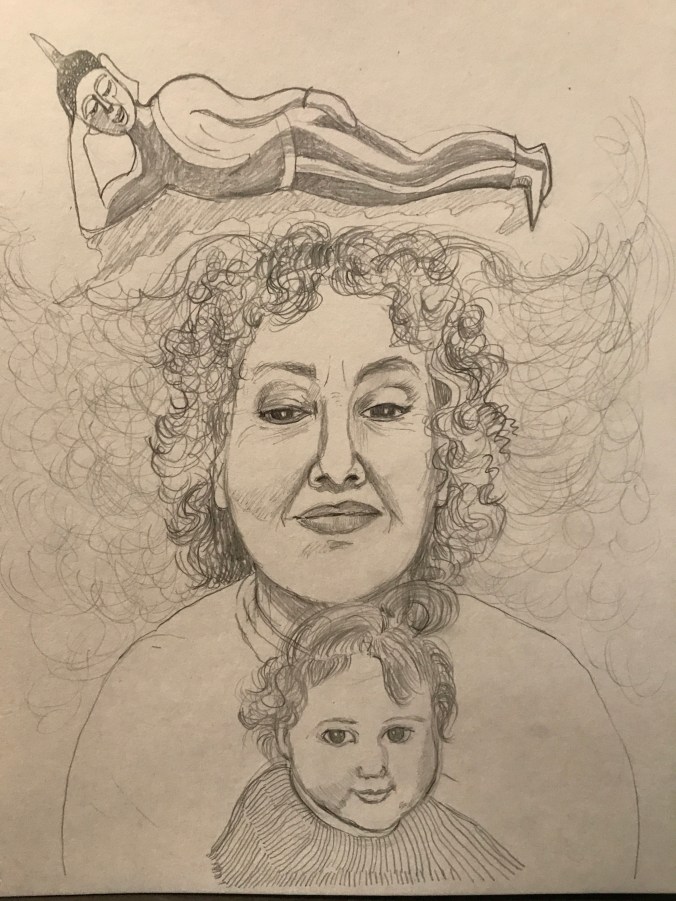










 Half moon phase

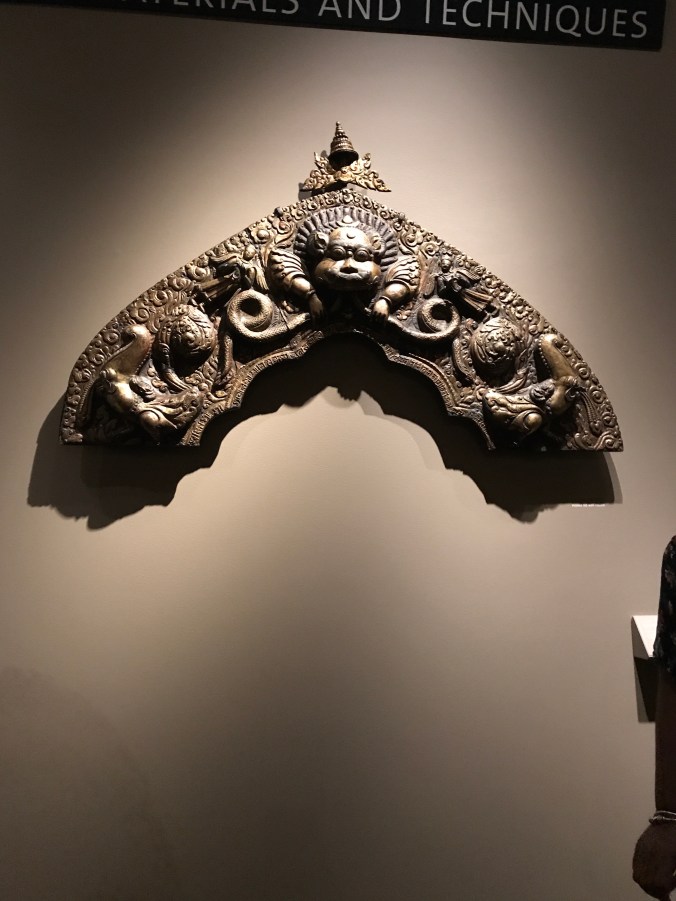 Torana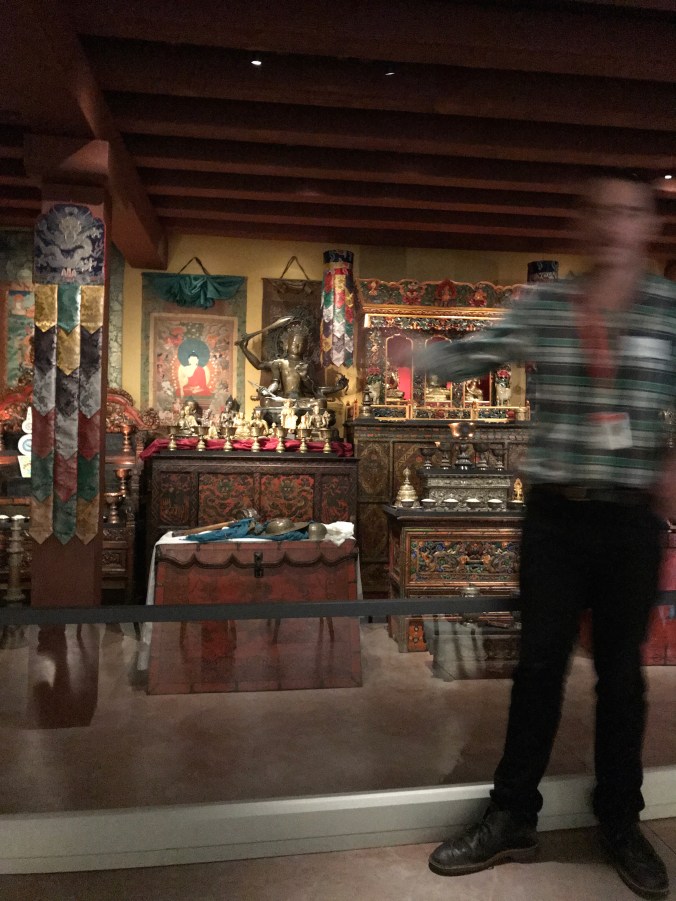
 The program is always over too soon. My attention span is longer than many who come here. I used to spend hours in museums looking at and discussing art with my students, and I wanted to see more. I asked Dawnette to tell me about an installation called The Road to Sanchi by an Israeli artist, Ghiora Aharoni, which was installed to the left of the Tibetan shrine Room. Obsolete taxi meters are outfitted with video screens that capture Aharoni’s travels to sacred sites across India for Hindus, Jews, Muslims and Buddhists. The title refers to one of the most important sites in Buddhism, famous for it’s Great Stupa built over the relics of the Buddha. Sanchi and the other sites, including the oldest synagogue at Mattancherry, the Sufi shrine at Nizmuddin in Dehli, and the ghats of Varnasi, are never seen in the videos. The journeys become the vehicles for examining the prism of time and the act of pilgrimage.
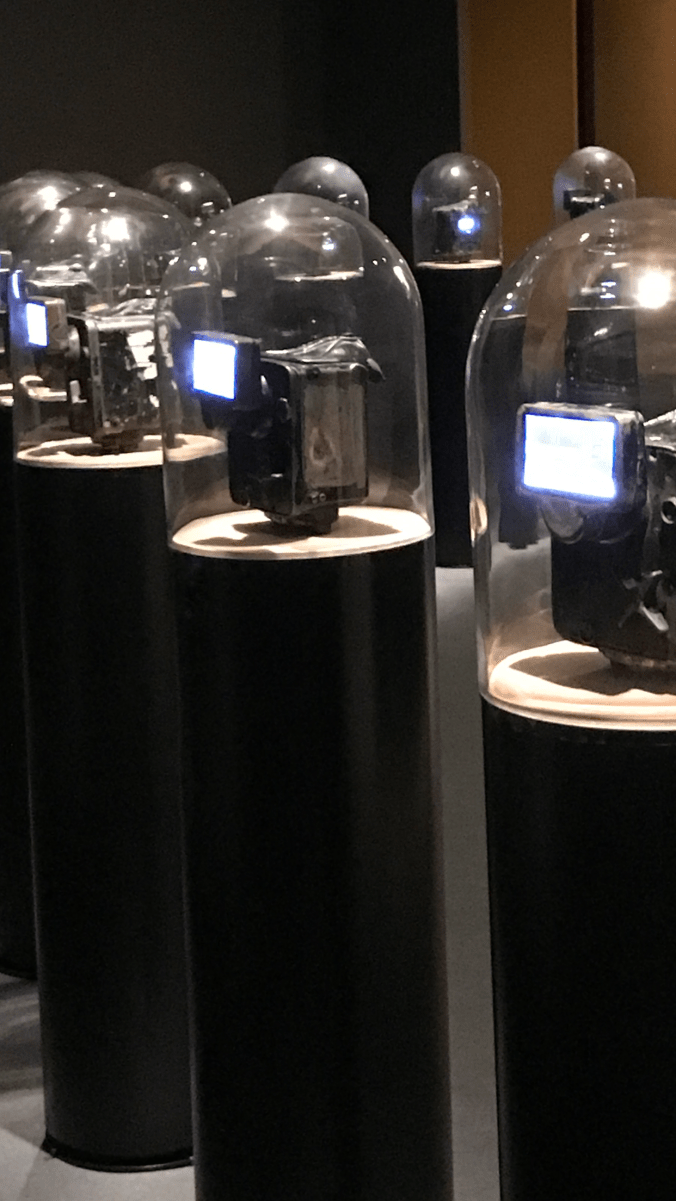 These objects, discarded obsolete taxi meters with films of journeys to pilgrimage sites, made more sense to me as art – spoke more to me about my condition and yearning for spiritual peace, than any of the ancient objects we had seen that day.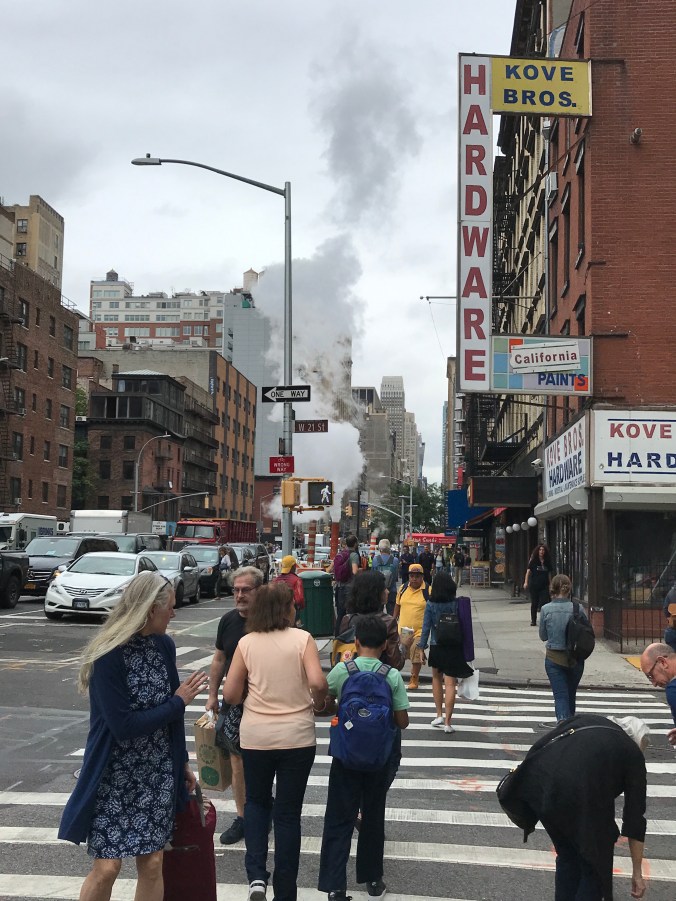
 We’re behind a truck on route to the Lincoln tunnel. I see how the museum and the art carries over into the street. Serpents and bodhisattvas. Serpents painted on the back of a truck. Symbols everywhere. Art is everywhere. Warriors of the spirit.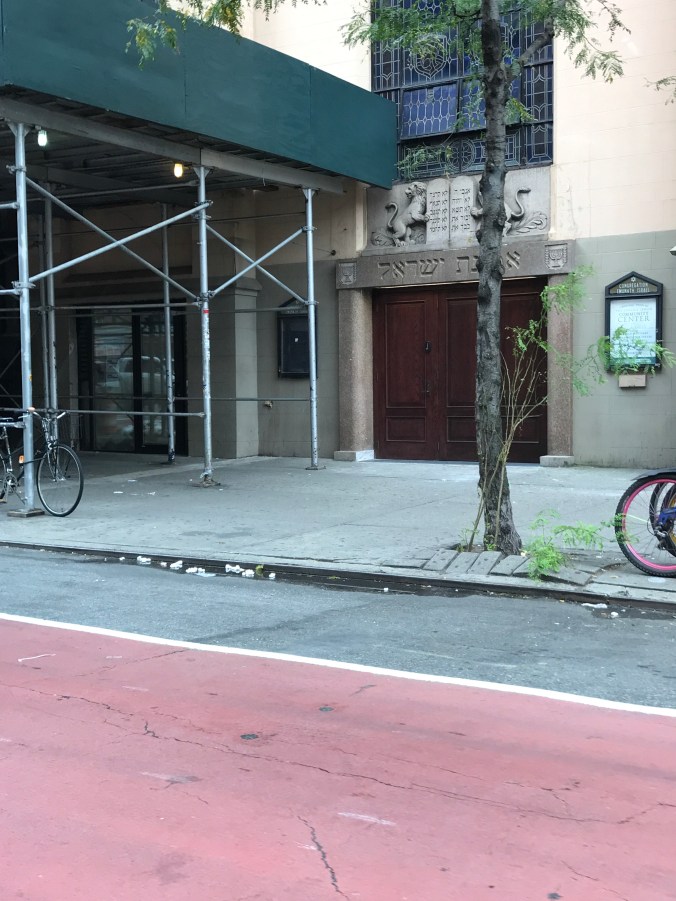
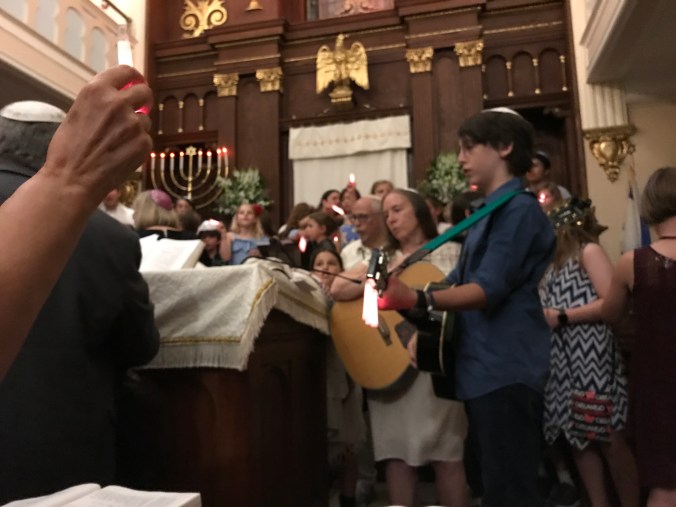
 Rosh Hashanah has arrived, and it’s 5779 in the Jewish calendar. A lot has happened since last year at this time, but because of progression of my Alzheimer’s, I do not remember everything. I take lots of photographs and remember what was happening when I took them. This helps me remember more and helps me remember what happened in certain months. I looked at photographs from September of last year, and thought about what I felt like around Rosh Hashanah last year. I had resigned from my position as chair of the art and art history department. I was very sad. I didn’t know what having Alzheimer’s would be like as I progressed and I knew that the disease is about progression. I had just started the blog. I was researching and researching. I was already having problems getting dressed. My dementia mentor Laurie suggested I put my clothes on a hanger the night before. I remember that I was very lonely. I spent the entire summer in my house. I hardly went out. My son and his wife and our baby granddaughter visited and we drove to their home a few times. My daughter slept over a few times. My husband did not understand my lack of motivation. All of my friends had abandoned me when the diagnosis of Alzheimer’s was made. People I used to spend a lot of time with disappeared. I had few places to go and going to synagogue was an attempt to reconnect, to rejoin the community. I knew I would be telling people I have this disease. I didn’t know what to expect. Would I be rejected by the Jewish community? How would I as a person with impairments be able to interact? I told my former film editor, Harry. He confided in me that his late father had had Alzheimer’s in his 70’s. He began visiting me and suggested I get a home health aide.
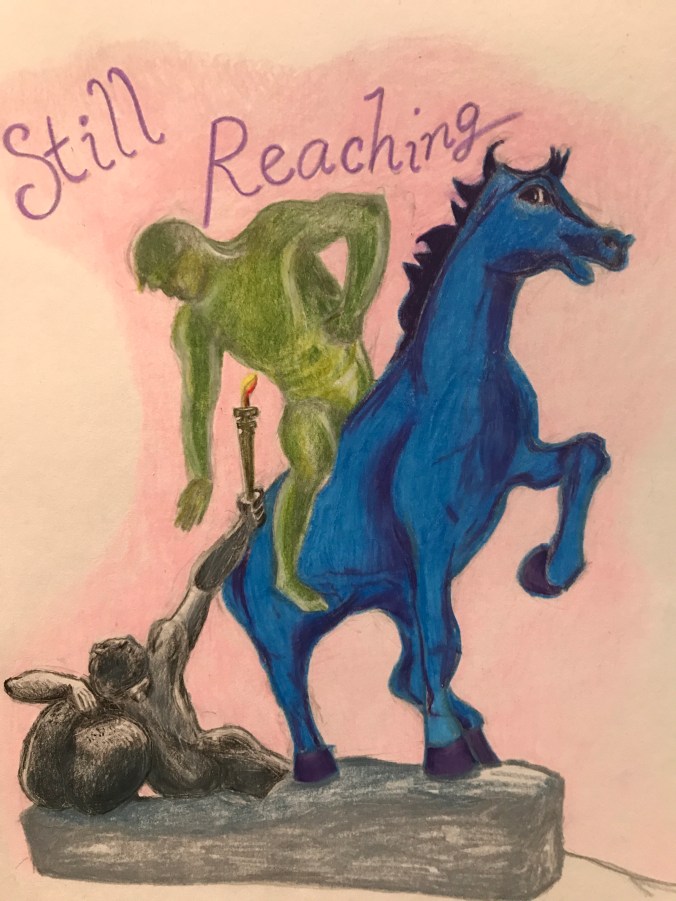 The drawing was made after Ruth (Jeanne’s sister who has been spending many days and nights with me since May) and I went up to Steven’s Institute’s campus last Tuesday, both of us pushing ourselves up the hill on 8th Street near my home, she with her walker, and me trudging and a bit unbalanced. Upon the sprawling campus that overlooks the Manhattan waterfront, is a larger than life sized sculpture by Anna Hyatt Huntington called The Torch Bearers. It shows a dying man giving a torch (symbol of knowledge) to a young man on a horse, representing the transmission of Western culture and civilization through history. For me, the metaphor is that I am transmitting my knowledge, my torch, as it were, by writing about my experiences as I live through this long goodbye.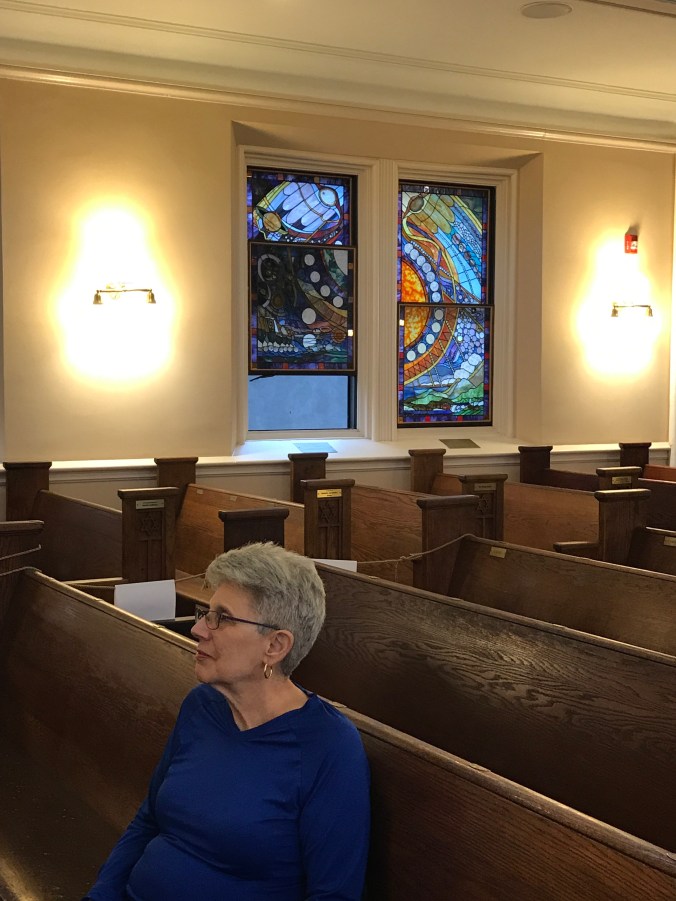
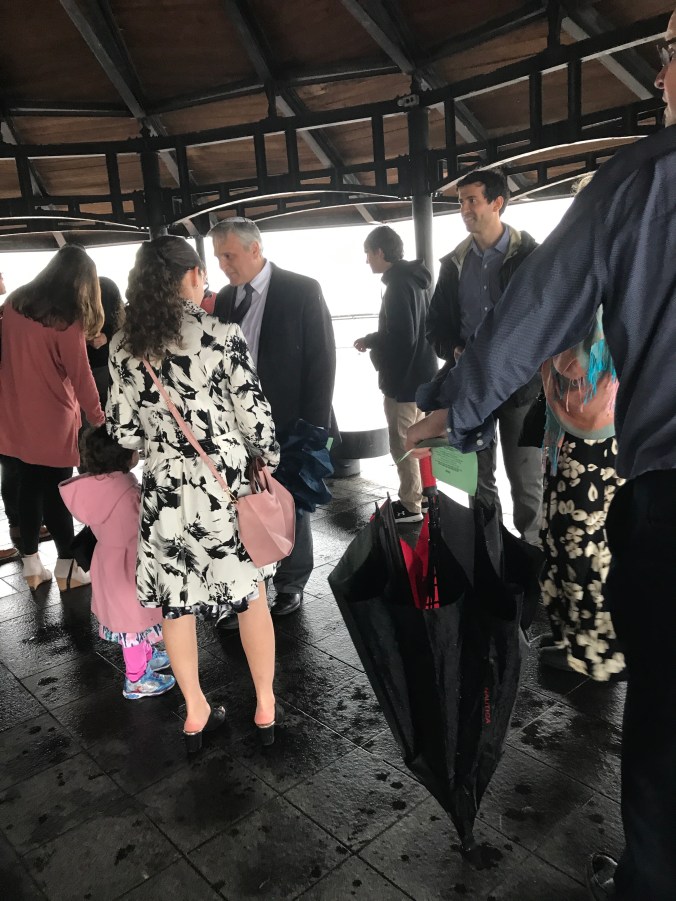
 I try to put an order to my thoughts in order to write. Try very hard to remember my days. Sunday, Monday, Tuesday, Wednesday, Thursday, Friday, Saturday. What happened on each of the days of my week? Without structure there is no shape. No shape to the days of my life. I write the date on the list I prepare every day for myself. The list that helps give structure to the day. I do this before I go to bed. Alzheimer’s is a memory disease, and the date is forgotten, and only to be remembered when I check my iPhone, and forgotten again.
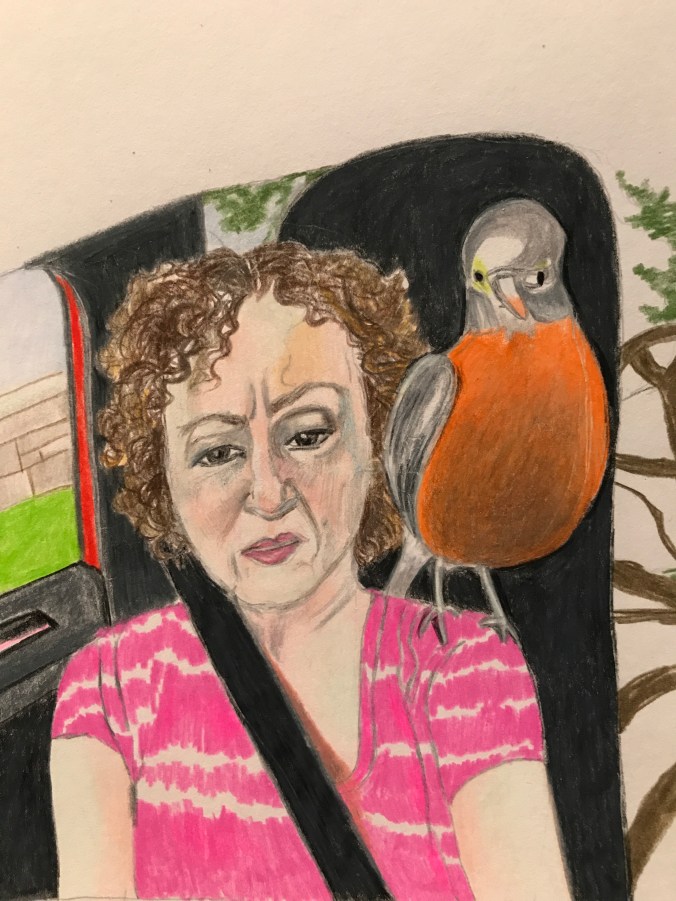
 I felt my father was with me, reminding me that he is still present in spirit. That he is waiting for me. Protecting me, alerting me, in this strange journey I am on now. My friend Ruth sat beside me. I spoke Yiddish to the bird, as he flew to the ground and pecked at some plants. An outsider would surely have thought me mad, hearing me speak Yiddish to a bird, but Ruth is no outsider. She understands the madness the disease is creating. She tells me she is proud of me for doing as much as I do. Continuing to function, not giving into the disease completely.
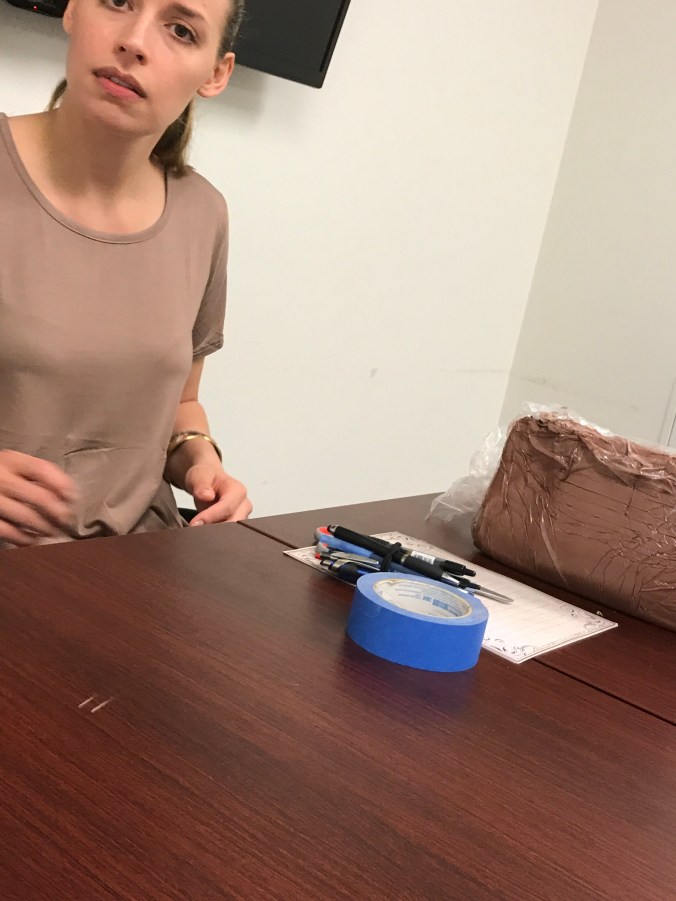 This is Amanda, an art therapist I met last Friday at The Alzheimer’s Association. She met with a group of us and brought clay. My reaction to viscous art materials, even though I was an art teacher, is to not want to touch them. I’ve heard this happens to some children who have autism. I didn’t want the clay to get inside my nails or on my hands, but I did want to make something. I asked for a ball of clay and saran wrap and formed a little monstrous head. I’ve felt since the beginning of this “change”, that the regression into this disease, is like becoming a monster.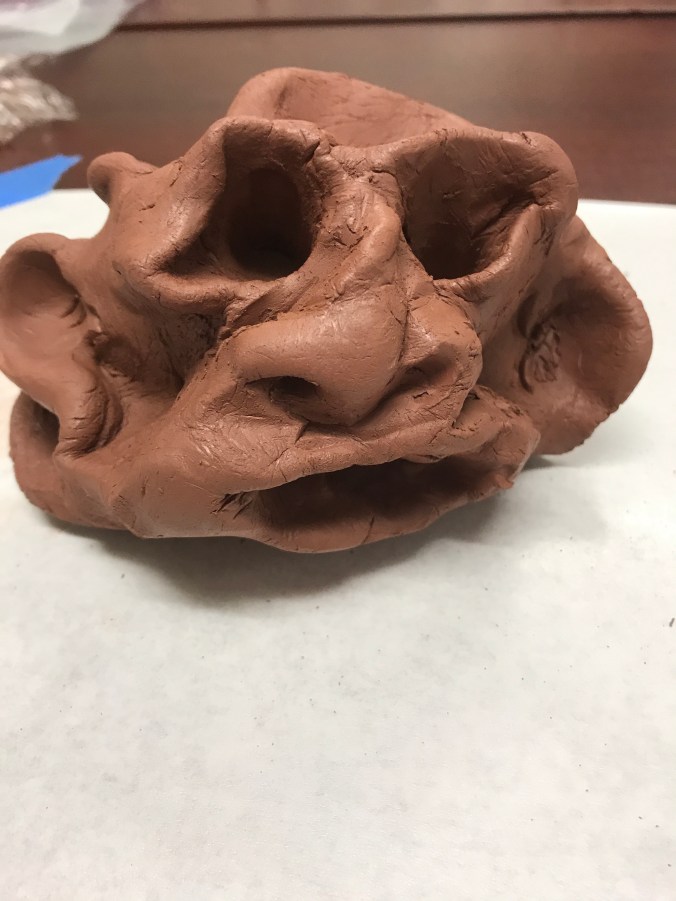
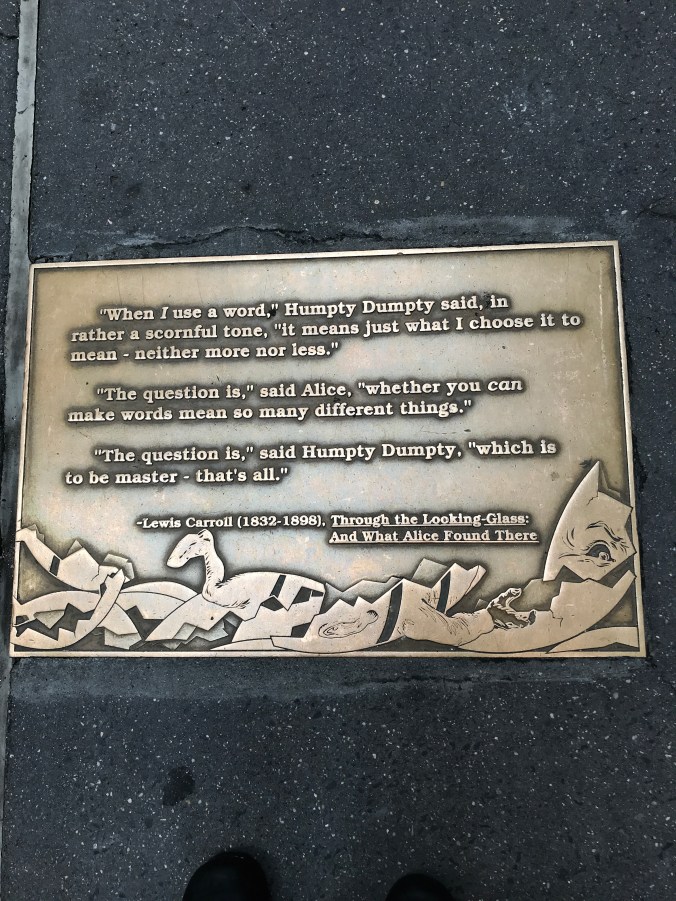
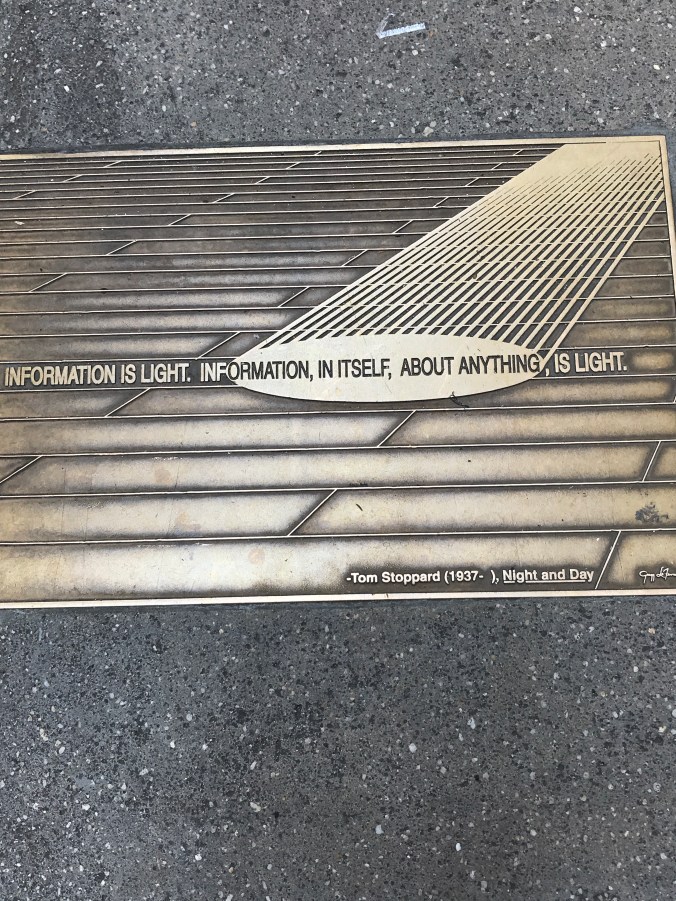
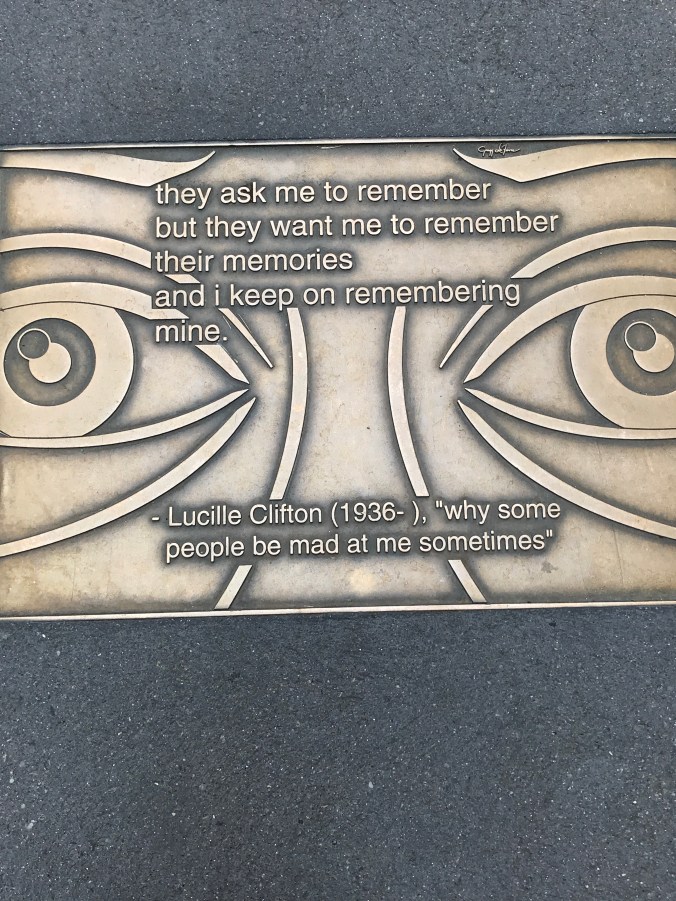 Then the walk to the Port Authority, through Bryant Park, and past a young homeless man sleeping on the sidewalk.


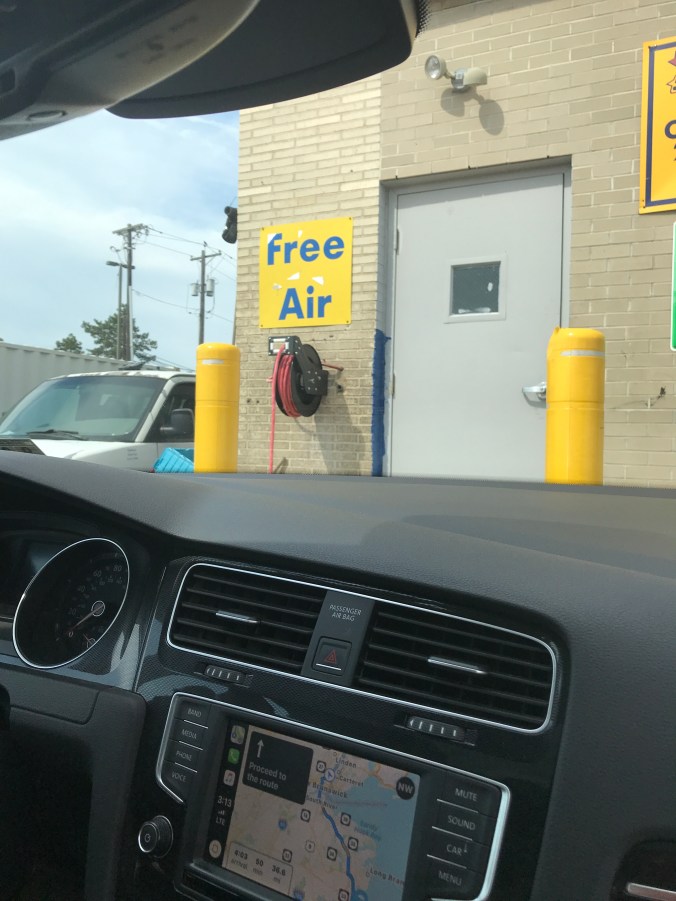
 Back on the highway, I sometimes wonder if my husband would find his way if he didn’t have GPS. Probably not. We were going in the right direction, and headed towards Tinton Falls, which we would have to drive through to get to Belmar Beach.
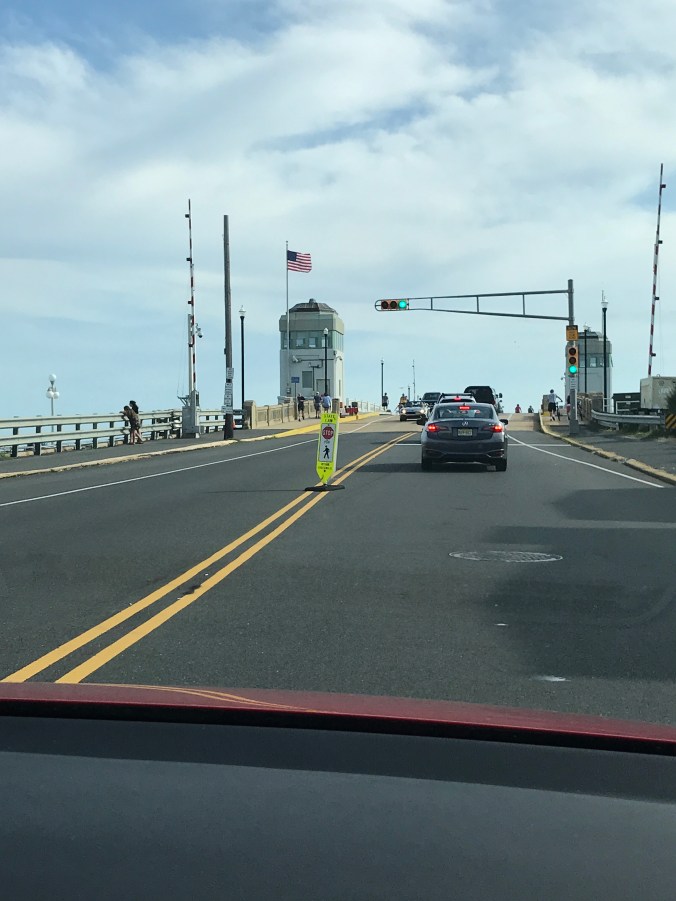
 Finally there, he parked the car on a side street close to the beach. A gazebo and what looked like a wedding in the distance.

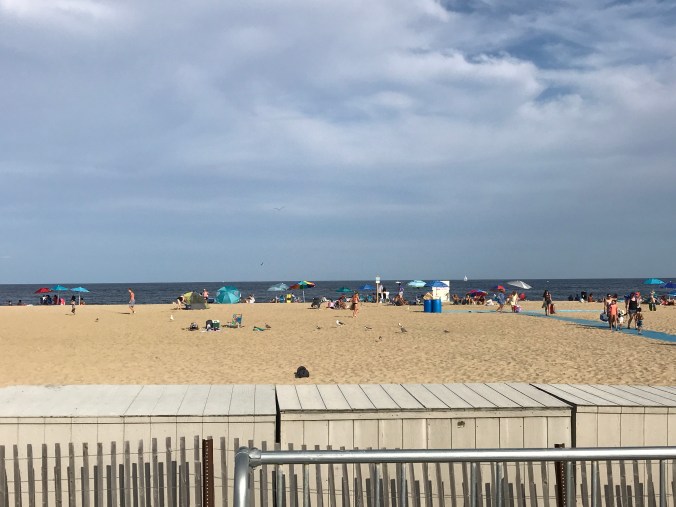


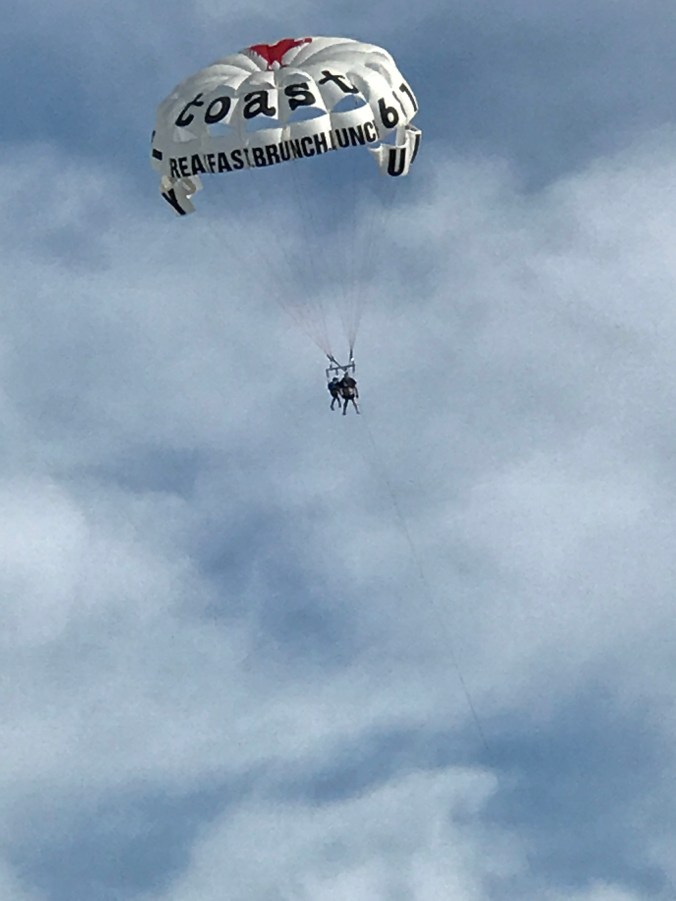
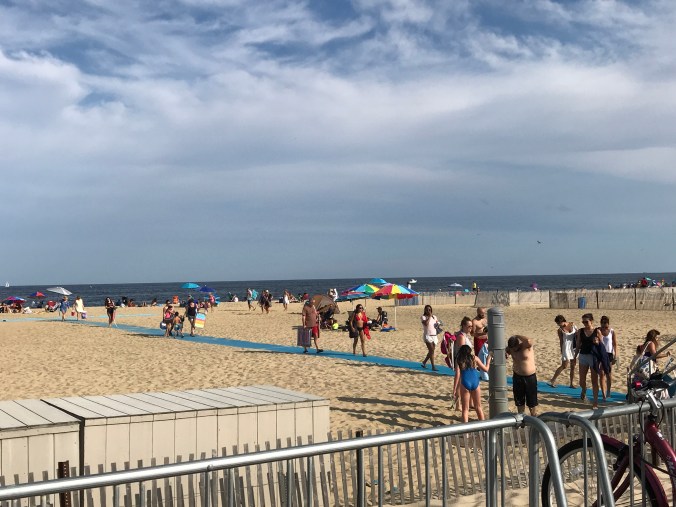
 It cost $16 for both of us to get onto the beach. It is free after 6pm and it was almost 6 o’clock. I did not have a bathing suit on, couldn’t possibly put one on. I wore my old beige pedal pushers and a pink and white tie dye tee shirt. On my feet were the black fit flops I used to wear before I got sick. I was afraid of walking on the sand, afraid of getting sand on my feet. Didn’t know how it would feel to walk on the sand. There was a blue plastic sand cover graciously provided to cover the sand that led partway to the shoreline. 6 o’clock came and we walked out onto the blue cover. No way to avoid getting sand on my feet. My goal was to put my feet in the water. I wanted to feel the ocean water on my feet. I rolled up my pants and walked up to the edge of the water and the wave came in and the water lapped at my feet. This is crazy I know, to be so afraid of the water, getting sand on my feet, knowing that with my feet wet, the sand would stick. This was immersion in my fear. Forcing myself to do it. My husband put a towel on the sand, a few yards back and I sat down, and took a photo of my feet. Ridiculous and absurd, I felt victorious for simply having waded into the shallow wave, and walking on the sand.
 The trip home. Clouds and a glorious sky. I fell asleep in the car.
 It’s rare for me to fall asleep in the day. It’s a normal response for normal people after a trip to the beach. But I’m not normal. For me sleep now has been the only escape from this disease, and I have very little of it. I usually sleep around four hours straight and lay in bed too exhausted to arise, for several hours. The car must have lulled me, and since I often chatter non stop and it’s a big distraction for my husband’s driving, it’s good I fell asleep. I woke and it was nighttime. Still in the car, but close to home. I looked up and saw a full moon and tried to photograph it. The results look like something from another planet.
 Suddenly Mad